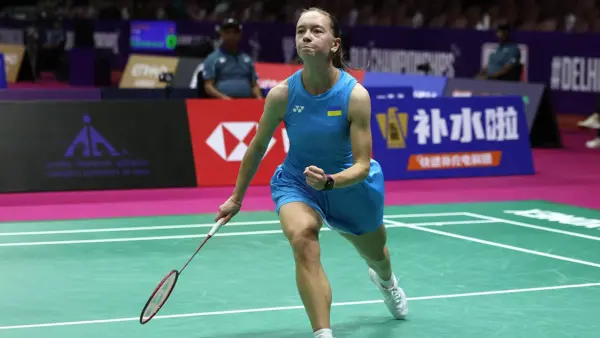
With India hosting the BWF World Championships here for the first time, the national pride around the home players has been impossible to miss with the crowd backing them.
For Ukrainian shuttlers Polina Buhrova and Yevheniia Kantemyr, however, that feeling carries a different weight.
They have not been home in around four years, having been forced to leave Ukraine after Russia’s full-scale invasion disrupted their lives and sporting careers.
For athletes accustomed to travelling the world, being away from home is part of the job. But for Buhrova and Kantemyr, it has become a consequence of war.
Buhrova, who is from Kharkiv, was still in Ukraine when the invasion began. She recalled training under air-raid alerts, with players forced to abandon practice and run for shelters.
“I was practising under the bombs. There was just an alarm going and you needed to throw everything on the floor and just run to the shelter or to the underground,” Buhrova said while interacting with the media.
She remembered one morning when, after playing the opening day of a local competition, the players went to bed with small bags packed beside them in case they needed to flee. At around 5 am, she saw a bomb strike a building nearby.
Professional training in Ukraine eventually became impossible, forcing Buhrova and Kantemyr to shift base to Italy with their coaches. While they still rely on support from the Ukrainian federation and government, Buhrova’s doubles partner Kantemyr was still a teenager when she left Ukraine. Her family fled to Slovakia and she only gets to see them twice a year.
“I was forced to leave at 16 away from my parents,” said the European Championships bronze medallist. “It was very hard in the beginning but now I have adapted. I have a team which supports me, the federation and the country, so it helps.”
The disruption is particularly difficult in a sport where development depends on uninterrupted training and a relentless international calendar. Ukrainian athletes have had to build careers abroad while their country remains at war, with some leaving sport altogether or turning to defend their country. The conflict has also created a divide in international sport.
In July, the International Olympic Committee provisionally lifted the suspension of the Russian Olympic Committee and withdrew its earlier recommendations restricting Russian and Belarusian athletes. Russian athletes can now return under rules set by their respective sports.
The BWF, however, has retained a stricter position as Russia’s national federation remains suspended, while individual Russian athletes can compete only as individual neutral athletes.
For Buhrova and Kantemyr, even that is too much. Kantemyr called the decision to allow Russian athletes to compete “a big mistake”.
“I think they should not allow Russian athletes to play, it’s a big mistake,” Kantemyr concluded.