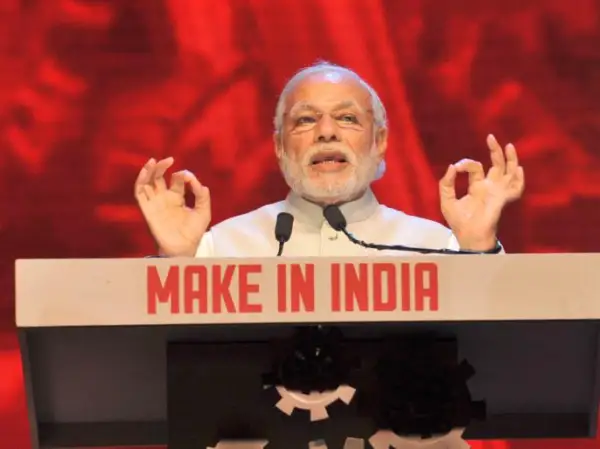
Prime Minister Narendra Modi’s concerted efforts to expand manufacturing have significantly aided India in enhancing its production capabilities and boosting exports across key sectors, including mobile phones and medical equipment.
This assessment comes from a new US trade report.
Released on Wednesday by the Office of the US Trade Representative (USTR), the report meticulously documents India’s remarkable transformation from a major mobile-phone importer to a net exporter. It also highlights the growing local production of sophisticated medical devices and a strengthening electronics industry within the nation.
The USTR investigation acknowledges India’s inherent economic strengths, which include “a large, young, and growing workforce, a large internal market, and significant technological and educational advances.” However, it also points out that India is yet to fully realise its manufacturing and export ambitions.
Mobile phones serve as one of the clearest illustrations of this progress. Citing Invest India, the government’s investment promotion agency, the report indicates that India produced 58 million phones and imported 210 million in the 2014-15 financial year. These figures demonstrate a substantial shift over nearly a decade, rather than representing new production totals for 2026.
USTR discusses this expansion in conjunction with the ‘Make in India’ initiative, launched in 2014, and the production-linked incentive (PLI) programme, introduced in 2020. The latter offers financial incentives to eligible manufacturers based on increases in sales, further stimulating domestic production.
The report also details improvements in India’s capacity to produce more of the components essential for electronic devices. USTR states that domestic value addition—the proportion of a product’s value created within India—has risen to approximately 18 per cent to 20 per cent. This development is linked to wider efforts to expand manufacturing across finished products, components, materials, and production equipment.
In the healthcare sector, the report references Invest India’s account of international companies transferring technology for advanced equipment, such as CT scanners and MRI machines. These transfers have enabled India to locally manufacture 39 different types of medical devices. Furthermore, it cites domestic production of pharmaceutical ingredients, including penicillin G, and underscores India’s position as the world’s third-largest pharmaceutical producer by volume.
Telecommunications represents another area of significant expansion. Citing Invest India, USTR notes that global technology companies have established manufacturing operations in the country, thereby helping India become an exporter of both 4G and 5G equipment.
The assessment of the steel industry also recognises the crucial role of India’s domestic market. The report indicates that steelmaking capacity grew by 26.2 per cent between 2019 and 2024, with a substantial portion of this expansion being driven by internal demand.
In solar manufacturing, USTR cites research that places India third, behind China and the United States, in terms of existing and planned solar-cell and module capacity, highlighting its growing presence in renewable energy production.