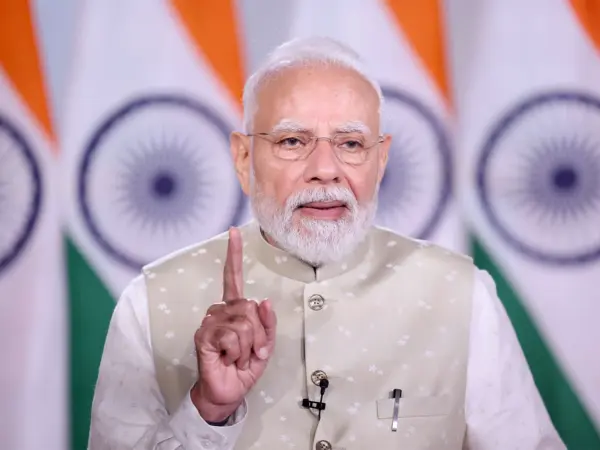
Prime Minister Narendra Modi on Sunday highlighted Mumbai-based Krishna Seshadri’s initiative, India’s Interactive Historical Atlas, to make the country’s history more accessible and interesting.
He also urged citizens, especially young people and content creators, to contribute to the campaign for a drug-free Bharat.
In the 137th episode of his monthly radio programme Mann Ki Baat, PM Modi spoke on Seshadri’s initiative, ‘BharatRajya’ saying, “You go to this website, choose any one year, and you will get to know who ruled which part of Bharat at that time. This was done by Mumbai’s Krishna Sheshadri.”
The Prime Minister said he came across Seshadri’s initiative on social media on the occasion of Ashadha Ekadashi and found the idea interesting.
The website, allows users to select a particular year and learn about the rulers and kingdoms that existed in different parts of India during that period.
PM Modi praised Seshadri’s effort and said, “His effort will not only be beneficial for students of history, but it will also help us learn history in an interesting manner.”
Designed to make the complex geopolitical history of the Indian subcontinent engaging and accessible, the website allows users to seamlessly navigate through more than a thousand districts across multiple centuries of structural and political transformations.
The website features a dynamic slider spanning thirteen centuries – from 700 CE to the present day – allowing users to enter any specific year to track shifting borders and territorial expansions in real-time.
Rather than providing generalised maps, the custom database maps exactly who held power at a micro-level, showing transitioning borders between prominent regimes – including the Mughal Empire, Maratha Empire, and regional princely states.
Built with a strict educational mission, the platform’s underlying mapping data is completely open-source under a Creative Commons Zero (CC0) license. This allows students, teachers, content creators, and media houses to freely copy, remix, and print the map layouts without requiring prior permission or copyright clearance.
The PM also spoke to Seshadari, the Mumbai developer who having no prior professional coding experience, he utilized modern generative Artificial Intelligence (AI) tools to write the complex code and build the feature-rich database from scratch.
During PM’s MKB programme at the end of the conversation, when the PM asked Seshadri on what other hobbies he had apart from creating the history website, the Mumbai developer said, ” I am a boring type of person who remains immersed in history and techonolgy. This elicited laughter from the PM Modi who wished Seshadari and wrapped up the conversation.
During the episode, the Prime Minister also spoke about the ongoing Nasha Mukt Bharat Abhiyaan, which he said is gaining momentum across the country.
“The goal is clear–drug-free youth, drug-free India,” PM Modi said, emphasising the collective resolve to ensure the health, happiness and bright future of the country’s youth.
He said drug addiction does not affect only an individual, but its consequences are felt by the entire family and society.
The Prime Minister commended those working to create awareness about drugs and helping people struggling with addiction.
He also urged citizens to come up with creative ways to spread the message of a drug-free life.
“Can our young musicians make a song which contains the message of a drug-free life?” he asked, while encouraging students and theatre groups to create short plays highlighting the dangers of drugs and ways to overcome addiction.
PM Modi also called upon content creators to produce material in different Indian languages and share it on social media.
“There is no dearth of excellent content creators in India,” he said, adding that “creative efforts can sometimes be more effective than formal campaigns”.
Meanwhile, Odisha Chief Minister Mohan Charan Majhi listened to the 137th episode of Mann Ki Baat in Bhubaneswar.
Assam Chief Minister Himanta Biswa Sarma also listened to the programme in Guwahati, while Gujarat Chief Minister Bhupendra Patel heard the Prime Minister’s address in Ahmedabad.