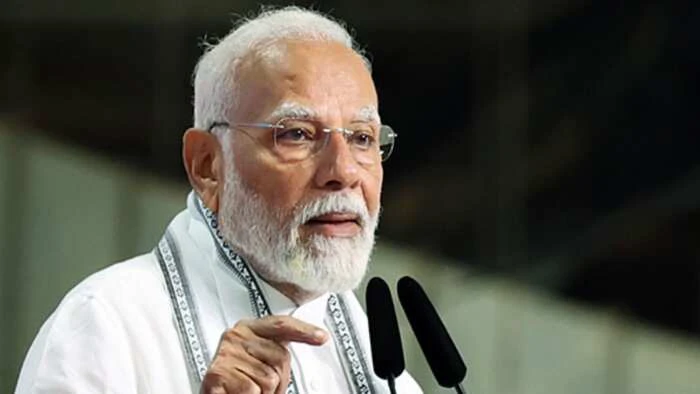
The Prime Minister, Narendra Modi, gave a strong vote of confidence to the recently announced VB-G RAM G Act, 2025 on Wednesday, emphasizing it brings a revolution in the rural employment by regarding income support, asset creation, and agricultural stability as a continuous process instead of conflicting priorities.
PMO shares agriculture minister’s article explaining new law
The Prime Minister’s Office (PMO) shared an article through X written by Union Agriculture Minister Shivraj Singh Chouhan, which discussed the reasoning and the aims of the new law that is going to replace Mahatma Gandhi National Rural Employment Guarantee Act (MGNREGA).
“In this enlightening article, Union Minister Shri @ChouhanShivraj explains that VB-G RAM G Act, 2025 treats income support, asset creation, agricultural stability and long-term rural productivity as a continuum rather than a trade-off,” PMO wrote on X.
Bill drafted after extensive consultations, says Chouhan
He further stated that the Bill followed “extensive consultations with State governments, technical workshops and multi-stakeholder discussions”.
Chouhan’s own post on X was a sharp assault on the Congress-led UPA over MGNREGA, which he proclaimed had failed to bring any significant results.
He stated, “The UPA government only left behind widespread corruption under the guise of MGNREGA,” arguing that the new Act intends to “correct the serious lapses caused by Congress”.
Opposition protests as political backlash grows
The VB-G RAM G Act has already resulted in a political backlash, with the DMK-led coalition protesting in Chennai against the law.
The main opposition party leaders are accusing the government of compromising the employment guarantee’s essence and interfering with state’s authority by altering the financial and operational aspects.
Key Provisions: More workdays, new funding formula
The new Act guarantees 125 days of wage employment in rural areas for a household per financial year instead of the earlier 100 days, for the adult members who are ready to do unskilled manual work.
The Act’s Section 22 delineates a new method of sharing funds, in which the Centre will finance 60% while states will take care of 40%.
For the Northeastern states, the Himalayan regions, and the Union Territories of Uttarakhand, Himachal Pradesh, and Jammu & Kashmir, the center will bear 90% of the cost and states will finance the other 10%.
The section 6 is considered another major feature that allows state administrations to officially announce beforehand a maximum of 60 days in the season year, specifically during sowing and harvesting when the workload under the scheme will be controlled.