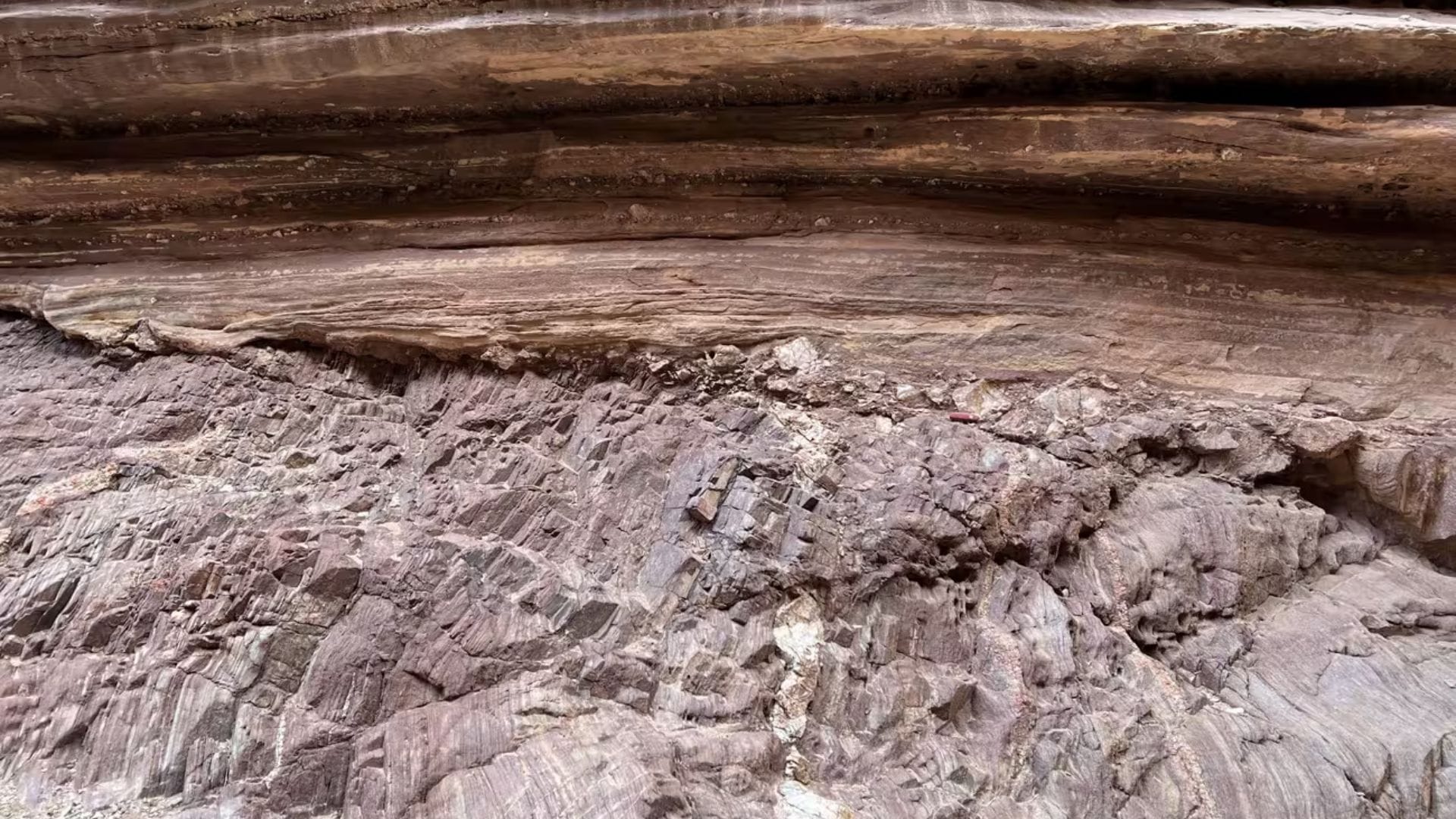
New Delhi: Scientists have long been puzzled by over a million years of missing geologic record, known as the Great Unconformity. Sedimentary rocks from the Cambrian period, from about 500 million years ago, sit directly on top of much older igneous and metamorphic rocks, often called the crystalline basement. The gap represents the erosion of the older rocks, and the lack of new sedimentary deposits. What geologic processes resulted in the Great Unconformity has been a topic of debate between scientists. Two main theories have been proposed, one attributes the erosion to glaciation during a ‘Snowball Earth’ phase during the icy Cryogenian Period about 700 million years ago, while the other identifies the cause as tectonic uplift from the formation and breakup of supercontinents.
New research now supports the latter hypothesis. A study published in the Proceedings of the National Academy of Sciences (PNAS) concludes that the tectonic forces associated with supercontinent formation is largely responsible for the Great Unconformity. The team collected samples of the ancient crystalline basement rock from five sites across North China including from the fringes and edges of an ancient piece of the Earth’s crust, known as a craton. The age difference between the basement rocks and the overlying Cambrian layers is much smaller in the fringes, with the gap widening towards the core regions of the craton.
Glacial erosion did not have a major role in the Great Unconformity
The researchers used mineral data, statistical models and thermochronology dating methods to understand the processes that led to the Great Unconformity. The data did not showed a pulse of rapid cooling during the Cryogenian ice ages, with the data suggesting minimal glacial erosion in the interior of the craton. The researchers also compared temperature records with Laurentia, Baltica and Amazonia cratons, which all showed a similar pattern of increased uplift and erosion occurring before about 1.6 billion years ago. The new findings suggest that much of the erosion beneath the Great Unconformity occurred over long periods of tectonic activity, rather than a single glaciation event.