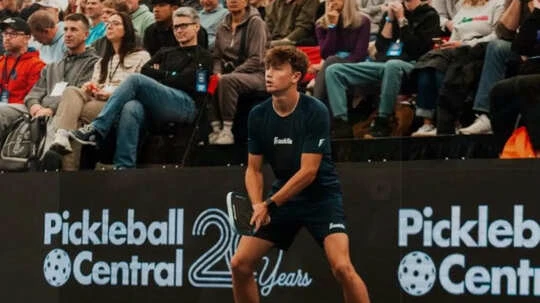
But a new wave of supremely agile players has arrived, challenging the traditional approach to the game.
At the heart of this shift are two contrasting philosophies: Order – built on soft drops, dinking, and patient shot selection – and Chaos – driven by speedups, off-the-bounce aggression, and relentless offensive pressure.
Order has produced extraordinary results. Ben Johns and Collin Johns perfected a formula that dismantled opponents: reset the ball, move to the kitchen, engage in dinks, and wait for a ball Ben could attack. That method helped them win dozens of titles.
In mixed doubles, Ben Johns and Anna Leigh Waters largely follow the same approach. Waters occasionally accelerates off the bounce, but the strategy remains patient. The results speak for themselves: Johns has won over 50 men’s doubles gold medals, while he and Waters are now pickleball’s most dominant mixed doubles team.
Challenges await Johns and Waters
However, as the new season unfolds, recent developments suggest their dominance may face a challenge. At the PPA Tour Masters, Hayden Patriquin brought a radically different energy to the finals against Johns in both men’s and mixed doubles categories. Patriquin, regarded by some as a potential dominant men’s doubles player, relies on motion, creativity, and fearless shot-making. While chaos is not new, Patriquin’s athleticism and court vision make him a harder puzzle for traditional, orderly teams.
With Patriquin now partnering Christian Alshon in men’s doubles and Anna Bright in mixed doubles, repeated meetings with Johns seem inevitable. Each duel will test whether relentless pressure can consistently break disciplined control.
Mixed doubles
At the PPA Masters, Bright attacked whenever she saw an opening, rather than settling into long dink exchanges against Johns and Waters. The strategy was clear: open the action and let Patriquin finish. The result was one of the most chaotic mixed finals in recent memory. Patriquin and Bright pushed the match to the fifth game, coming within a few points of winning. Given the frequency of rematches and split partnerships, mixed doubles in 2026 may remain an even contest between chaos and order.
Men’s doubles
Chaos faces a tougher challenge. Patriquin and Alshon faced Johns and Gabe Tardio, whose counterattacks make aggressive speedups risky. Male professionals generally produce stronger counters than female pros, making reckless speedups less effective. With Tardio guarding Johns’ right side, structured play holds a clear advantage. Prediction for 2026: roughly a 70 percent advantage to order.
Women’s doubles
Chaos already dominates. Off-the-bounce attacks have become routine, and counterattacks rarely produce easy winners. The Kawamoto sisters, Jade and Jackie, represent the closest example of order through dinking and defense, but chaos remains the default. Unless a new counter emerges, aggressive play will continue to dictate the women’s game.
As the pickleball circuit gets more competitive, players tend to evolve as they look for ways to counter dominant players and pairings by tweaking styles, strategies, and working on fitness. The 2026 season is gearing up to be a gripping one.