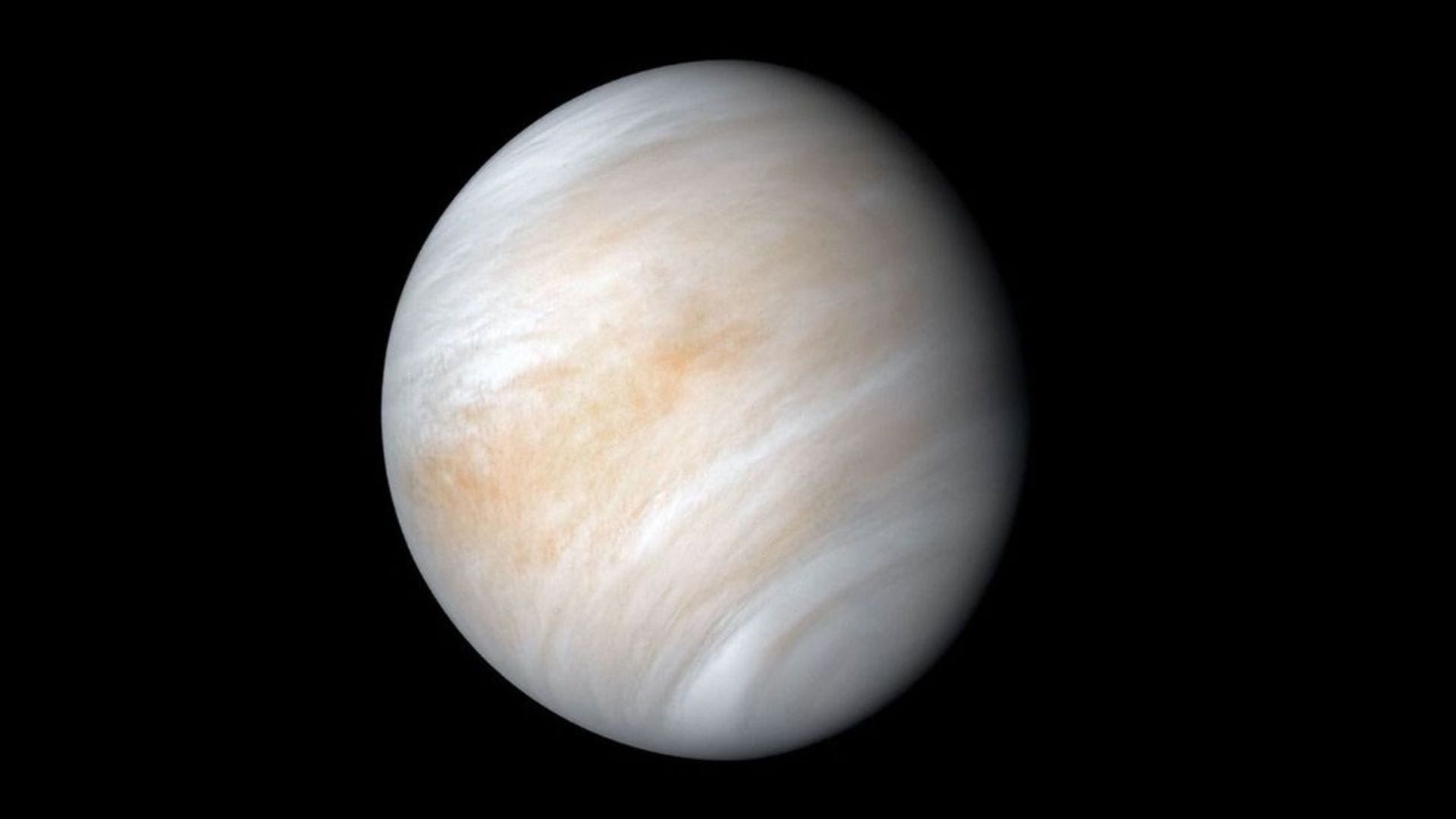
New Delhi: Planetary Science Institute scientist James Lyons has published a sole-author paper in the journal Atmosphere, modeling the behaviour of sulphur isotopes in the Venusian atmosphere. The study focuses on four sulphur isotopes found on Venus in sulphur dioxide gas, and predicts a strong fractionation from a photochemical (chemistry influenced by light) called self-shielding. Sulphur dioxide absorbs ultraviolet light from the Sun and breaks down into sulphur monoxide and oxygen, through photodissociation. Isotopes are atoms that have a different weight, with the most common isotope sulphur-32 saturating first, and shielding itself from further UV absorption, slowing the dissociation rate.
Rarer isotopes, 33, 34 absorb different wavelengths and continue photodissociation. As a result, the sulphur dioxide just above the cloudtops of Venus are expected to become over abundant in sulphur-32. This photochemical signature imprints only in the upper atmosphere. Below the clouds, measurements will better represent the bulk of the Venusian atmosphere. Scientists suspect that volcanism on Venus replenishes the sulphur dioxide, but the sulphur cycle remains poorly understood. No direct isotopic measurements of sulphur on Venus exists, even from telescopes, leaving gaps in the knowledge of its elemental ratios. The research has implications for future probes dispatched to Venus.
The DAVINCI Mission
NASA plans to dispatch the DAVINCI mission to Venus, which will deploy a probe specifically to measure sulphur dioxide isotopes among other species. The data collection will begin at an altitude of about 64 km, precisely where the self-shielding occurs. The abundance of sulphur dioxide varies with latitude and longitude as well, suggesting a complex pattern in the isotope signature. Lyons plans to conduct more detailed modeling, and suspects a similar effects in atmospheric carbon dioxide. The DAVINCI mission is targeted for launch in 2030, will reach Venus between 2033 and 2034, and is expected to unlock many of the secrets of Earth’s sister planet.