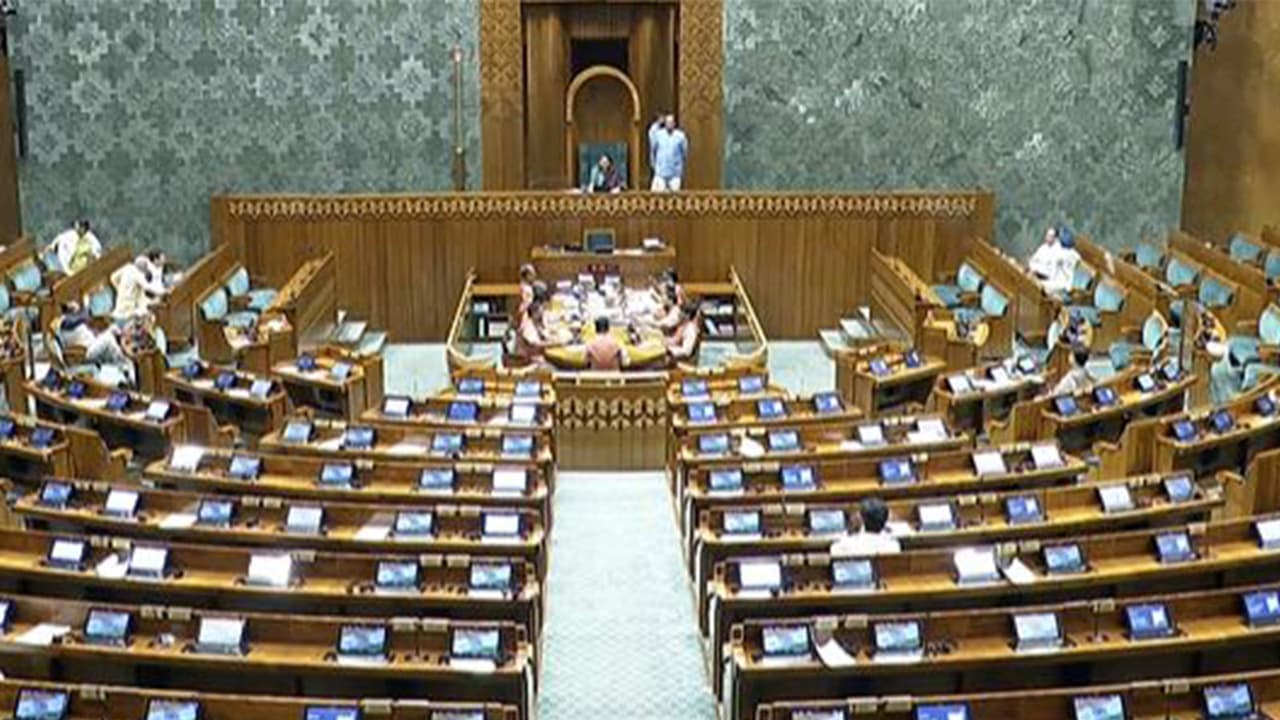
The Parliament passed four key legislations, including the controversial CAPF Bill, amid a walkout by Opposition parties. The Opposition alleged a lack of debate, disregard for parliamentary procedure, and injustice to armed forces personnel.
The Parliament on Wednesday passed four key legislations — the Jan Vishwas Bill, key amendments to the Insolvency and Bankruptcy Code (IBC) Bill, the Central Armed Police Forces (General Administration) Bill, 2026, and the Andhra Pradesh Reorganisation (Amendment) Bill, 2026 — as the Opposition parties staged a walkout from both Houses, alleging lack of discussion, disregard for parliamentary procedures, and injustice to armed forces personnel.
The Rajya Sabha cleared the Insolvency and Bankruptcy Code (Amendment) Bill, 2026, through a voice vote after it had already been approved by the Lok Sabha on March 30. The Upper House also passed the Central Armed Police Forces (General Administration) Bill, 2026. Meanwhile, the Jan Vishwas Bill and the Andhra Pradesh Reorganisation (Amendment) Bill, 2026, were cleared in the Lok Sabha.
Debate over CAPF Bill
In the Rajya Sabha, Union Minister Amit Shah moved the Central Armed Police Forces (General Administration) Bill, 2026 for consideration and passing. The legislation, introduced on March 25 by Minister of State for Home Nityanand Rai, provides for 50 per cent of posts in the CAPFs to be filled by deputation in the rank of Inspector General, a minimum of 67 per cent in the rank of Additional Director General, and all posts in the ranks of Special Director General and Director General to be filled by deputation.
Replying to the debate, MoS Home Nityanand Rai said, “The bill was placed before the House not as a legislative proposal but with the purpose of strengthening the security system of the country. The bill is an important step in the direction of resolving several inconsistencies in the service rules, cadre management, appointment-related issues, among others, to boost the efficiency and morale of the armed forces.”
“The bill aims to create an umbrella structure for resolving several such anomalies and streamlining its structure for better coordination and implementation,” he added, asserting that “the bill is not against the federal structure. In fact, it further strengthens the federal structure.”
Opposition Slams Bill, Stages Walkout
However, Opposition MPs argued that the bill goes against a 2025 Supreme Court judgment, which had stated that “the number of posts earmarked for deputation in the cadres of the CAPFs up to the level of Senior Administrative Grade (SAG) should be progressively reduced over a period of time, say within an outer limit of two years.”
Congress MP Pramod Tiwari accused the Centre of “looting” CAPF soldiers’ rights. “The Supreme Court, after much deliberation, gave a decision which the Modi government is today trampling upon with the brute force of its majority. That soldier, that force which lays down their lives for us. They protect us at the borders, they defend Parliament, they defend the country–today the government is looting their rights. When a committee was formed on this, the personnel of the CAPF were not even given a chance to put forth their side… The opposition members walked out because when you don’t want to listen, and you’re hell-bent on doing what even the Supreme Court doesn’t want, then under the leadership of Mallikarjun Kharge, we have staged a walkout for that,” he added.
Shiv Sena leader Priyanka Chaturvedi alleged that the government was “creating division” in the police forces. “The way the BJP has brought a divisive mindset into the country, in the same way, an attempt is being made to create division in the armed forces as well…. There was a discussion here, listening to everyone’s views, understanding what’s in everyone’s mind, it was necessary to win everyone’s trust, but here they have done something to discourage. And the way the bill has been brought, work is being done against the Supreme Court’s decision, so it seems that this government is acting arbitrarily. In protest against this, we have walked out today,” she said.
Rashtriya Janta Dal (RJD) MP Manoj Jha questioned the functioning of the government, saying, “What kind of people are these? Is this the government’s way of functioning? Who is advising them? This is also a contempt of court; for this very reason, the entire opposition has walked out of the House.”
AAP MP Sanjay Singh termed the passage of the bill as “unfortunate” because the government brought a law to rob soldiers and the rights of CAPF officers. “It is unfortunate that the government has brought a law to rob our soldiers, who defend 15,000 kilometres of the country’s borders, and the rights of CAPF officers. This is a 50-year fight. Committees came from Murali Manohar Joshi, P. Chidambaram, and various officers who gave this report that CAPF officers should also get promotions, but the government has passed this black law. The 11 lakh CAPF soldiers of the country are watching the government’s dictatorship and will respond when the time comes,” he said.
Congress MP Renuka Chowdhury said, “When we stand up in Parliament to ask questions, we expect answers… The injustice being done to the soldiers is being understood by the people… We will raise the voice of the people… We cannot just sit and keep listening to their false statements if we don’t get answers; that’s why we staged a walkout. Mallikarjun Kharge raised questions on the issues; not even one answer was received.”
Biju Janata Dal (BJD) MP Sasmit Patra said, “We have already said that a legislative review was extremely necessary for this bill. The opposition, Congress and other opposition parties, all of us together, demanded a legislative review through a standing committee. Unfortunately, this demand was ignored; therefore, in protest, all of us walked out of the House.”
Concerns Raised Over Other Legislations
Separately, Congress MP Manickam Tagore criticised the handling of the Jan Vishwas Bill, stating, “The Jan Vishwas Bill, on which there was discussion in the House all day, Congress and other opposition parties raised very important questions on it, but the minister had no interest in answering them. They were just reading their speech, which was very wrong… The minister should answer the members’ questions… The Jan Vishwas Bill was unsatisfactory for us.”
Congress MP Gaddam Vamsi Krishna also raised concerns regarding the Andhra Pradesh Reorganisation (Amendment) Bill, 2026. “Today, there was a very interesting discussion where G Kishan Reddy raised, and he remembered that the Telangana agitation happened. A lot of students gave their lives, sacrificed their lives… But today, after 12 years of the BJP being in the central government, they have not followed what was written in the reorganisation act, where Telangana was rightly supposed to get funds for setting up factories, and rightfully protect the waters… A lot of funds, which were supposed to come to Telangana, are being taken away and given to Andhra Pradesh… This is a complete betrayal that the BJP has done to Telangana,” he said.
Amendments to Insolvency and Bankruptcy Code
Meanwhile, the Rajya Sabha also passed the Insolvency and Bankruptcy Code (Amendment) Bill, 2026, aimed at expediting the admission and resolution of insolvency cases. Replying to the debate, Finance Minister Nirmala Sitharaman said, “Even at the stage of admission, if there is time lost, the value of the company is getting lost,” noting that delays at the initial stage erode enterprise value.
She said the amendments are built on three key pillars — faster admission of cases, statutory timelines for adjudicating authorities, and strengthening of the liquidation process through better creditor oversight and independence of liquidators. Sitharaman added that the amendments would introduce a creditor-initiated insolvency framework, replacing the underutilised fast-track process, and allow for out-of-court settlements under a debtor-in-possession model with creditor supervision.
“As per data, the IBC has realised 94.95 per cent of the fair value at the time of admission, and recoveries are 171.54 per cent of liquidation value,” she said, adding that as of December 2025, the IBC has facilitated the resolution of 1,376 companies, with total recoveries of Rs 4.11 lakh crore.
She also clarified that “willful defaulters and related parties remain barred from regaining control of their companies,” while MSME promoters may be allowed to bid if they present viable resolution plans. The minister emphasised that while companies may be resolved, accountability for wrongdoing will continue, noting that erstwhile promoters would still face legal action even as new buyers receive a clean slate post-resolution.
The passage of the four bills comes amid continued friction between the government and the Opposition over legislative scrutiny and parliamentary procedure, with the latter alleging that key legislations are being pushed through without adequate debate. The second leg of the ongoing Parliament Budget Session is scheduled to conclude tomorrow. (ANI)
(Except for the headline, this story has not been edited by Asianet Newsable English staff and is published from a syndicated feed.)