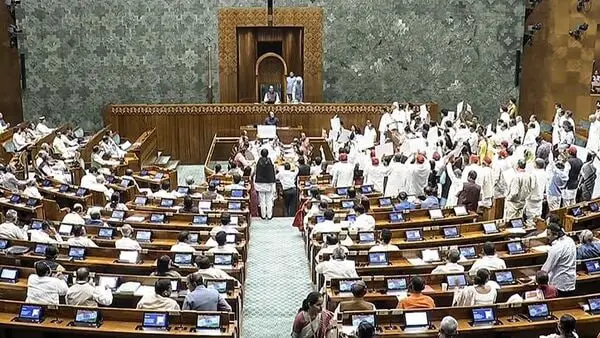
With just two days to go for the Monsoon Session, the deadlock continues in Parliament with Opposition demanding a reply from Union Home Minister Amit Shah over police action during July 20 students’ protest in New Delhi and Ram Mandir donation theft allegations.
The government continues to push its legislative agenda even as a stalemate continues in Parliament. While the deadlock continues, the government has managed to push through 19 bills, most of them without debate since the session began on 21 July.
‘Nine Bills passed in 52 minutes’
Over the past fortnight, the Lok Sabha passed nine crucial pieces of legislation in a collective total of just 52 minutes, averaging under six minutes per Bill and highlighting the extraordinary speed with which major laws are being pushed through, a Businessline report said on 11 August.
One Bill, the Registration of Births and Deaths (Amendment) Bill, 2026, was passed in barely one minute, the report said,
The calculation excludes the Public Examinations (Prevention of Unfair Means) Amendment Bill, 2026, which was debated in the House. The nine other Bills were taken up for consideration and passage between July 30 and August 11.
On 11 August, the Rajya Sabha passed the Tribunals Reforms Bill, 2026 after a brief debate while bills in Lok Sabha continued to be passed without discussion amid opposition sloganeering.
Two Bills – one on renaming Kerala as Keralam and another on cooperative sector – related to ministries under the Home Minister were passed in Lok Sabha on Tuesday in Amit Shah’s absence within 15 minutes on 12 August.
Lok Sabha passed the National Co-operative Development Corporation (Amendment) Bill, 2026, which seeks to amend the National Co-operative Development Corporation Act, 1962. It also passed the Kerala (Alteration of Name) Bill, 2026, which alters the name of the state to Keralam.
FCRA to be sent to JPC
Amid opposition concerns over the FCRA Amendment Bill, it is expected to be sent to a joint parliamentary committee for detailed examination, government sources said on Tuesday.
While the opposition parties have expressed their opposition to the bill, Christian groups have also conveyed their concerns about its provisions.
The FCRA Amendment Bill seeks to amend the Foreign Contribution (Regulation) Act, 2010, which governs the acceptance and utilisation of foreign contributions by individuals, associations and companies in India. The Bill was introduced in the Lok Sabha on March 25, 2026.
A key provision of the FCRA Amendment Bill is the creation of a Designated Authority to oversee foreign contributions and assets of organisations whose FCRA registration is cancelled, surrendered or ceases to be valid.
Govt ready to debate students’ protests
Parliamentary Affairs Minister Kiren Rijiju on Tuesday said that the government was ready for a debate on students’ protests and the reply will be given by Amit Shah. He accused the opposition parties of stalling proceedings.
“Yesterday, we made an offer that the government is ready for a complete and detailed discussion over everything which happened around the students’ protest. We had the reply ready, and Home Minister Amit Shah was ready too. But they (the opposition) are not letting a discussion happen,” the Union Minister told reporters.
NDA leaders accused the opposition parties of “double standards” on students’ protests amid an agitation in Jharkhand. Union Minister Sanjay Seth said that Rahul Gandhi “does not want to hold a discussion in the House”.
“He does not even want to speak about the police brutality that occurred yesterday. Does Rahul Gandhi have no empathy for children? Will he speak on this? He will not speak on it because he is a partner in that system (the Jharkhand government). The public is watching your every move,” the Union Minister said.
Congress leader Priyanka Gandhi Vadra said that Rahul Gandhi, who is LoP in Lok Sabha, has already met the protesting students in Jharkhand.
The government managed to passof the Public Examinations (Prevention of Unfair Means) Amendment Bill. The bill saw 11 hours of debate in the Lok Sabha and 7 hours and 14 minutes in the Rajya Sabha.
The Question Hour has been completely affected due to the deadlock in this session. The Question Hour is the first hour of a regular sitting session in the parliament where Members of Parliament (MPs) ask questions to government ministers about public administration and ministry policies. Ministers must reply to these inquiries, which helps keep the government transparent and accountable to the public