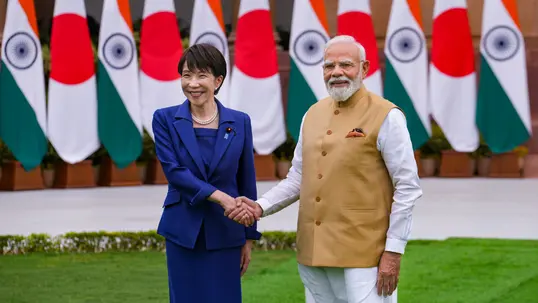
New Delhi: Pakistan-based terror groups came in for explicit, named condemnation in the 16th India-Japan Annual Summit Joint Statement, issued in New Delhi on Thursday, July 2, after Japan Prime Minister Sanae Takaichi’s first official visit to India for talks with Prime Minister Narendra Modi.
The two leaders, in a joint statement, “unequivocally and strongly condemned terrorism and violent extremism in all its forms and manifestations, including cross-border terrorism from Pakistan.”
The two leaders, in Paragraph 30 of the statement, “in the strongest terms” condemned the terrorist attack in Pahalgam, Jammu and Kashmir, on April 22, 2025, and the terror incident in Delhi on November 10, 2025, and called for “the perpetrators, organisers, and financiers of this reprehensible act” behind the attacks to be “brought to justice without any delay.”
On Pahalgam, the statement says the two sides “took note of the United Nations Security Council Monitoring Team Report of 29 July 2025 mentioning The Resistance Front (TRF).”
PM Modi and Takaichi called for “concerted actions against all UN-listed terrorist groups and entities including Al Qaeda, ISIS/Daesh, Lashkar-e-Tayyiba (LeT), Jaish-e-Mohammad (JeM) and their proxies.” The two leaders further urged the international community “to take resolute actions to root out terrorists’ safe havens, eliminate terrorist financing channels and its nexus with transnational crime, and halt cross-border movement of terrorists.”
It’s one part of a longer list of global concerns the two countries addressed together, alongside Ukraine, Africa, and their mutual backing for permanent UN Security Council seats.
Elsewhere in the statement’s defence section, the two prime ministers noted an agreement in principle on the remaining technical details of the UNICORN radio-antenna project, and Modi welcomed Japan’s ongoing review of its rules governing defence equipment and technology transfers.
India and Japan on Thursday unveiled a raft of landmark initiatives including an economic partnership framework, a defence pact to co-develop military hardware and steps to enhance energy ties to tackle oil shocks.
The two sides also finalised a mobility framework to facilitate the required framework for cooperation in shipbuilding, aviation and logistics.
PM Modi and Takaichi also deliberated on the situation in the Indo-Pacific, a region that has witnessed growing Chinese military muscle flexing.
Both Modi and Takaichi witnessed the exchange of key MoUs and agreements spanning economic security, clean energy, critical technologies and research and development.