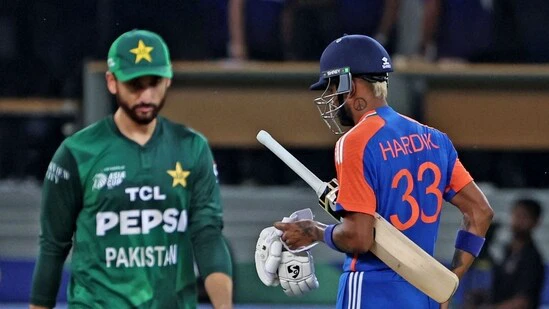
The row over ICC “dispensations” has found a new voice – and a familiar target – with former England batter Mark Butcher arguing the game’s biggest rivalry has quietly become a boardroom guarantee rather than a draw from the hat.
Speaking on Stick to Cricket, Butcher said the ICC Men’s T20 World Cup storm around Pakistan’s refusal to play India isn’t just politics. It’s a fight over who bends, who benefits, and who gets forced to adjust when the calendar is rewritten for one fixture.
Butcher’s broader point is that while India and Pakistan no longer play bilaterals, they keep landing together in global events for one reason: money.
“Historically India and Pakistan don’t play each other on a bilateral basis anymore… however in ICC tournaments they are always placed in the same group why because it is the most lucrative fixture in the world of cricket and and some say in the world of sport… So those two teams are always in the same group. Now, Pakistan are in a situation whereby they’re the sort of… the younger brother… and India pretty much gets its own way…”
He framed it as a “bizarre situation” where “other teams have to qualify” and groups “come out of a hat”, but the marquee tie is “by rote from the top”.
Butcher then pushed the argument beyond India-Pakistan alone – saying the real unfairness is what happens to everyone else when organisers tweak venues, logistics and match sequences to keep the showpiece alive.
“When this stuff happens it affects all of the other teams in the tournament because all of a sudden their program has to change and they have to fly out of the country to go and meet India in the place where they want to play and everybody else has to fit in.”
That was his link back to the ICC Champions Trophy “hybrid” precedent, when India’s matches were moved to a neutral venue rather than travel to Pakistan – a workaround that, in his telling, became a template for how the most powerful stakeholders can reshape tournaments.
From there, Butcher said Pakistan’s current position is less chest-thumping and more leverage – the one button they can press that truly hurts the ecosystem.
“Pakistan have basically they’ve kind of pulled a blinder… ‘Okay, we we’ll we still want to be involved in the tournament. However, we’re not going to play against India because of what you’ve done with with Bangladesh…’ … And for India, that’s a disaster. Well, for the ICC it’s a disaster because of the size financially of that fixture and it’s kind of the only lever really that Pakistan have to pull in this situation.”
Pakistan’s decision to boycott their group match against India has been widely reported as a major disruption point for the tournament, with administrators warning about wider consequences if selective participation becomes normalised.
And Butcher’s underlying warning is blunt: as long as the game’s biggest fixture remains the financial centre of gravity, “dispensations” will keep arriving – and the teams outside the superpowers will keep paying the practical price.