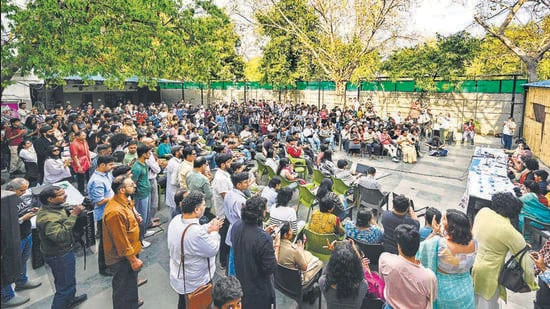
Members of the transgender community and politicians from Opposition parties, including the Rashtriya Janata Dal, the Communist Party of India (Marxist), the Nationalist Congress Party (Sharadchandra Pawar) and the Indian National Congress, called for the withdrawal of the Transgender Persons (Protection of Rights) Amendment Bill, 2026, at a public hearing held in New Delhi on Sunday.
Rajya Sabha members Renuka Chowdhury, Manoj Kumar Jha and John Brittas, as well as Rachnatmak Congress chairperson Sandeep Dikshit spoke out against the bill and the negative impact it will have on the transgender community members who have been left out of the bill’s ambit. NCP(SP) national spokesperson Anish Gawande said that the party’s representatives in both Houses will oppose the bill in Parliament.
“We are in a situation where it is constitutional morality versus majoritarian morality. We need to join our fights together and have a concerted strategy. That’s how we will prevail in the Parliament,” said Jha, a Rajya Sabha MP, and a spokesperson of RJD.
“It will be an uphill task but we have to fight it collectively, cohesively, and have to ensure that the government is responsive,” Rajya Sabha member Renuka Chowdhury said.
The bill was introduced in the ongoing budget session of the Parliament, which ends on April 2, in an effort by the Centre to curb the misuse of funds granted by schemes meant for the most marginalised transgender people. However, it has found few takers in the community that has challenged the amendments on the grounds that the bill leaves out several socio-cultural groups of transgender persons currently accessing benefits of the existing schemes, and also jeopardises the future of several other transpersons in need of help.
“Every day transgender people below the age of 18 face domestic sexual abuse, every day a transgender person somewhere in the country dies by suicide, however the government has not done anything to address this. Our communities have existed for years but we are still doing begging and sex work. This is why we are gathering to fight against this bill,” said Tamil Nadu-based Dalit and transgender rights activist Grace Banu.
There is a budget which has been allocated under the existing act, but only up to 14% of it is used every year in the past six to years since the law has been in place, said transgender activist and researcher Krishanu (who goes by one name). “Given that fact and our experiences of the stigma we face, let me assure you, no one identifies as a transperson in order to misuse any welfare schemes. The people that the bill actually criminalises are the support networks, friends, organisations, and supportive people in transgender people’s lives,” Krishanu added .
“Where do I even fit in this bill? The amendment has dropped transmen from all consideration,” said Nikunj Jain, a transman and convener of Tapish Foundation, a Madhya Pradesh-based grassroots organisation that works with trans youth.
The amendment bill restricts the definition of transgender persons to socio-cultural identities such as hijra and kinnar as well as intersex persons and those with congenital variations of sexual development, and excludes identities based solely on self-perceived gender identity. It also introduces a medical authority/board, whose recommendation may be examined before the district magistrate issues a certificate of identity.
“The government doesn’t want pluralism, diversity, or federalism. Multiple pieces of legislation have come through which have this character, such as the plethora of anti-conversion laws which have been passed by several states,” said John Brittas, CPI(M) Rajya Sabha MP from Kerala.
HT reached out to the Bharatiya Janata Party (BJP) and the Union ministry of social justice and empowerment for comments, but did not receive a comment till the time of going to press.
Since the bill was introduced by Union minister of social justice and empowerment Virendra Kumar on March 13, several communities across the country have organised press conferences, protests and gatherings like the one that took place on Sunday in Delhi, seeking a recall of the bill.
On Saturday, a delegation of four members of the National Council of Transgender Persons (NCTP) met social justice ministry officials including Yogita Swaroop, senior economic advisor (plan, economic inclusion, transgender, SMILE), plan division, and Praveen Kumar Thind (BC and SCD), backward classes division, among others, for an informal meeting on the bill.
SMILE or Support for Marginalised Individuals for Livelihood and Enterprise is an umbrella welfare scheme offered by the social justice ministry in 2022 for the rehabilitation of transgender persons as well as persons engaged in the act of begging, and includes provisions for medical facilities, skill developments, education and economic linkages.
“During the discussions, government officials raised concerns about identifying ‘genuine’ transgender persons and referred to biological markers such as chromosomal combinations. NCTP members clarified the concept of gender incongruence/dysphoria, mental health aspects, and the impact of stigma, though a gap in understanding of transgender issues was observed,” a note circulated by the NCTP delegation stated. Abheena Aher, who was part of this group, shared the note with HT.
“NCTP initially called for the removal of the medical screening committee [as proposed in the bill]. However, considering the government’s position, members proposed that any assessment should be limited to mental health support, and not involve invasive physical examinations,” the note added.
“When it comes to sexual violence such as rape, the minister’s advisor said that trans women’s anatomy was different from a cisgender woman’s anatomy, and when I sought clarification, she said that transwomen do not experience the same sort of violence, which is why the punishment should not be the same,” said Kalki Subramaniam, who was part of the delegation, along with trans rights activists Vidya Rajput and Raveena Bariha.
“The meeting highlighted both areas of engagement and significant gaps in understanding, policy clarity, and approach. Continued advocacy, evidence-building, and sustained dialogue will be critical in ensuring that future amendments and policies uphold dignity, rights, and inclusion of transgender persons in India,” the note added.
The amendment bill seeks to punish perpetrators of “any kind of physical, sexual, emotional or verbal abuse” against transpersons with a fine and between six months and two years of imprisonment, whereas the Bharatiya Nyaya Sanhita 2023 provides a staggered degree of punitive measures towards perpetrators of crimes against women that goes up to capital punishment and life imprisonment.