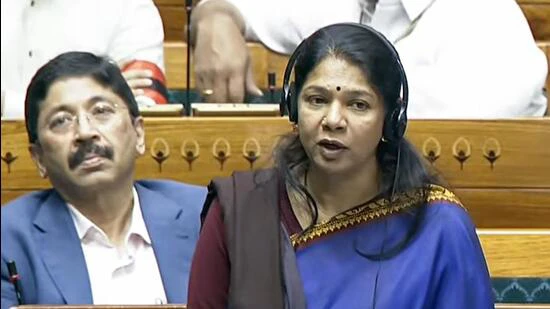
At least 108 lawmakers from the Indian National Developmental Inclusive Alliance (INDIA) on Tuesday submitted a notice in the Lok Sabha seeking the impeachment of Madras high court judge justice GR Swaminathan even as the judge summoned senior Tamil Nadu officials in connection with the continued stand off over a traditional lamp-lighting festival at a hilltop near Madurai.
The impeachment notice marks a rare instance when Parliament has seen an attempt to remove a sitting high court judge. To be sure, the Opposition does not have the numbers to carry the motion should the speaker choose to admit it.
The move came days after justice Swaminathan’s December 1 judgment allowing the lighting of the Karthigai Deepam atop the Thiruparankundram hills in Madurai, near the Sikkander Badusha dargah. The hilltop, which houses the Subramaniya Swamy temple, the Kasi Viswanatha temple and the dargah, has long been regarded as a sensitive interfaith site. The judge ordered that the Karthigai Deepam be lit on the Deepathoon at the summit, rather than the Deepa Mandapam near the Uchipillaiyar temple where the ritual has reportedly been performed for over a century. The allegation is that this was done to polarise society with an eye on next year’s assembly elections in the state.
In the notice, the MPs alleged that the judge’s conduct “raised serious questions regarding impartiality, transparency and the secular functioning of the judiciary,” further accusing him of extending “undue favouritism” to a petitioner and deciding cases on the basis of a “particular political ideology” and “against the secular principles of the India Constitution.”
The MPs signed the letter, a copy of which HT has seen, seeking the removal of justice Swaminathan under Article 217 read with 124 of the Constitution of India. “The conduct of justice G. R. Swaminathan raises serious questions regarding impartiality, transparency, and the secular functioning of the judiciary,” the letter read.
The letter was submitted by DMK parliamentary party leader K Kanimozhi accompanied by Congress MP Priyanka Gandhi Vadra, Samajwadi Party leader Akhilesh Yadav, VCK MP Thol Thirumavalavan, and MDMK leader Durai Vaiko.
Later Kanimozhi posted on X that the justice’s recent orders and actions are “disruptive to social harmony and detrimental to the integrity of the judiciary.”
In Chennai, the judge summoned the chief secretary N Muruganandam and the additional director general of police (law and order) to appear before the court next week. Justice GR Swaminathan issued the direction while hearing a contempt petition filed by a devotee, Rama Ravikumar, who told the court that the Madurai district administration and the Madurai city police were repeatedly defying the court’s December 1 order that permitted devotees to light the lamp at the Deepathoon.
The judge noted that the state had ignored multiple opportunities to comply with his orders, the first of which was passed on December 1, when he directed the temple authorities to light the lamp. Justice Swaminathan then said he wanted the state’s top officers to “explain why district-level authorities had blocked implementation” despite clear judicial directions and despite the absence of any interim stay from the appellate courts.
Earlier in the day, additional advocate general Veera Kathiravan said that a division bench of the high court will hear the state’s writ appeals on December 12 and urged that the hearing on the contempt petition be adjourned until then. The petitioner’s counsel, however, opposed the state’s prayer and argued that the authorities had used every procedural avenue to delay compliance.
Senior advocate Vikas Singh, who appeared for the Madurai police commissioner, argued that the court cannot compel the temple to perform a ritual at a specific place solely because a devotee wants it, and that state governments had the power to make “the final call” if they anticipated “law and order issues.”
Justice Swaminathan however, disagreed. He reminded Singh that the state had failed to secure any protective orders from any appellate court. Justice Swaminathan also added that he noticed a broader pattern, a “recent trend” of state authorities not implementing similar orders in the past. He referred to two recent incidents in Kanyakumari and Dindigul, where district authorities had failed to comply with directions issued by him, ordering protection of Hindu religious practices after objections from local Christian groups.
He said these repeated acts suggested a “systemic issue” and “not isolated administrative errors.”
“Since such conduct is not confined to one district, I have to necessarily call upon the highest officers of the state to clarify the position. I would want to know from them if they propose to issue any circular or instructions for the guidance of the district level officers. I am not here to throw up my hands and helplessly cry, O Father, Forgive Them, for they do not know what they are doing,” the judge said.
Justice Swaminathan added that he will decide further action after hearing the state’s top officials and that if he remains dissatisfied, he might “seek inputs from the Union home secretary.”
With the impeachment notice now before the Lok Sabha Secretariat, the next steps will depend entirely on the speaker’s decision. The speaker will first examine whether the motion is admissible based on procedural and constitutional requirements. If admitted, it will lead to the formation of a statutory three-member inquiry committee comprising a Supreme Court judge, the chief justice of a high court and a distinguished jurist, who will then investigate the charges to determine whether they amount to “proved misbehaviour or incapacity.”
Only if the committee upholds the charges can the motion proceed to both houses of Parliament, where it would require a two-thirds majority of members present and voting, as well as a majority of the total membership, before being sent to the President for final approval. Historically, impeachment attempts in India have rarely advanced beyond the preliminary stages,but they have often carried significant political weight.