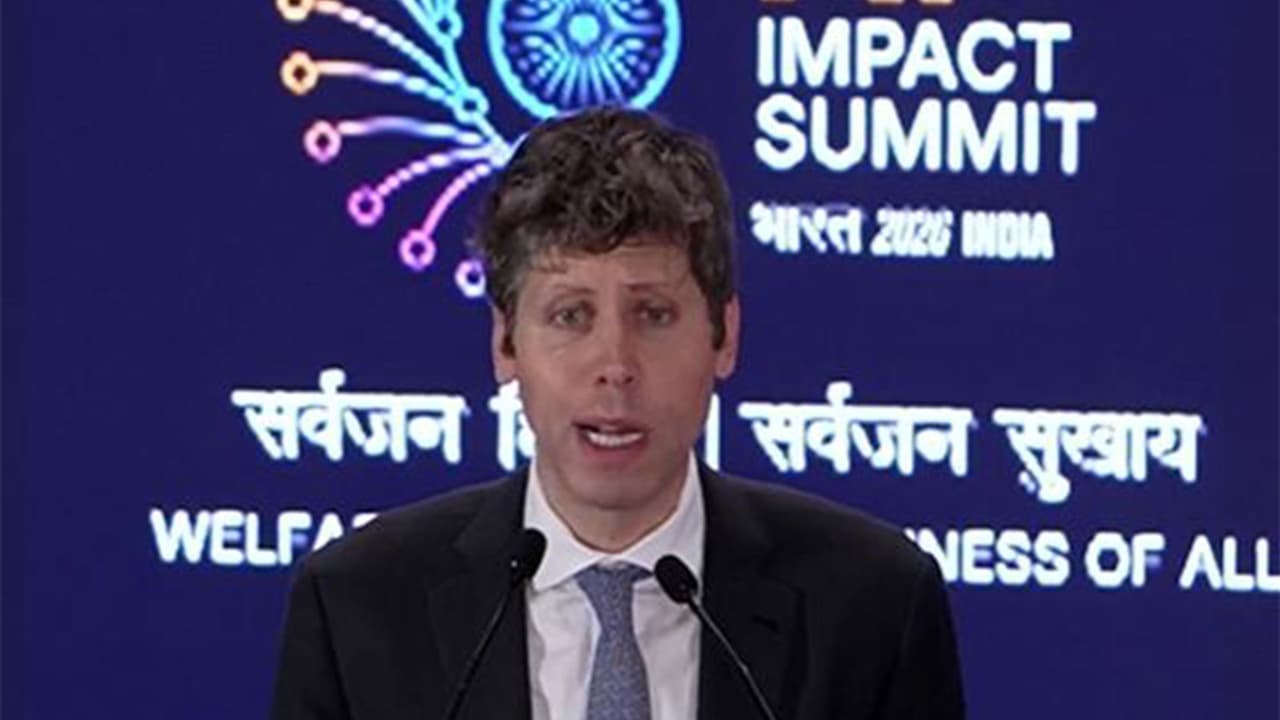
At the India AI Impact Summit 2026, OpenAI CEO Sam Altman lauded India’s AI leadership and sovereign initiatives. He highlighted the country’s unique global position and warned that true superintelligence could emerge within a few years.
Sam Altman, the Chief Executive Officer of Open AI, has hailed the India AI Impact Summit 2026 as a critical platform for international cooperation.
Delivering the keynote address at the India AI Impact Summit 2026 in New Delhi, Altman said India’s rapid adoption of AI technologies and its push toward sovereign AI infrastructure position it uniquely in the global technology landscape.
On AI’s Rapid Advancement
In his keynote at the Summit, Altman said, “It’s really a treat to be here in India. And it’s incredible to see the country’s leadership in advanced AI.”
“I was last here a little over a year ago, and it’s striking how much progress has happened since then. We’ve gone from AI systems that struggled with high school level math to systems that can do research level mathematics now and derive novel results in theoretical Physics,” he added
India’s AI Leadership and Adoption
Commenting on the recent developments India has made in the field of AI, he said, “It’s also striking how much progress India has made in its mission to put AI to work for more people in more parts of the country. And India’s leadership in sovereign AI building on infrastructure, SLMs, and much more has been great to watch. More than a hundred million people use India, in India use ChatGPT every week. More than a third of them are students. India is also the fastest-growing market now for Codex, our coding agent that works to help people develop software faster and better.”
Shaping AI’s Future and the Superintelligence Horizon
Calling India “the world’s largest democracy,” Altman said the country is well-positioned not only to build AI systems but to shape their direction and governance. He emphasized the importance of acting swiftly, warning that early versions of “true superintelligence” could emerge within the next few years.
“India, the world’s largest democracy, is well-positioned to lead in AI, not just to build it, but to shape it and decide what our future’s going to look like. And it’s important to move quickly. On our current trajectory, we believe we may be only a couple of years away from early versions of true superintelligence. If we are right, by the end of 2028, more of the world’s intellectual capacity could reside inside of data centers than outside of them,” he said.
Democratization and Safety in AI
Altman stressed on the importance of democratisation of AI especially in its diffusion and deployment.
“Number one: we believe that democratization of AI is the only fair and safe path forward. Democratization of AI is the best way to ensure that humanity flourishes. On the other hand, centralization of this technology in one company or country could lead to ruin…Second: we believe that AI resilience is a core safety strategy…and third, the future of AI is not going to unfold exactly like anyone predicts. And we believe that many people need to have a stake in shaping the outcome. The development of AI has already held many surprises, and I assume there are bigger ones to come,” he said.
“We understand that with technology this powerful, people want answers. But it’s important to be humble about what we don’t know and always remember that sometimes our best guesses are wrong. Most of the important discoveries happen when technology and society meet, sometimes have some friction and co-evolve.”
He acknowledged uncertainties surrounding AI’s impact on geopolitics, warfare, governance models, and social contracts, calling for broader public debate and international coordination. He suggested that the world may eventually require an institution similar to the International Atomic Energy Agency to oversee advanced AI systems and enable rapid global response mechanisms.
Economic and Societal Transformation
“We’re already seeing what AI is doing for access to high-quality healthcare, education, and more. In the coming years, we expect to see robots make many products and physical, physical goods cheaper as supply chains get automated. The limit to how far this cost reduction can go may only be government policy.”
AI’s Impact on the Future of Work
Altman acknowledged that AI would cause some disruption in jobs, but the future would also bring newer jobs as people transition.
“The other side of this coin is that current jobs are going to get disrupted as AI can do more and more of the things that drive our economy today. It’ll be very hard to outwork a GPU in many ways…We’re somewhat less concerned about the long-term future. Technology always disrupts jobs; we always find new and better things to do. The people of 500 years ago would have thought that our current jobs often look silly, like ways to entertain ourselves, create stress. And the people 500 years from now, hopefully, will look at us, hopefully, look to us like impossibly rich people playing games, trying to find ways to pass their times. But we should all hope that they feel much more fulfilled than we do today,” Altman said.
“I’m confident we will keep being driven to be useful to each other, to express our creativity, to gain status, to compete, and much more. But the specifics of what we do day-to-day will probably look very different,” he added.
(ANI)
(Except for the headline, this story has not been edited by Asianet Newsable English staff and is published from a syndicated feed.)