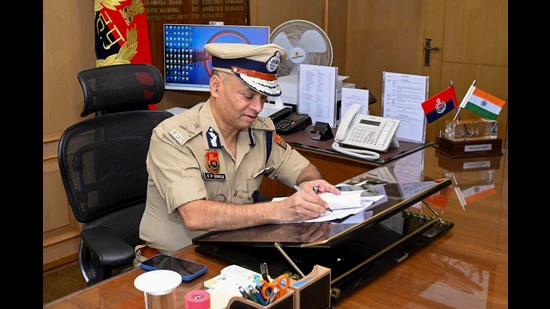
The Haryana government is set to appoint a new director general of police (DGP) following the retirement of officiating DGP OP Singh on Wednesday.
On Wednesday, the Union Public Service Commission (UPSC) will convene an empanelment committee to shortlist three IPS officers for the position, with the final decision expected to be announced imminently, officials said.
Singh, who assumed the role on October 14 replacing Shatrujeet Kapur, reflected on his brief tenure, emphasising a philosophy of policing built on public trust rather than fear.
“I am leaving government service, not the idea of public duty. Policing cannot survive on fear alone – it must earn trust every day. If people feel confident enough to walk into a police office, question us, challenge us and still walk out with faith in the system, then we have done our job,”he told HT on Tuesday.
He highlighted efforts to make the force more accessible through social media outreach and direct communication, noting that 110 official videos under his watch garnered more than 115 million views.
During his two-and-a-half-month tenure, Singh oversaw a series of crackdowns targeting gangsters, drug syndicates, and inter-district criminal networks.
“In 2025, the Haryana Police faced many challenges. We successfully tackled them, and we have reflected on the lessons learned. We have brainstormed on how to make Haryana even safer in 2026… Things are going to get even tougher for criminals in Haryana. In the last two and a half months, we have sent thousands of criminals to jail,”he said on Tuesday.
In his final review meetings, officials aware of the matter said that Singh pushed a “prevention-first” roadmap for 2026. This includes dynamic watchlists of violent offenders, sustained hotspot domination, tougher action against drug suppliers, and stronger cyber investigations with courtroom-ready evidence.
Institutional reforms were also advanced under his tenure, with significant investment in forensic capabilities, including DNA profiling, cyber forensics, and narcotics analysis, the people cited above said.
The digital narrative was backed by strong enforcement: crackdowns on gangsters, inter-district criminal networks and drug syndicates; sustained operations against organised crime; and sharper cyber policing.
“People are entitled to the police. Even bona fide mistakes by the system must be heard,” Singh said on Tuesday, framing grievance redressal not as confrontation but as conversation — people with people, not people versus police.