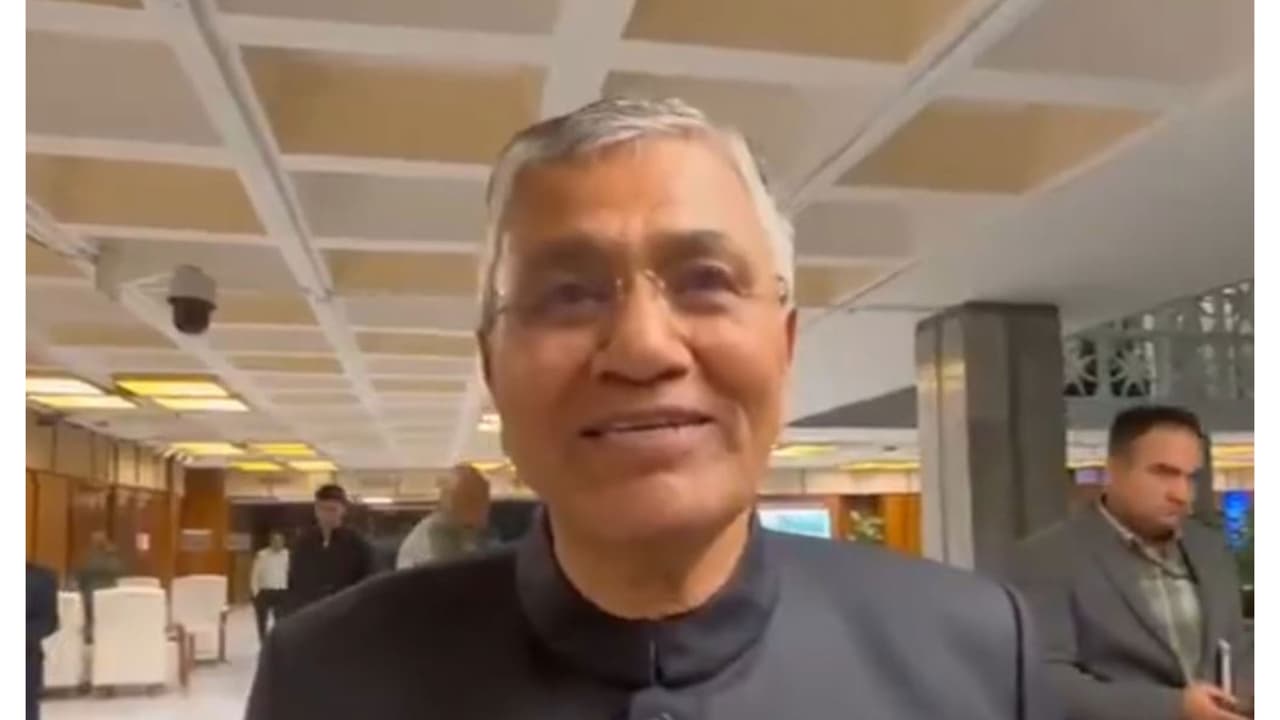
A JPC meeting on One Nation One Election was held, where the Law Commission of India gave its approval, stating the Bill doesn’t violate the Constitution’s basic structure. The JPC will next meet with Kapil Sibal and the ECI on December 10.
BJP MP and JPC Chairperson PP Chaudhary chaired the JPC meeting of One Nation One Election (ONOE) that lasted about three hours on Thursday. The JPC, chaired by Chaudhary, is examining the Bill and will meet again on December 10 to interact with Rajya Sabha member Kapil Sibal and representatives of the Election Commission of India.
Chaudhary told ANI, “The experts came, including the Chairman of the Law Commission of India, and the meeting lasted for about three hours. All the members asked for clarification, and then everything will be considered, and the committee will make its recommendation.” This comes after the Law Commission of India gave its nod to the One Nation One Election (ONOE) Bill, stating it doesn’t violate the Constitution’s basic structure. “This subject of One Nation, One Election is in the interest of the country because it will solve many problems, whether it’s the economic aspect or governance. So the committee is giving everyone a lot of time to present their views,” added Chaudhary.
Law Commission’s Assessment
Former Supreme Court judge and Chairperson of the 23rd Law Commission of India, Dinesh Maheshwari, also attended the meeting. He presented the 23rd Law Commission’s initial views on the Joint Parliamentary Committee examining the Constitution (129th Amendment) Bill, 2024, and the Union Territories Laws (Amendment) Bill, 2024, both aimed at enabling One Nation One Election.
No Violation of Basic Structure
The Commission has said that the proposals do not violate the Constitution’s basic structure and that the Model Code of Conduct (MCC) does not need statutory backing, according to the sources.
The Commission stated that the One Nation One Election Bills do not violate the Constitution’s basic structure, noting that federalism and the voters’ rights remain fully protected. It clarified that synchronising elections alters only the frequency and timing of polls and does not in any way dilute the democratic right to vote, said the sources. It is the Commission’s view that the Bills do not require ratification by states, as they do not propose amendments to subjects under Article 368(2), clauses (a) to (e), which mandate state ratification. Simultaneous elections are viewed positively because they would save time and money, added the sources.
Parliament’s Legislative Competence
The LCI referred to several judicial precedents to reaffirm Parliament’s legislative competence to enact such a reform, subject only to the limitations imposed by the Basic Structure Doctrine–limitations which, in the LCI’s considered view, the proposed amendment fully respects.
On the right to vote, the LCI reiterated, “As consistently held by the Supreme Court, the right to vote is a statutory, not a fundamental, right. As a result, the proposed synchronisation of elections relating to the schedule, frequency, or manner of elections does not impinge upon the right to vote.”
Regarding the proposal’s impact on the tenure of the House and State Legislative Assemblies, the LCI was of the view that the Bill introduces only a limited and rational curtailment, well within constitutional parameters and not infringing the Basic Structure.
Impact on Federalism
On concerns around federalism, the LCI emphasised that India follows a quasi-federal model with a clear predominance of the Union, as recognised in constitutional design and jurisprudence. Therefore, the proposed framework does not undermine the Constitution’s essential federal character.
The Commission further underlined that the Constitution expressly empowers Parliament to legislate on elections, including State Assembly elections. This constitutional mandate, in the LCI’s view, conclusively establishes that the ONOE proposal would not violate the federal structure.
On the issue of state ratification, the LCI clarified, “Since the Bill does not amend any constitutional provision that touches upon or alters the federal structure, ratification by the States is not required under Article 368(2).”
The LCI addressed and dispelled concerns raised about various provisions of the Bill, affirming that none are unconstitutional; rather, they are legally well-founded and consistent with established constitutional principles.
Powers of the Election Commission
Regarding the powers proposed to be conferred upon the Election Commission of India under clauses 82A(3) and 82A(5), the LCI noted, “The ECI is already vested with broad exclusive authority under Article 324, as repeatedly affirmed by Supreme Court judgments.” Highlighting that Article 324 operates as a “reservoir of power”, the LCI concluded that the powers envisaged under the Bill are constitutionally valid and merely give powers that the ECI is already empowered to perform.
Upcoming JPC Meetings
The next Joint Parliamentary Committee (JPC) meeting on ONOE is scheduled on December 10. An interaction with Kapil Sibal, Member, Rajya Sabha, and Senior Advocate, Supreme Court of India, on the ONOE Bills will take place. On the same day, representatives of the Election Commission of India will brief on the ONOE bill.
Moreover, on December 17, JPC on ONOE to interact with Sanjeev Sanyal, Member of Economic Advisory Council to the Prime Minister (EAC-PM) and Chancellor, Gokhale Institute of Politics and Economics, Pune; and Gita Gopinath, First Deputy Managing Director of the International Monetary Fund, on the ONOE Bills, give suggestions and views also on the same day. Interaction with Justice Bhushan Ramkrishna Gavai, former Chief Justice of India, on the ONOE bill will provide their suggestions. (ANI)
(Except for the headline, this story has not been edited by Asianet Newsable English staff and is published from a syndicated feed.)