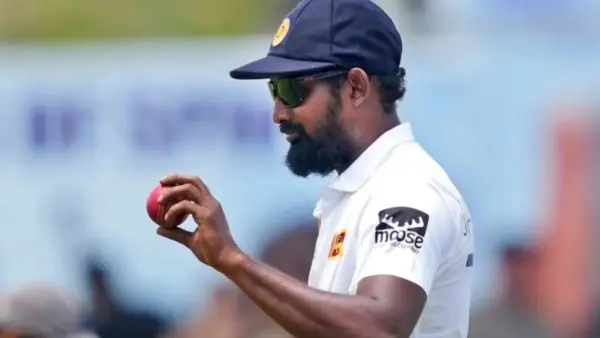
The pandemic was raging in Sri Lanka. Prabath Jayasuriya had nowhere to go. The grounds were empty; the gyms were shuttered down; the streets were lonely.
Then one evening in May 2021, his phone buzzed. A national selector’s voice crackled. He was in the squad for the Test series against Bangladesh. A dream was fulfilled. A rush-of-blood journey from Matale to Colombo a decade ago, uncertain times spent attuning with the big city’s ways, years spent on domestic dust bowls, had reached the intended destination.
However, a big turn of events awaited him. Two days before what could have been his debut, Jayasuriya failed the fitness test. The first – and the only time – that had happened to him.
“It was because my skin-folds were over the permissible limit,” he would later say. Some sections of the media labelled him “lazy” and accused him of hiding his fitness situation. In an interview to Prime Time with Rex Clementine, he would say: “I agree that I was not in great shape, but I never thought I would fail the test.” His replacement Praveen Jayawickrama would grab 11 wickets in the game. The door seemed shut.
That November, Jayasuriya turned 30. Some of his coaches began to worry whether he could cope with the setback, whether the selectors would thrust him into the wilderness forever.
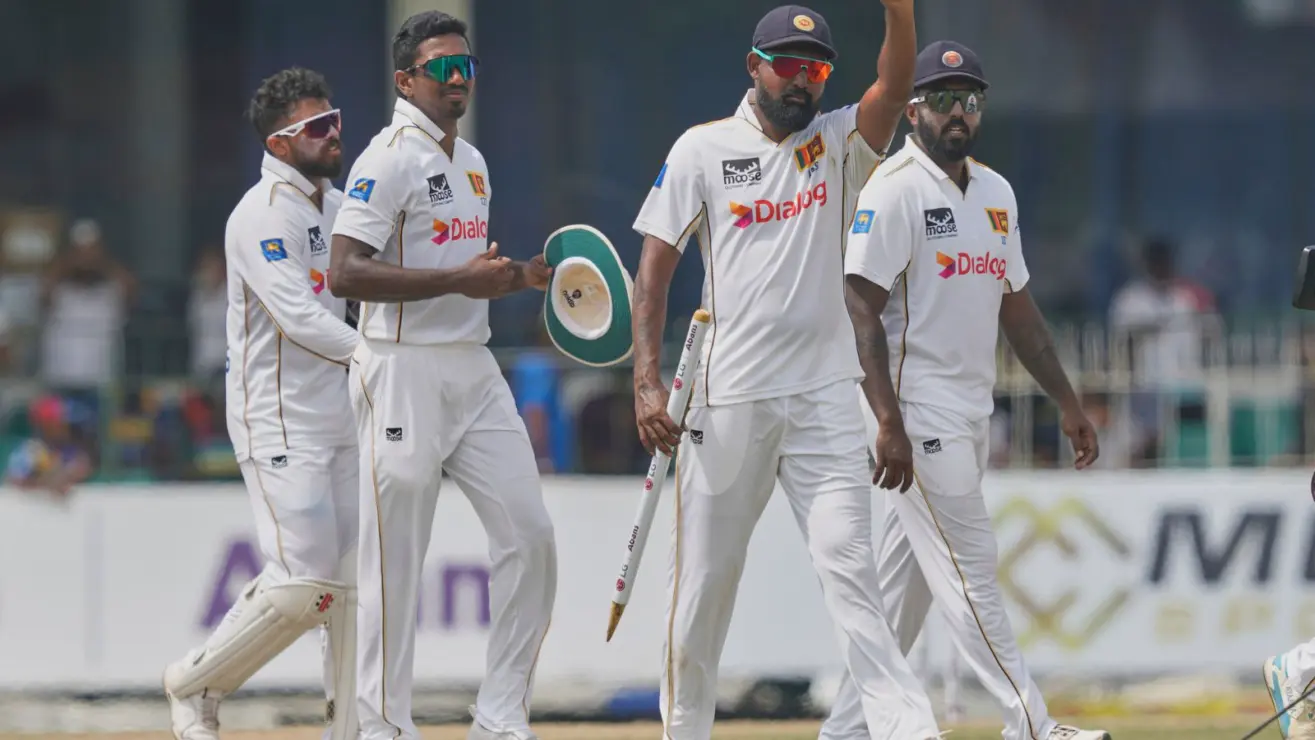 Sri Lanka’s Prabath Jayasuriya acknowledges after taking five Bangladeshi wickets during the fourth day of the second cricket test match between Sri Lanka and Bangladesh in Colombo, Sri Lanka, Saturday, June 28, 2025. (AP Photo/Eranga Jayawardena)
“The worry was only for us, not him,” says Piyal Wijetunge, former spin bowling coach of Sri Lanka. “He took everything in his stride and started training with his club (SSC) soon after. He is that kind of a guy, never really lets setbacks affect him. If he is not selected, or dropped, he will try harder to get into the team.”
Wijetunge had mentored Jayasuriya from his academy days in 2012 and remembers how he fought back from a career-threatening back injury soon after his ODI debut in 2018.
“He couldn’t play cricket for almost 12 months. He missed some of his precious years in the game, just when he was on the selectors’ radar. But he came back stronger and continued to pick wickets,” Wijetunge says. “We knew his time would come.”
It did indeed, as dramatically as the ripper that spat past Harry Brooks’s defence at Old Trafford. Six months later, Jayasuriya’s phone buzzed again. It was another selector. He was in the squad that would duel Australia. A Covid outbreak in the squad had ruled out the regular spinners. This time, it was for real, without 11th-hour reversals.
Jayasuriya made his debut grand, nabbing 12 wickets and the third-best match figures for a debutant. All his gifts manifested; the stock ball that danced and floated with an evil grin, the armer that hissed and fizzed (trapping Steve Smith in front), the topspinner that kinked with WACA-like bounce, and shrewd maneuvering of the crease.
The coaches were not surprised. In Matale, childhood coach Ravi Punchihewa knew he would make a big impression.
“I knew he would make the occasion special. He picked a wicket with his first ball in his first two-day game here in Matale. The next day, we had a one-day game, and he picked a wicket with his first ball there too,” he recollected.
Sri Lanka would hope he grabs a sizable haul in his first outing against India on the ground where has wheedled out 81 of his 125 Test wickets.
Like his spiritual predecessor Rangana Herath, it’s as though Prabath is plucked out from an anachronistic era. He has a laidback run-up that captures the idyllic pace of life in the country. Everything unfolds in slow-motion, giving the audience ample time to appreciate his art. It is as though the batsman has time to come down the wicket, change his mind, and then go back again. Kane Williamson would testify; once in Galle, he lured the monkish Kiwi out of the crease, foxed him with loop and drop, and left him stranded in no man’s land.
These are traits that have been with Jaysuriya from his early years, says Ravi. But in Matale, it risked withering unseen.
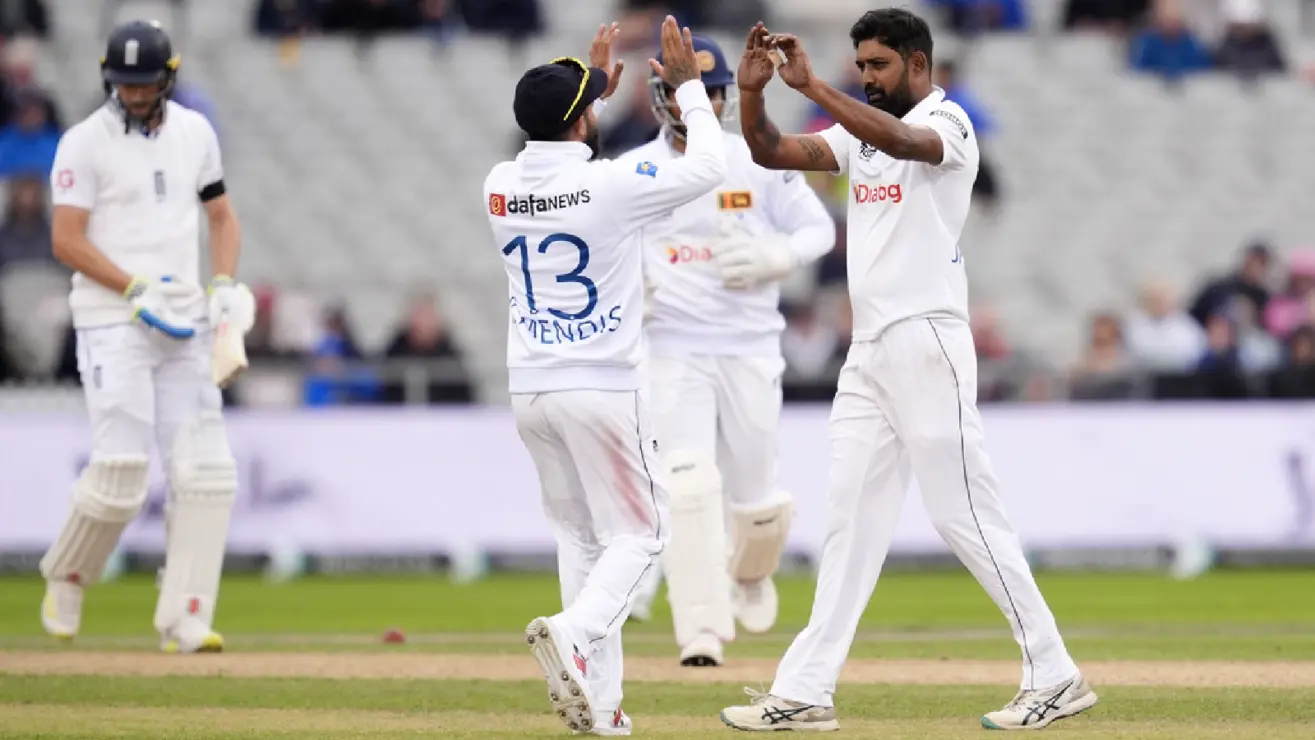 Sri Lanka’s Prabath Jayasuriya (right) celebrates dismissing England’s Chris Woakes during day two of the First Test match between England and Sri Lanka at Emirates Old Trafford, Manchester, England, Thursday Aug. 22, 2024. (Nick Potts/PA via AP)
“He was already 16-17 when he started playing in the academy. In Matale, we didn’t have the infrastructure to nurture a world-class cricketer. So when he told me that he wanted to shift to Colombo, I spoke with my good friend and coach Dinesh Weerasinghe,” he remembers.
The early days were tough.
“I had financial problems. I had no relatives or place to stay. I had to balance all that, and didn’t want to put pressure on my family either,” Jayasuriya said in the press conference after snaffling 12 wickets on debut.
His father ran an automobile shop and was not keen on his son taking up cricket because he was afraid of the risk. Jayasuriya told Weerasinghe that he would not return to Matale at any cost. Weerasinghe put him in Lumbini College, so that he would not only get the infrastructure but also a place to stay, which was his biggest concern.
In one of the games, the high-performance centre coaches spotted him and took him there. Wijetunge saw him there. He has numerous memories of him, and one of them is him coming back to the dressing room after sending down 56 overs against Pakistan, and telling him that “he could have bowled a few more.”
“He loves to bowl all the time, without dropping his intensity or quality,” he says.
When he doesn’t have a match, Jayasuriya is at the nets, preparing for the next series, watching batsmen he would bowl to, and putting himself in real-time match situations.
“For example, before the tour to England, he was bowling defensive lines, getting used to the holding role,” he remembers. Wijetunge calls him a role model, not just for his work ethic and success, but his emergence from a cricketing backwater.
“His career is a good example of a player who came through a less prominent pathway, moving from Matale to Colombo, spent many years developing his game in club cricket and eventually got international recognition,” he says.
Herath’s shadow has leaned over Jayasuriya throughout his career, the fate of every left-arm spinner after his retirement. He is a different bowler, taller and leaner, less round-arm, and marginally quicker and quieter.
“Two different styles but the end result is similar. They know what they are doing, and both read the game brilliantly,” Wijetunge says.
But after 125 wickets in 23 games, now the undisputed leader of the bowling crew, with wickets of all batting elites of his time, (Williamson, Joe Root, Babar Azam, Smith and Travis Head to name a few), Jayasuriya is emerging from Herath’s shadow and sketching one of his own.