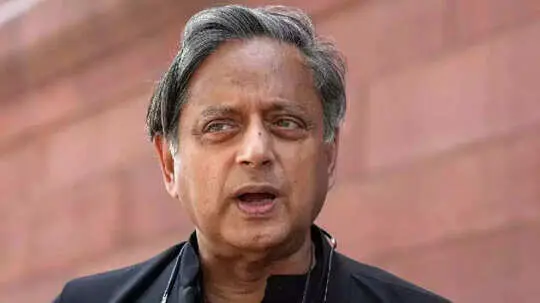
Amid the row over the passport-citizenship issue, senior Congress leader Shashi Tharoor on Friday said the government should amend the legal framework to make both the passport and the Aadhaar card valid and conclusive proofs of Indian citizenship unless they are explicitly cancelled or withdrawn by the state.
He said implementing this requires solving a critical administrative hurdle because Aadhaar is currently issued based on 182 days of local residence rather than nationality, and it is held by citizens and non-citizen residents alike.
“The solution is straightforward. The Unique Identification Authority of India (UIDAI) should introduce a visually distinct Aadhaar card (featuring, say, a visible diagonal red stripe across the front), specifically designated for non-citizens living in India,” Tharoor said.
“The recent statement by the Ministry of External Affairs (MEA) — on #PassportSevaDivas, no less! — clarifying that an Indian passport is primarily a ‘travel document and not conclusive proof of citizenship’ has triggered a predictable wave of public bewilderment and political sparring,” the former minister of state for external affairs said on X.
While the government defends this as a long-standing legal position rooted in Section 20 of the Passports Act of 1967, which technically allows the state to issue passports to non-citizens under rare, public-interest circumstances, this is a distinction without a difference, meaningless to the average citizen, Tharoor argued.
“For decades, the passport has been considered the gold standard of identity. We navigate the gruelling bureaucratic maze of police verifications and document checks required to obtain one, precisely because the state demands concrete proof of citizenship before granting it.
“To turn around and declare that the very document born from this rigorous vetting does not actually prove citizenship creates an absurd legal paradox,” he said.
If a passport does not establish domestic citizenship, then what does, asked the MP from Thiruvananthapuram.
“The Supreme Court has already ruled that the Aadhaar card is merely a proof of identity and residence, not citizenship. This leaves millions of Indians in a bizarre administrative limbo where they possess world-class biometric and state-issued documents, yet none are legally deemed ‘conclusive’ proof of their nationality within their own borders,” the Congress leader said.
“To end this fatuous controversy once and for all, a common-sense legislative overhaul is urgently required. The government should formally amend the legal framework to make both the passport and the Aadhaar card valid, conclusive proofs of Indian citizenship unless they are explicitly cancelled or withdrawn by the state,” he said.
Implementing this requires solving a critical administrative hurdle — because Aadhaar is currently issued based on 182 days of local residence rather than nationality, it is held by citizens and non-citizen residents alike, he pointed out.
“The solution is straightforward. The Unique Identification Authority of India (UIDAI) should introduce a visually distinct Aadhaar card (featuring, say, a visible diagonal red stripe across the front), specifically designated for non-citizens living in India. By clearly demarcating the two categories, the state can safely mandate that carrying either a standard citizen’s Aadhaar or a valid passport is compulsory and sufficient proof of citizenship for all Indian nationals at all times,” he said.
This dual-document policy would immediately streamline domestic verification, eliminate arbitrary bureaucratic challenges during electoral revisions, and provide every Indian with absolute, unquestionable legal certainty regarding their identity, Tharoor said.
The raging controversy erupted on Thursday on the passport-citizenship issue with the government asserting that no new decision has been taken on the travel document in the past 12 years and the opposition alleging that groundwork is being done to “arbitrarily deny” citizenship rights to those who “disagree” with the ruling dispensation.
Citing the Passports Act 1967, government sources said passports can be given to even non-citizens “in the public interest” while Election Commission officials said passport continues to be among the 12 valid supporting documents required by voters to prove their eligibility to be on the voters’ list.
Amid the row, the Ministry of External Affairs (MEA) on Thursday published a gazette notification, dated June 20, announcing the hike in the application fee for an ordinary fresh passport containing 36 pages from Rs 1,500 to Rs 2,500.
The controversy emerged after the media reported, quoting MEA officials, that a passport is a travel document, not proof of citizenship. It is not a document that establishes citizenship, the MEA officials had said on Wednesday.
“It was not decided yesterday that the passport is not proof of citizenship. It was not even decided in the last 12 years under the Narendra Modi government. The passport has never been a proof of citizenship,” a government source said.
The sources also cited Section 20 of the Passports Act, 1967, which says that passports and travel documents can be issued to persons who are not citizens of India.