In 2009, the Insurance Institute for Highway Safety crashed a 1959 Bel Air into a then-new 2009 Chevy Malibu to prove . That vintage cars were fragile and not tough tanks proved hard for some people to accept, but given their lack of safety features and the limited understanding of crash performance before the implementation of federal safety standards, that makes sense. Airbags and crumple zones made a huge difference, but that doesn’t mean safety improvements have stopped.
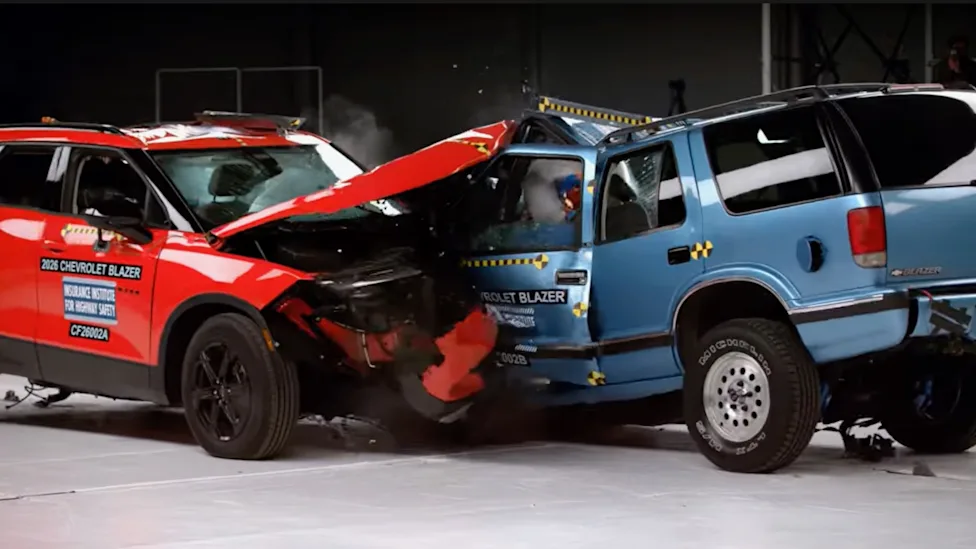
The IIHS recently to prove that. This time, it pitted a 1996 Chevy S-10 Blazer against a 2026 Blazer to show how much its testing program has helped improve car safety over the past 30 years. The cars were crashed head-to-head under the same parameters as the IIHS’s moderate overlap front test, which normally involves a single car being run into a stationary barrier at 40 mph. I can’t tell what was more painful: watching that mint S-10 Blazer get destroyed in the name of science, or the existential crisis brought on by the realization that said Blazer is, in fact, three decades old.
IIHS
The front end of the new Blazer absorbed most of the impact, keeping the cabin intact, which would have allowed a real-life driver to walk away with only minor “bumps and bruises,” according to an IIHS press release. In contrast, the 1996 S-10 Blazer’s was compressed, pushing the dashboard and steering column into the crash-test dummy’s lap. Instead of softening the blow, the airbag hit the dummy in the chin, pushing its head back with such force that it detached.
Both SUVs performed as expected. The 1996 Blazer earned the lowest “Poor” rating in the moderate overlap front test when new, and the 2026 Blazer received the highest “Good” rating. However, it hasn’t yet undergone the updated version of the test introduced in 2022, which also looks at rear-passenger safety.
The IIHS has been testing cars since 1995, using data from insurance companies to find crash scenarios not covered by federal regulations that tend to have high rates of injuries and deaths in the real world, and those same insurers’ money to conduct the tests. It’s dropped or added tests over the years to keep automakers on their toes, and also expanded the testing regime to cover safety-related features like headlights and
The nonprofit estimates that safety improvements resulting from its crash tests saved 48,352 lives between 1999 and 2024. That’s based on a comparison of real-world fatality rates for cars and trucks rated “Good” and those with the lower ratings of “Acceptable,” “Marginal,” and “Poor.” The IIHS also says safety improvements saved $538 billion, citing U.S. Department of Transportation data. That’s a nearly 900-fold return on investment from the $600 million insurance companies spent on IIHS crash testing during that time.