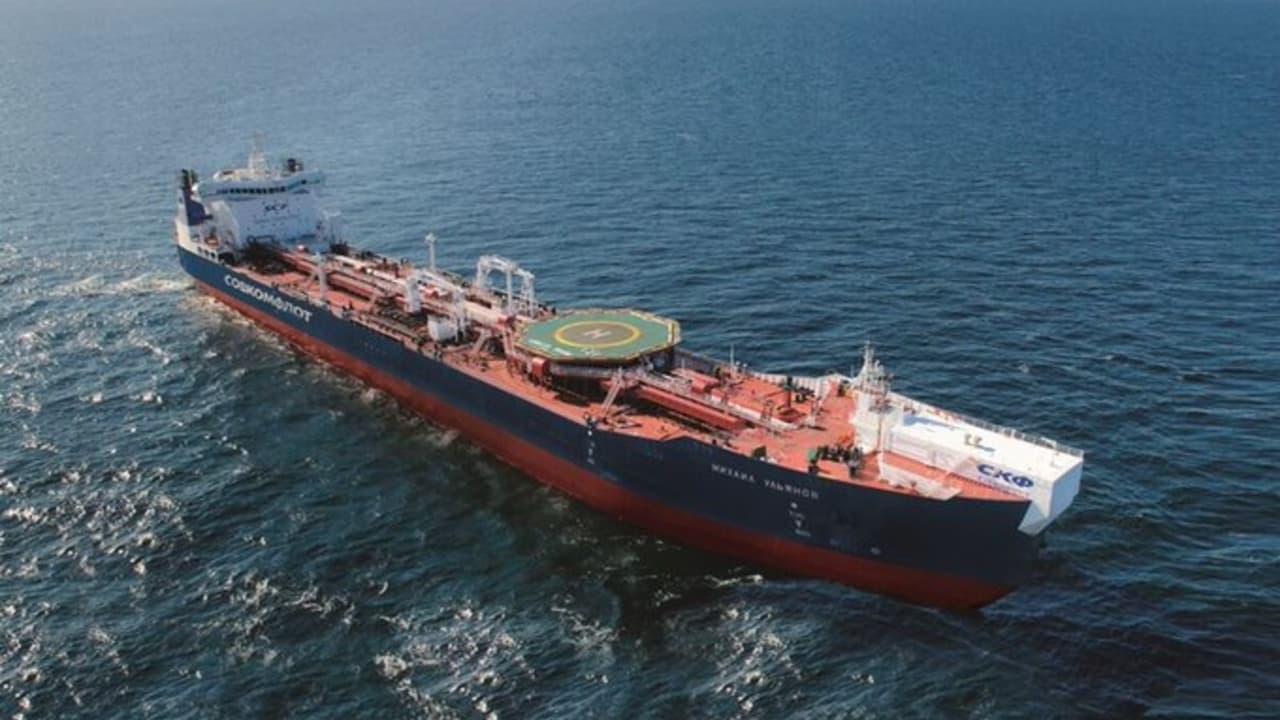
Despite tension in West Asia, ‘Shellong’ tanker carrying crude oil from Saudi Arabia has reached Mumbai. Amidst the threat of missile attack from Iran, this ship switched off its identification system and crossed the dangerous ‘Strait of Hormuz’.
New Delhi: Due to increasing tension in West Asia, the world’s most important oil route ‘Strait of Hormuz’ has almost come to a standstill. According to the report of S&P Global Commodities, amidst this dangerous environment, the first tanker carrying crude oil from a country other than Iran has reached India via this route. Iran had threatened that if an oil tanker from any other country passed through this route, it would attack it with a missile.
‘Shellong’ tanker reached Mumbai
According to S&P data, this tanker named ‘Shenlong’ had left Saudi Arabia’s largest oil export terminal ‘Ras Tanura’ on March 1. On March 10, this tanker reached Mumbai coast of India. When the ship was at Ras Tanura, its draft (the part of the ship submerged in water) was 9.3 metres, but it became 15.8 meters when it reached Mumbai. This shows that the ship was fully loaded with oil. This ship belongs to ‘Shelong Shipping Limited’ and is operated by the Greek company ‘Dinacom Tankers Management’.
Was it a secret operation?
Tracking software showed that the ship had turned off its Automatic Identification System (AIS) just before crossing the Strait of Hormuz. This system tells the location of the ship. It was restarted after crossing the strait. However, no information has been received about the final destination of the ship.
US Navy did not provide any security
At one time the US Energy Minister had tweeted that “The US Navy has provided security to the oil tanker and made it safely cross the Strait of Hormuz.” But later this post was deleted. On this, the White House clarified that the US Navy has not provided security to any commercial ship.
Transportation costs skyrocketed
Due to this tension, the fare for transporting oil through Hormuz is skyrocketing. The fare, which was $51.42 per metric ton on February 27, increased to $158.63 by March 10. Due to this, there is a danger of increasing oil prices.
Why a matter of concern for India?
20% of the world’s oil supply and 50% of India’s total energy imports pass through the Strait of Hormuz. At present the movement of ships here has reduced considerably. On normal days, 60 ships used to pass through here every day, but now only 2-3 ships are passing through here. Experts believe that alternative export routes such as Fujairah and Yanbu are working at full capacity, but they cannot compensate for the loss caused by the closure of the Hormuz Strait.
According to Jim Burkhard, head of crude oil research at S&P Global Energy, ‘The pressure on the Asian market is clearly visible. Half of the oil in Asian refineries comes from Gulf countries. If the Strait of Hormuz remains closed for a long time, it will affect not only Asia but oil reserves and prices across the world.