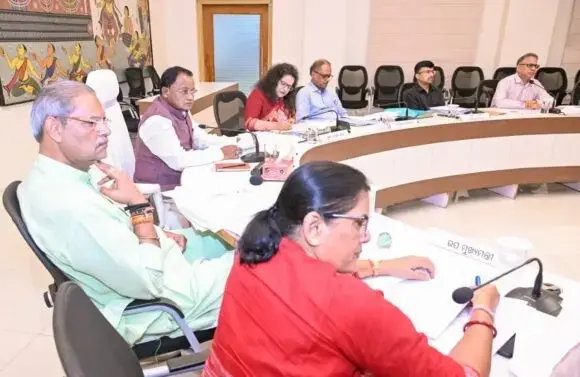
Bhubaneswar: The Odisha Cabinet, chaired by Chief Minister Mohan Charan Majhi, on Wednesday approved key amendments to the Odisha Renewable Energy Policy (OREP), 2022.
The decision aims to boost renewable energy development, improve investor confidence, and ensure affordable green power for consumers across the state.
The Odisha Renewable Energy Policy, originally notified on November 30, 2022, was created to establish a supportive ecosystem for clean energy investments. Based on stakeholder feedback and implementation experience, the government introduced several key policy refinements:
Electricity Duty Exemption: Extension of the electricity duty exemption at the rate of 50 paise per unit for eligible net-metering consumers on energy consumed from state-established renewable projects for 10 years from the commissioning date.
Transmission Charge Exemption for BESS: A 20 paise per unit State Transmission Utility (STU) charge exemption for Standalone Battery Energy Storage Systems (BESS) commissioned in Odisha, provided the input energy comes from RE projects and output energy meets state demand.
Wind Power Framework Rationalisation: Removal of the existing cumulative cap of 500 MW for wind power project allocation under the first-come-first-served mechanism.
Wind Power Parks: Direct promotion and encouragement of dedicated Wind Power Parks.
Right of First Refusal: Provision of up to 25% Right of First Refusal (RoFR) capacity for RE Captive projects.
Streamlined Operations: Harmonization of operational guidelines and designation of GRIDCO as the Nodal Agency for implementing legacy Small Hydro Electric Projects (SHEP).
The Cabinet also approved the “Amendment to Odisha PSP Policy, 2025 and Operational Guidelines on PSP Policy, 2025,” which will remain effective until March 31, 2030. The policy provides a dedicated framework for Pumped Storage Hydro Projects-a cost-effective solution for long-duration energy storage required to balance intermittent renewable power.
PSPs store surplus electricity during off-peak hours and release it during peak demand, enhancing grid stability through instantaneous load response, frequency regulation, spinning reserves, and black start capabilities. The policy aligns with Odisha’s broader goal to add approximately 11,000 MW (11 GW) of renewable energy capacity by 2030.
To encourage developer participation, the PSP policy offers key incentives:
Tax & Charge Exemptions: Full exemption from Electricity Duty, cross-subsidy surcharge, wheeling charges, STU charges, and water cess.
Financial & Infrastructural Benefits: Infrastructure support, provision of free power, and access to Local Area Development Fund (LADF) benefits.
These policy revisions are expected to accelerate green power projects and further solidify Odisha’s standing as a premier destination for clean energy investments.
Other Cabinet Decisions
Third Amendment to Semiconductor Policy: The Cabinet approved the third amendment to the Odisha Semiconductor Manufacturing and Fabless Policy to align with the national India Semiconductor Mission (ISM 2.0). The amendment extends fiscal incentives to emerging segments including semiconductor equipment manufacturing, R&D, specialty gases, and advanced materials. The state will provide an additional fiscal support of 25% of eligible capital expenditure (capex) for ISM-approved projects, disbursed pari passu with central assistance.
Approval for OSWAS 3.0 Project: The Cabinet cleared a proposal accepting a single bid of ₹1,22,60,25,436 (excluding taxes) submitted by M/s TCS Ltd for the implementation and 5-year support of OSWAS 3.0. The next-generation Odisha State Wide Area Workflow Automation System will feature a modern microservices-based architecture integrated with advanced Artificial Intelligence capabilities to drive paperless governance across state offices down to the block level.