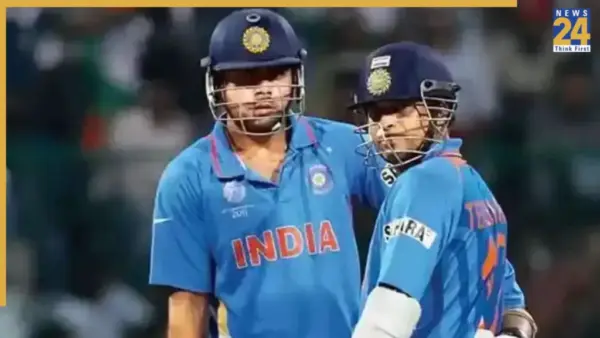
The GOAT debate in cricket never really ends. But former Australia fast bowler Brett Lee has made his choices clear.
Lee has picked Sachin Tendulkar as the best batsman he has seen, while naming South African legend Jacques Kallis as the best overall cricketer.
Lee explained that Kallis’ numbers make his case almost impossible to ignore. The Australian pacer has faced both legends during his career and also shared a dressing room with Kallis at Kolkata Knight Riders.
Sachin Tendulkar is Lee’s greatest batter
Lee has consistently spoken highly of Tendulkar. He has described the Indian legend as the best batsman he ever bowled to. Lee’s admiration for Tendulkar is not surprising.
The Australian pacer played against him during one of the most competitive periods of international cricket.
In an earlier interview, Lee explained that Tendulkar seemed to have more time than other batters when facing fast bowling.
Tendulkar finished his international career with 100 international centuries. He also remains the leading run-scorer in both Test and ODI cricket.
Why does Lee pick Kallis as the greatest cricketer?
This is where Lee’s choice gets interesting. He is not calling Kallis the greatest batter. Instead, he is talking about the complete cricketer.
Kallis could win matches with the bat, ball and in the field. His numbers show just how rare that combination was.
He scored 13,289 Test runs and took 292 Test wickets. In ODIs, he scored 11,579 runs and took 273 wickets. He also took 200 catches in Test cricket.
Kallis’ numbers are almost impossible to match
Kallis is the only cricketer to have scored more than 10,000 runs and taken more than 250 wickets in both Tests and ODIs. That statistic explains why Lee sees him differently from a pure batter or bowler.
Kallis effectively gave South Africa two world-class players in one package. He could produce a big century and then return with the ball to take important wickets.
His Test batting average was 55.37, while he finished with 45 Test centuries. He also scored 17 ODI centuries.
Sachin vs Kallis: Why Lee separates the two
Lee’s choice creates an interesting distinction. If the question is ‘Who is the greatest batsman?’, he picks Tendulkar. If the question is ‘Who is the greatest cricketer?’, he picks Kallis.
That difference matters. Tendulkar’s career was built around extraordinary batting. Kallis contributed across almost every department. So Lee is not really comparing the two in exactly the same category.
Tendulkar’s batting record speaks for itself
Tendulkar played international cricket for 24 years. He scored 15,921 Test runs and 18,426 ODI runs. He also became the first player to reach 100 international centuries.
The ICC lists him as the leading run-scorer in both Test and ODI cricket. His longevity was another major part of his greatness. He played against several generations of bowlers and remained one of India’s most important batters throughout his career.
Kallis was more than a batter
Kallis’ numbers become even more impressive when his bowling is included. He took 292 Test wickets at an average of 32.65. He also collected 273 ODI wickets.
His ability to bowl useful spells while carrying a huge batting workload made him one of the most valuable all-rounders in cricket history. He was also an outstanding slip fielder. Kallis finished his Test career with 200 catches.
Lee has seen both legends up close
Lee’s opinion carries extra weight because he played against both Tendulkar and Kallis. He also shared the Kolkata Knight Riders dressing room with Kallis.
The two were part of the KKR team that won the 2012 IPL title under Gautam Gambhir. That gave Lee a chance to see Kallis not only as an opponent but also as a teammate.
What did Lee say about Virat Kohli?
Lee also had plenty of praise for Virat Kohli. The former Australian pacer said he could see Kohli’s confidence when they faced each other.
Lee described Kohli as a player who looked straight at the opposition and appeared ready for the contest. He also defended Kohli against criticism about his form or age. Lee’s point was simple. A player’s overall record cannot be judged by one poor match or one difficult period.