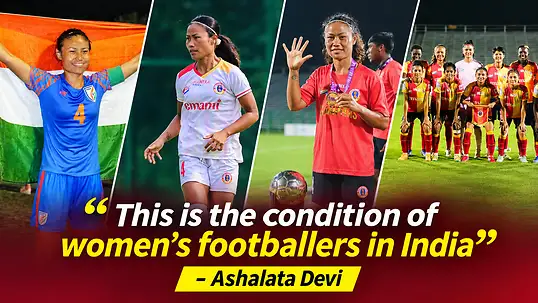
When East Bengal began their AWCL campaign in Kolkata, the first time the tournament’s group stage has been staged in India, one of the most decorated players in Indian women’s football was missing from the squad.
Not because of injury or form, but because of a missing piece of paper.
Ashalata Devi, former India captain and the first women’s national team player to feature in 100 international matches, is still waiting for a No Objection Certificate (NOC) from the Indian Railways, her employer. She applied for clearance for both the AFC Women’s Champions League (AWCL) and Indian Women’s League (IWL) about 18 days ago. It has not arrived yet.
“Unfortunately, I am not in the team yet because I did not get the NOC from Railways,” the 33-year-old defender told Sports Now.
“Hopefully, I get it for IWL.”
Not the first time
It is not the first time this has happened to her. During the 2025-26 AFC Women’s Champions League group stage in China, she travelled with the team but watched every match from the stands as her NOC came through only after she returned home.
As she plays in the IWL without pay for the Railways, every request for the NOC goes through the personnel department, then the sports department and then the Railway Board. That takes at least a month, and the IWL schedule is often confirmed only 10-15 days before kick-off. The upcoming 2026-27 season was postponed to October 16, and then it was once again delayed at short notice. Now it is finally set to begin on November 13. Until the NOC arrives, she cannot even leave headquarters.
WATCH FULL INTERVIEW: ASHALATA DEVI
Her routine also reflects the strain. She has gym in the morning, office by 9:30 or 10, and then training after work. She reaches home around 7:30 pm. “Sometimes I don’t feel that I am a professional player,” she said.
She is clear that she isn’t alone. Most women footballers in central government jobs face the same hurdles, and she appealed to authorities to let athletes play, while they still can. They were hired for their sport, not their studies.
Retirement plans
The frustration and constant battle have led to a bigger decision. Ashalata has ruled out a possible comeback to the national team and revealed that this IWL could be her final season, citing injuries, personal issues and problems at work.
“I think this IWL can be my last season. I am facing a lot of physical problems. I have a lot of injuries and some personal issues. I am also facing a lot of problems with my job,” she said.
“If I had only one problem, I would have tried to solve it.”
Coaching does not interest her, but she wants to remain involved in the game. She has already started a football initiative for girls and children in Imphal.
Humble roots
Her football journey began at 13, on a ground near her home where only boys played. Her parents, especially her mother, opposed it. Neighbours questioned what future a girl had in football; she would only get married.
In 2008, she made the India U17 squad for AFC qualifiers in Malaysia, her first international. In the national camp in Lucknow, she and 11-12 Manipuri players spoke no Hindi.
“Sometimes it feels like there is no need for language in football,” she said.
She started as a midfielder, then moved to centre-back at KRYPHSA because of her height. He initially resented the move, but now loves the position. She likes organising her team with the whole game in front of her. Reaching 100 caps in 2024 was a proud moment, she added, but her “dream is bigger than this.”
Pay gap
She also praised East Bengal for paying salaries on time, but said delays are common across Indian women’s football. With women’s salaries at perhaps less than 10 per cent of what male players earn, unlike ISL players who can save enough in a few seasons, women need government jobs to survive after retirement.
“This is the condition of women’s footballers in India,” she said.