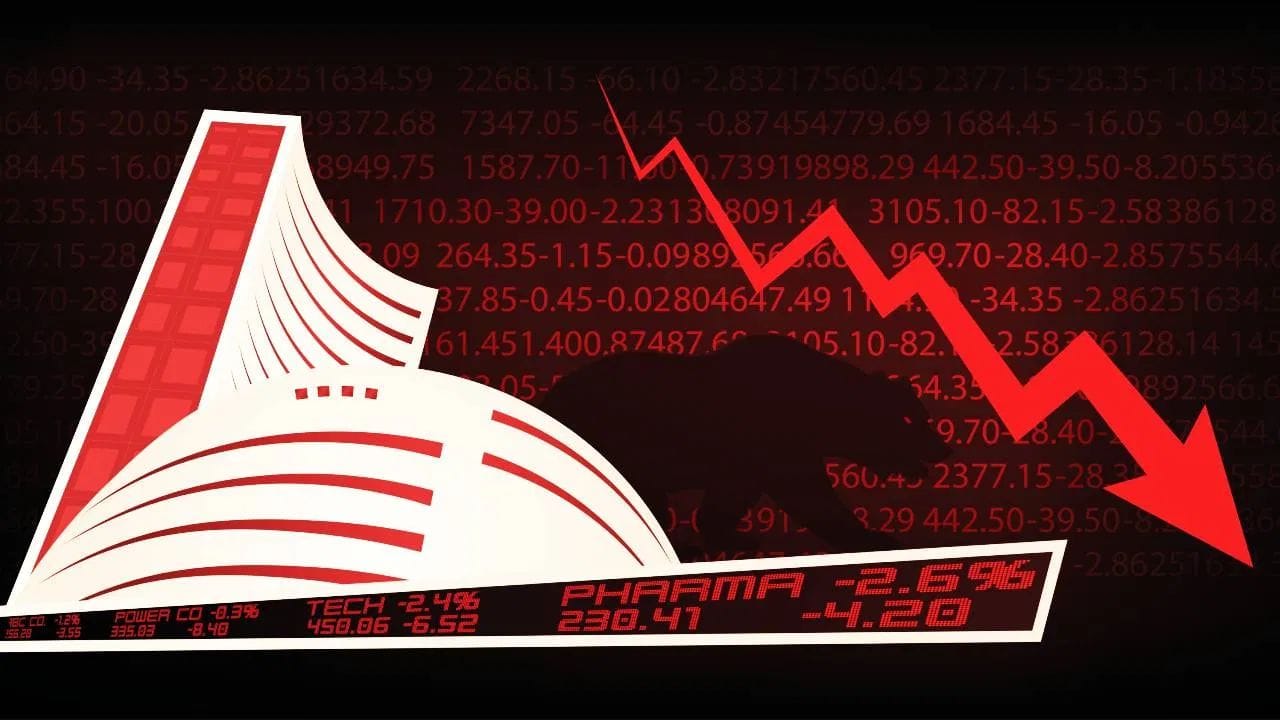
The biggest fall in stock market sentiment in 6 years was seen on the budget day.
The way the stock market had opened in the morning and Sensex and Nifty had gained momentum even after the budget speech, it did not seem that the market would remain brightly lit. But this did not happen. As soon as Finance Minister Nirmala Sitharaman talked about increasing the tax on STT and increased the tax on buyback. After that the stock market lost its color and investors suffered huge losses. At one time the Sensex had fallen by about 2400 points. At the same time, a fall of 749 points was seen in Nifty. But later there was a recovery in the market and the stock market closed with a slight decline of less than 2 percent. By the way, this is the biggest fall in the stock market in 6 years on the budget day.
Sensex and Nifty crashed
Sensex and Nifty fell heavily in the special trading session on February 1 due to profit-booking by investors following Finance Minister Nirmala Sitharaman’s proposal to increase the Securities Transaction Tax (STT) on derivatives. The government said that this step has been taken with the aim of curbing excessive speculation in the futures and options (F&O) segment. Reversing early gains, the Sensex fell 2,370.36 points or 2.88 per cent below the 80,000-mark at 79,899.42. It closed at 80,722.94, down 1,546.84 points or 1.88 percent. Nifty fell 495.20 points or 1.96 percent to close at 24,825.45. During the day, it fell 748.9 points or 2.95 percent to close at 24,571.75.
Which stocks had a big decline?
Due to heavy selling in the shares of companies listed on BSE, the market cap declined by Rs 9.40 lakh crore. Shares of State Bank of India fell by 5.61 percent, while shares of Adani Ports fell by 5.53 percent. Shares of Bharat Electronics, ITC, Tata Steel, UltraTech Cement and Reliance Industries were also among the declining stocks. Shares of Tata Consultancy Services, Infosys, Sun Pharma and Titan saw a rise. The market trend remained negative, as about 1673 shares gained, 2296 shares declined and there was no change in 158 shares.
STT increase
Finance Minister Nirmala Sitharaman said that STT on option contracts will be increased from 0.02 percent to 0.05 percent. He said that it is proposed to increase the STT on option premium and exercise of options to 0.15 percent from the current rate of 0.1 percent and 0.125 percent.
Akash Shah, technical research analyst at Choice Equity Broking, said in a Money Control report that the increase in STT, especially in F&Os, could have a marginally negative impact on foreign investment (FPI) inflows, especially for high frequency and derivative-centric global funds.
FPIs have already been cautious with equity outflows of over Rs 41,000 crore in January 2026 amid global risk-free sentiment, rising US bond yields and currency pressures. Shah further said that in this environment, high STT further reduces after-tax returns, making India relatively less attractive for short-term and derivative-oriented foreign investors.
The Finance Minister’s proposal to increase STT on futures to 0.05 per cent is structurally negative for the overall capital market structure, especially F&O (Financial and Ownership) based trades. The increase in transaction costs is likely to reduce trading volumes, slow down the short-term and reduce the profitability of active market participants. Due to decline in trading efficiency after tax, participation of FIIs (financial and economic investors) in derivatives may also reduce, which will affect over liquidity.
Raj Gakar, research analyst at Samco Securities, said in a Money Control report that this could have a major impact on the revenue sources of broking companies, exchanges, AMCs and depositories, which are directly linked to market trading. Given that derivatives volumes have already declined in recent months, this increase could put further pressure on earnings clarity in the near future. Although this measure is financially helpful, it poses a challenge for capital market-linked stocks.
India VIX increases
India VIX, an indicator of market volatility and investor uncertainty, rose by more than 12 percent to 15.10. An increase in the volatility index usually indicates greater nervousness among investors, often leading to cautious trading and increased short-term volatility in stock markets.
Selling in shares of public sector banks
The public sector banks index fell more than 4 per cent amid heavy selling by investors, emerging as the worst performing index. The Nifty Public Sector Bank index recorded the biggest decline among the major regional indices. The biggest decline was recorded in the shares of Bank of India and Bank of Baroda, which fell by 7 percent and 6 percent respectively. UCO Bank and Punjab & Sindh Bank declined the least, falling 2 per cent and 2.7 per cent respectively. All 12 banks of the index closed in the red.
What are the experts saying?
Shrikant Chauhan, Head of Equity Research, Kotak Securities, said in the Money Control report that huge fluctuations were seen in the benchmark index today. Nifty fell by 495 points, while Sensex closed with a fall of 1546 points. Talking about sectors, almost all the major sectoral indices were trading in the red, but the biggest decline was recorded in Capital Market, Defense and PSU Bank indices, which fell by more than 5 percent.
He said in the report that technically, the market recovered some losses after the sharp fall in the second half of the day. There was a sharp rise in the market from the day’s low. On the daily chart, it has formed a long bearish candle and is currently trading below the 200-day simple moving average, which is largely negative. We believe that short-term market conditions are volatile and volatility is likely to continue in the near future. Therefore, level-based trading would be the ideal strategy for day traders.
On the upside, 25,000/81300 will act as an important resistance level. As long as the market is trading below this level, weak market sentiment is likely to dominate. On the downside, the correction wave is likely to continue till 24650-24600/80100-79900. Even more decline may continue, which may take the index to 24500-24300/79600-79000. On the other hand, above 25,000/81300, the market may move towards 25,200/81900 or 200 days simple moving average.