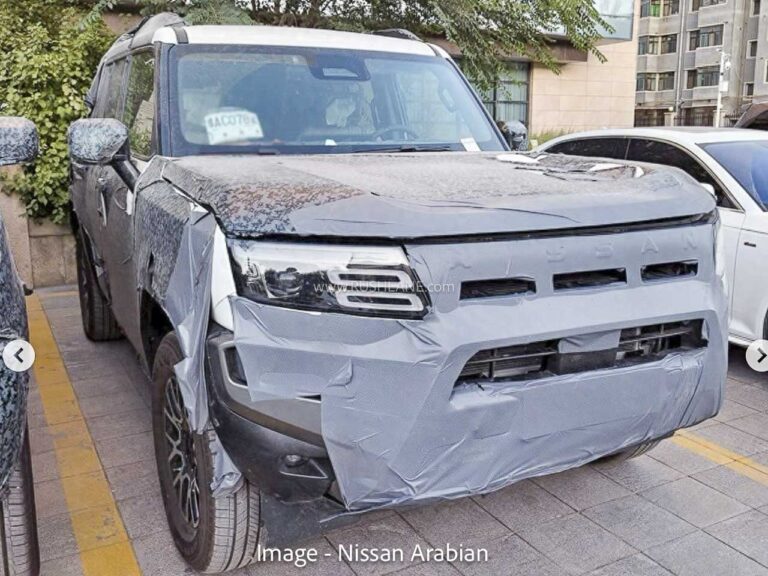
Other than the off-road-focused gear seen on the Terrano PHEV concept, the production version retains most of the design features
Earlier this year in April, Nissan had at the Beijing Auto Show. The SUV will be manufactured in China, as part of the joint venture between Nissan and Dongfeng. Launch in China is expected in early 2027. From there, Terrano will also be exported to locations like the Middle East, ASEAN nations and Latin America. Ahead of its launch, Nissan Terrano has been spotted during road tests, revealing key details.
Nissan Terrano – Design and features
Likely the production version of Terrano PHEV concept, this test mule closely matches the exterior features seen with the concept. However, hardcore off-road equipment such as bonnet mounted fog lamps, roof mounted lights, full length platform rack and knobby off-road tyres are apparently missing. It remains to be seen if these are made available as accessories.

A relatively sober design for the alloy wheels has been used with the test mule. The concept version was presented with more rugged alloy wheels. At the front, Nissan Terrano PHEV has distinctive lighting elements in enlarged and elongated pixel-style format. A relatively narrow closed-off grille has been used in combination with a large and prominent bumper section that includes a robust skid plate and underbody protection.
Nissan Terrano has an upright design, sharp panelling and a clamshell bonnet. Other key features include flared wheel arches, body cladding, large wheels, pull-type body-coloured door handles, rectangular ORVMs and capable roof rails. All pillars are blacked-out for a floating roof effect. The SUV is expected to get features like a 360 degree camera setup.

With a flat beltline and roofline, Terrano has a boxy, planted appearance. At the rear, the SUV has a largely flat windshield and tailgate, and a spare tyre. Tail lamps are vertically stacked and a chunky bumper has been used.
Premium cabin
Inside, the test mule has a dual tone tan and grey interior theme. Leatherette treatment can be seen across the seats, doors and the dashboard, creating a plush cabin aesthetic. The SUV has a flat centre console with neatly laid out electronic gear selector, rotary driver mode controller / terrain select dial, toggle switch panel, electronic parking brake with auto hold and cup holders.

A wide padded armrest can also be seen. Wireless charging pads are likely installed at the front section of the centre console. Other key features include a leatherette steering wheel with mounted controls, a large centrally positioned touchscreen infotainment system and a digital instrument cluster. The SUV has a layered dashboard and oblong shaped AC vents.
Performance, off-road features
As per reports, Terrano’s chassis, core mechanical systems, safety equipment and off-road gear have been developed by Nissan. The SUV’s design was created by Nissan’s design centre in China with guidance from Nissan’s head office in Japan. Dongfeng has contributed by providing the hybrid powertrain and other technology systems. The engine that will be used with the pure petrol version has been developed by Mitsubishi.

Terrano will have a ladder-frame construction, derived from the platform used with Nissan Frontier Pro/Dongfeng Z9 pickups. While the focus in the Chinese market will be on the PHEV version, emerging markets and the Middle East could get both ICE and PHEV versions. Collaboration with Dongfeng will help speed up development time and also reduce costs.
Nissan Terrano India Launch
Nissan Terrano could have an India connection as well. According to Autocar India, Nissan is evaluating products developed through its 50:50 joint venture with China’s Dongfeng for the Indian market, and the production version of Terrano PHEV Concept is believed to be among the leading candidates.

Nissan is reportedly particularly interested in the PHEV version for India. If introduced, Terrano would enter the premium ladder-frame SUV space currently dominated by Toyota Fortuner. A potential ex-showroom price of around Rs 40 lakh is being considered.
Local manufacturing will be important to achieving competitive pricing. Although Nissan no longer holds a stake in the Chennai manufacturing facility previously operated jointly with Renault, it retains 2.5 lakh units of annual production capacity reservation at the plant. The facility itself has an annual capacity of around 5 lakh units and currently has significant spare capacity.

Terrano could therefore become part of Nissan’s broader India revival plan, which extends beyond models shared with Renault. However, the SUV is still under evaluation for India and its launch has not been confirmed. If the programme progresses as planned, the first Dongfeng-derived Nissan product could reportedly arrive in India within the next two years.