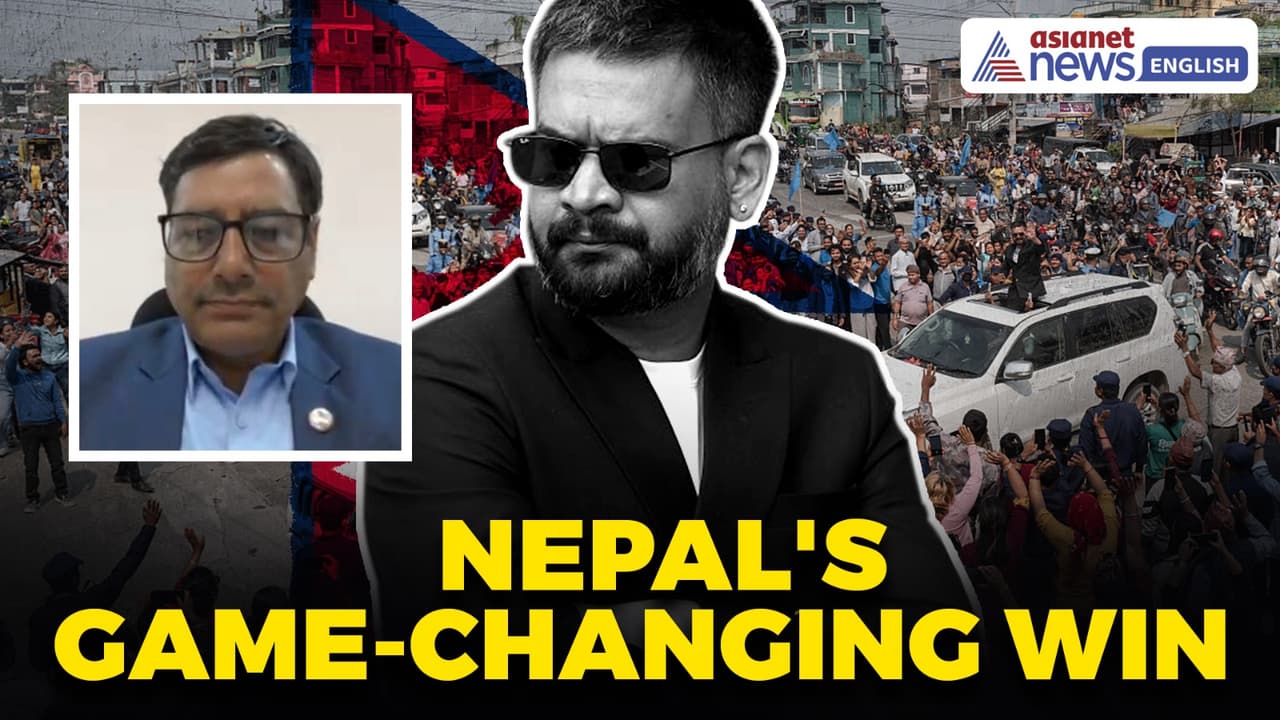
Nepal’s outgoing minister Madhav Chaulagain explains Balen Shah’s sweeping victory, the 2025 protests that toppled KP Sharma Oli, and what lies ahead for Nepal’s economy, governance, and India ties.
Nepal stands at a rare political crossroads. Six months after violent protests shook the Himalayan nation and forced the exit of former prime minister KP Sharma Oli, voters have delivered a sweeping mandate to a new generation of leadership. At the centre of that political earthquake is Balendra Shah — the 35-year-old rapper-turned-politician whose party, Rastriya Swatantra Party, secured a commanding majority in the March 5 parliamentary elections.
The transition has been rapid, dramatic and uncertain.
In an exclusive conversation with Asianet Newsable English’s Somya Jaiswal, Nepal’s outgoing Minister for Forest and Environment Madhav Prasad Chaulagain reflected on the turbulent months that reshaped the country’s politics — from youth-driven protests to the emergence of Balen Shah as the face of a new Nepal.

The rise of Balen Shah: A youth icon turns national leader
For Chaulagain, Shah’s victory was not just electoral success — it was a reflection of a deeper change within Nepali society.
“It’s overwhelming. It’s overwhelming in terms of the way he created, his team created a massive interest to select the new faces, to elect new faces in the country.”
Shah had already built a strong following long before entering national politics. As mayor of Kathmandu, he cultivated an image as an anti-establishment reformer who spoke directly to frustrated voters — particularly young Nepalis.
Chaulagain believes that reputation carried him to a historic mandate.
“So he has been a quite inspiring figure among the youths, not only youths, I think for all kind of people in the country for last couple of years. Before becoming the mayor of the metropolitan capital city of Kathmandu, he was also popular among the youngsters.”
He added, “So he has been an inspiring and interesting figure over the past many years, and especially in this context. So he has been instrumental in changing the people’s mindset, the understanding and the hope. Especially the people have seen a hope in him that he can make a change. That’s what he created his image around the years.”
From protests to peaceful elections
The election that brought Shah to power came after one of Nepal’s most turbulent political periods in decades.
Deadly protests in September 2025 — initially triggered by anger over a government ban on social media — spiralled into wider demonstrations against corruption, economic hardship and governance failures. At least 77 people were killed during the unrest.
Yet within six months, Nepal managed to hold a national election.
Chaulagain credits the interim administration led by Sushila Karki for stabilising the country.
“Thankfully, now we have the outcome of the election. So it went very successfully. It created a record that within a very short time, we could turn out this in a peaceful manner.”
He recalled the deep uncertainty that followed the riots.
“Looking at the beginning, the September unrest, everybody was sceptical amidst this chaotic situation. There was a lot of disbelief that how could this level, this scale of unrest can be settled in a very peaceful manner.”
Even as preparations for elections began, doubts remained — both within Nepal and internationally.
“Within the government, within the country and outside in the world, people have a sceptical view over the transparency, the capacity of delivering these things.”
But according to Chaulagain, the interim government focused on constitutional processes and patience.
“Despite this revolution, bringing the country into a peaceful transition, it requires a lot of thoughtful process and a patience. So this all element, I think it was successfully materialised.”
The role of neighbours in Nepal’s transition
Nepal’s political crises rarely unfold in isolation. Sandwiched between two Asian giants, its internal developments often attract close attention from its neighbours.
Chaulagain acknowledged the importance of external support.
“Of course, like always, because I mean neighbours, if you take that example in a village, we have a really village-village country. So the neighbours, you have so many relations established there. We’re connected by land or by other cooperative things. So if neighbours do not help, you cannot succeed.”
He specifically praised India’s role in backing Nepal’s democratic transition.
“India has been a very good neighbour from the very beginning. India respected the popular voice, the democratic youth voice. That reflection has come in all over the media, even the government also supported in this process.”
Later, he added, China too extended support.
“When we were working on the election process, especially India and later China as well, so our two close neighbours, they supported. India from the beginning actually supported very much for this democratic transition.”
Foreign policy may prove equally challenging for Shah’s administration.
Nepal has historically tried to maintain neutrality between India and China — a delicate balancing act that has become even more complex amid rising geopolitical tensions and the ongoing conflict in West Asia.
Chaulagain believes the new leadership understands this balance.
“Nepal being a country which keeps the neutral stance, we have our own principles of working with our friendly countries, neighbouring countries. So this new government should maintain that relationship and bring that to the next level.”
Nepal and Bangladesh: Similar protests, different outcomes
The upheaval in Nepal has often been compared to youth-driven protests in Bangladesh, where demonstrations also forced political change.
But Chaulagain believes Nepal’s transition moved faster.
“We were also watching Bangladesh progress. It took a while to materialise the election in Bangladesh.”
Nepal, he said, was able to hold elections within six months because of its long experience with democratic participation.
“Nepal materialised this election quite in time, in a very short time, like just in six months.”
He pointed to Nepal’s diversity — ethnic, linguistic and geographical — as a factor that strengthened democratic instincts.
“Nepal has, as I mentioned earlier, we are very diverse in terms of not just only geography or ecologically, but we have like caste, ethnicity, peoples. There are different linguistic diversity as well.”
Despite early distrust of political institutions, people eventually returned to the ballot box.
“Soon after, even the youth who actually were in front of this unrest, this revolution, they realised the importance of this election ballot or democratic process to have a peaceful transition as well as to achieve their demand.”
The daunting tasks awaiting the new government
The election victory gives Shah a rare advantage in Nepal’s fragmented politics — a majority government.
But that also means expectations are sky-high.
Economically, Nepal faces structural constraints. The new government has pledged to create 1.2 million jobs, double per-capita income to $3,000 within five years, and reduce reliance on overseas labour remittances — which currently account for roughly one-third of the country’s GDP.
Chaulagain believes the government’s first priority must be governance reform.
“At the domestic level, within the system, I mean, these people’s unrest, the reason behind this unrest is people are not satisfied with the delivery of the previous government system.”
He emphasised the need to overhaul institutions and bureaucracy.
“Establishing good governance, you need some measures, like it may be reforming some legal provisions or the instruments, or reforming the bureaucracy, which is the delivery mechanism of the political aspirations and agenda.”
And corruption remains a central concern.
“Bringing that into a safe, making an efficient and performance-orientated governance is one of the big challenges that actually contributes to the agenda of preventing the corruption.”
India–Nepal ties: “Nobody can prevent that relationship”
Perhaps the most sensitive diplomatic question concerns Nepal’s ties with India — a relationship defined by open borders, deep cultural links and significant economic interdependence.
Shah has occasionally been critical of India in the past, particularly in social media posts. But Chaulagain downplayed concerns that the new government could strain relations.
“I don’t think that there will be that kind of… If there has been anything, it will create a difficult situation in the future. That’s absolutely not an issue.”
He emphasised the centuries-old connections binding the two countries.
“In Nepal, India in particularly, our relationship is age-old. We share the civilisation, we share the trade, we share the ecosystem, biodiversity. And so many, not just only cultural, it’s a natural connection also there. Nobody can actually prevent that relationship becoming flourished.”
The ties extend far beyond politics.
“Even like Balen Saha just recently, in his ex-post, congratulated India for winning the T20 World Cup. So that level of sports connection is there. Music connection is there. Traditional cultural connection is there.”
For Nepal, India’s economic strength also presents opportunities.
“India is an economic power centre in this side of the world… So we can benefit from these Indian technologies, economic opportunities to fulfil our aspirations as well.”
A rare moment of stability — and a test of leadership
Nepal’s politics has long been marked by fragile coalitions and frequent government changes. Shah’s majority could offer something rare: stability.
“This new upcoming government is providing a stable government. These people’s mandate is in that way.”
And stability, Chaulagain said, could transform diplomacy and governance.
“If the government is stable, so bilateral relationship also becomes stable and they bring to the new level… So I think good days are there for bilateral relations also. That’s what I feel.”
For Nepal, the revolution has already happened at the ballot box.
Now comes the far more difficult part — turning hope into governance.