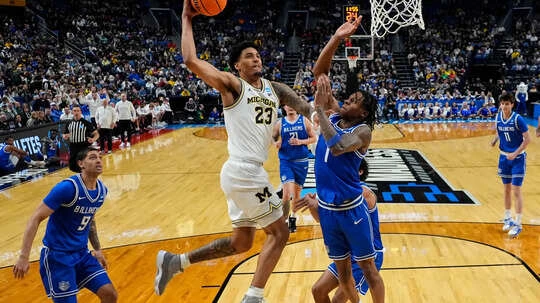
The NCAA Tournament continues to showcase moments of excitement, including buzzer beaters and unexpected upsets, yet the chaos often associated with March Madness appears increasingly rare.
As dominant performances by top seeds become the norm, the tournament’s unpredictability may be diminishing, leading to a more predictable outcome for fans and teams alike.
Top Seeds Dominate Early Rounds
The top four seeds in each region achieved a perfect 16-0 record during the first two days of the tournament, echoing a similar trend from the previous year. The average margin of victory in these initial games reached 17.4 points, marking the highest since the tournament expanded to 64 teams. Additionally, fourteen games were decided by at least 20 points, a record-setting figure, while Florida’s victory by 59 points stands as the second-largest margin in tournament history.
While women’s basketball shows signs of increasing parity, higher-seeded teams also experienced relative ease in their first-round matchups, reflecting a broader trend of dominance among top-ranked programs.
Impact of Transfers and NIL on Competition
The trend of dominant performances correlates with changes in transfer rules and the introduction of Name, Image, and Likeness (NIL) compensation for athletes. This new landscape has led to a widening gap between elite programs and their less-resourced counterparts.
Saint Louis emerged as one of the few lower-seeded teams to advance to the round of 32, only to be swiftly eliminated by top-seeded Michigan. Wolverines forward Yaxel Landenberg, a highly sought-after transfer, scored 25 points and secured six rebounds in the victory.
Saint Louis coach Josh Schertz commented, “I think the talent gap at the top is more significant than it was. I think NIL has created that, where just the size and physicality, the differences between the top five or 10 teams and everybody else … I do think there’s a chasm.”
This disparity poses challenges for teams striving to compete, as larger schools attract top talent and resources, leading to a cycle where smaller programs struggle to retain their best players.
The Changing Landscape of College Basketball
Coaches are increasingly concerned about retaining talent in the current environment. Texas Tech coach Grant McCasland noted the difficulty smaller programs face in keeping standout players, stating, “If you’re great, it’s like, you’re in a catch-22. If you play great, you’re gone because there’s people with more resources.”
Alabama’s Nate Oats reflected on how the elimination of the transfer sit-out rule has changed player retention dynamics, pondering whether he could have kept key players like C.J. Massinburg for multiple seasons under today’s rules.
UConn coach Dan Hurley pointed out that high-major schools are increasingly opting for experienced players rather than relying solely on younger talent, saying, “(Schools are) going out and purchasing a ready-made roster of grizzled, talented veterans.”
Scheduling Challenges for Mid-Majors
Mid-major programs face significant challenges in scheduling competitive games that adequately prepare them for the NCAA Tournament. This often results in mismatches during the opening rounds.
Despite these challenges, High Point, the Big South champion, managed to secure a victory over fifth-seeded Wisconsin, continuing the tradition of 12th-seeded upsets.
High Point coach Flynn Clayman expressed a desire for more equitable scheduling, stating, “Fans deserve to see High Point versus a good team in the nonconference.”
Purdue’s Matt Painter acknowledged the scheduling frustrations but noted that power-conference teams are often reluctant to schedule road games against mid-majors, focusing instead on boosting their own NCAA Tournament resumes.
The Enduring Appeal of March Madness
Despite the increasing predictability of tournament outcomes, the potential for upsets remains a compelling aspect of March Madness. High Point forward Cam’Ron Fletcher remarked, “I think there were some teams that ducked us this year. But, I mean, like coach Flynn says, we’re here now, so … there’s no ducking anymore.”
As the tournament progresses, the allure of underdogs and unexpected victories continues to captivate audiences, reminding fans that anything can happen in March.