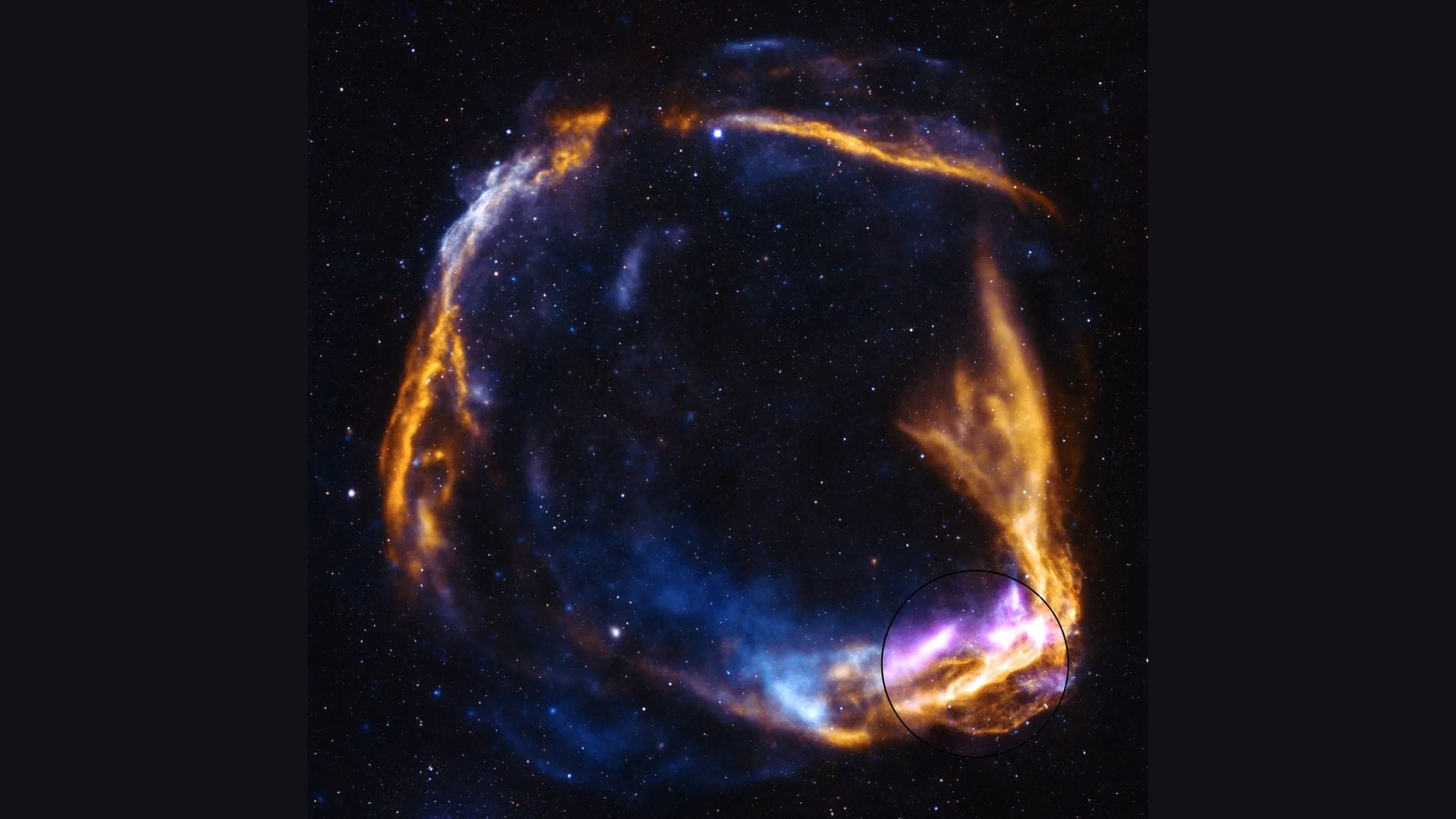
New Delhi: NASA’s Imaging X-ray Polarimetry Explorer (IXPE) mission has captured a new observation of the supernova remnant designated as RCW 86. Previously, astronomers had discovered a large cavity region around the system while observing RCW 86, that led to the supernova remnant expanding far more rapidly than expected. The low-density cavity region could have been the cause of the unique shape of the planetary nebula. IXPE has observed the outer rim of the supernova remnant, where the expansion is suspected to have halted at the edge of the cavity, creating the reflected shock effect highlighted in purple, towards the lower right corner of the image.
The supernova that created the remnant was recorded in 185 AD. Researchers focused on the southwestern rim, a complex region where the shockwave of the explosion is hitting the wall of the cavity, which was carved out by the original star before it died. IXPE can reveal the structure and alignment of the magnetic fields within the remnant. The highly polarised light indicates a coordinated, organised magnetic field, while low polarisation suggests a turbulent, chaotic magnetic field. Despite over 800,000 seconds of observation time, the scientists could find no significant detection of polarisation. Sophisticated modelling has allowed the scientists to establish the upper limits of polarisation at roughly 15 to 40 per cent, depending on the region.
Scientific Implications
These low amounts of polarisation is surprising compared to other supernova remnants such as Tycho or Cas A, which typically show higher levels of magnetic coherence. The lack of a clear signal suggest that the magnetic fields in RCW 86 are extremely disordered, at scales smaller than one parsec. The data suggests that shockwaves are moving slower than previously estimated in some models, or are propagating through uneven ‘clumpy’ regions of stellar ejecta. The findings challenge conventional theories on how high-energy electrons are accelerating in such chaotic, dynamic environments.