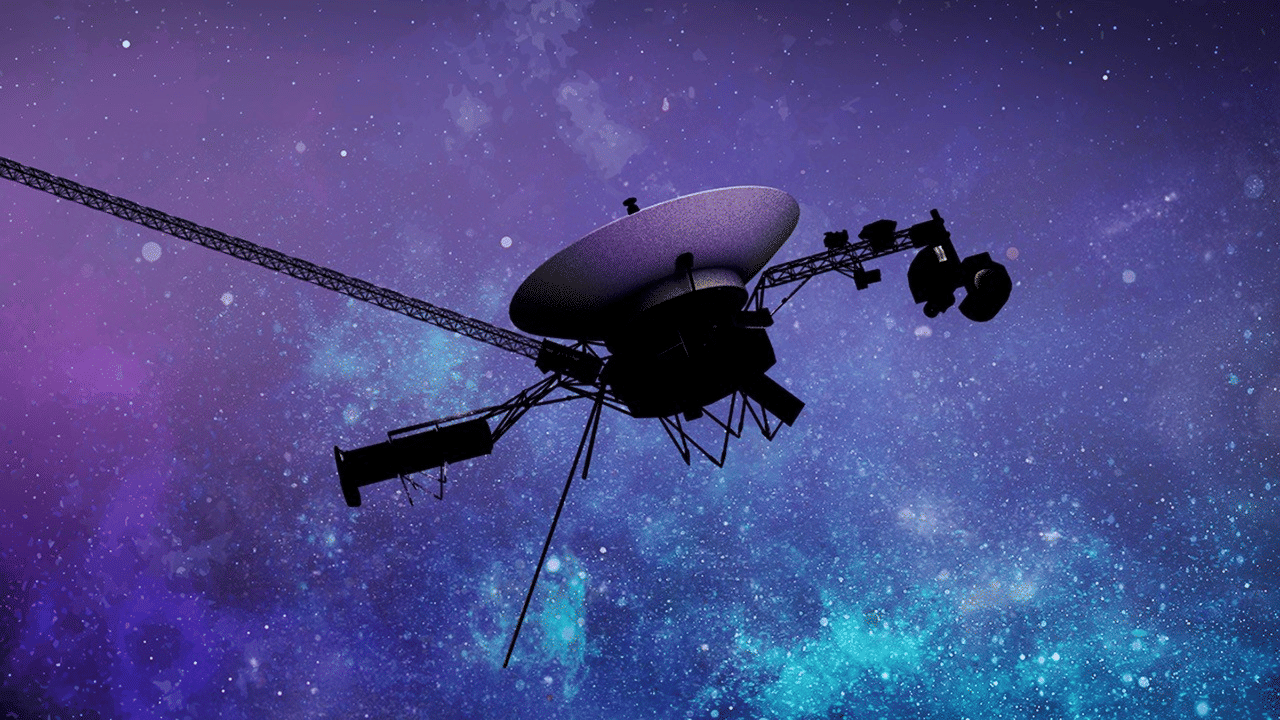
New Delhi: In a decisive move to extend the life of humanity’s most distant spacecraft, NASA has shut down one of Voyager 1’s long-running science instruments. The command on April 17, 2026, to turn off Low-energy Charged Particles (LECP) experiments by engineers at the Jet Propulsion Laboratory (JPL) to conserve power.
The 1977-launched spacecraft is currently operating on very low power. As power levels continue to drop, tough decisions are being made by mission teams to keep Voyager 1 running. The decision means that the probe will be able to keep on relaying back rare data in interstellar space, a place that none of the other human-made objects have travelled to.
Why NASA shut down the LECP instrument?
The LECP instrument was nearly 49 years old and was in operation almost continuously. It was used to measure deep space ions, electrons and cosmic rays. These readings gave scientists an insight into the nature and dynamics of the interstellar medium outside our solar system.
The power supply of Voyager 1 is, however, weakening, provided by a radioisotope thermoelectric generator (RTG). Approximately 4 watts of power are lost in the spacecraft annually. According to NASA/JPL-Caltech, shutting down LECP was the most practical way to prevent unexpected system failures caused by low voltage.
Race against time and power loss
This was done after engineers noticed a sharp decrease in power during a routine manoeuvre in February 2026. An additional fall would have led to automatic shutdown of vital systems and a lengthy and arduous recovery effort.
It is not what one would like to hear, but it must be done to turn off a science instrument on a mission called Voyager, Kareem Badaruddin, the mission manager. He assured us that two very important tools, the plasma wave and the magnetic field sensors, are also still operational and relaying useful information.
This was not a last-minute call. Scientists had years ago devised a sequence of shutting down instruments so as to optimise the life of the mission. Out of the original 10 instruments, only a few remain active on Voyager 1.
Part of the LECP system will remain on even during a shutdown. A tiny motor which spins the sensor will not stop working due to the little amount of power used. This leaves open the case of restarting the instrument in the future.
What’s next: NASA’s ‘Big Bang’ strategy
The new energy-saving upgrade called the ‘Big Bang’ is now planned by NASA. The plan will be to replace several systems simultaneously with less-powerful options. The idea is to ensure that both Voyager spacecraft remain warm and functional as long as possible.
Voyager 2 will be the first to undergo the test, which will start in mid-2026. The same changes will be implemented in Voyager 1 in case they are successful. This is something engineers hope will prolong the mission – and perhaps even restore some of the instruments to functionality.
Voyager 1 is over 15 billion miles (25 billion kilometres) from Earth. It takes almost 23 hours to receive signals. The spacecraft is still transmitting invaluable scientific information in spite of the distance and the ageing hardware.
In the meantime, NASA is saving time through cautious use of power. And so long as Voyager 1 continues to send the signal, the journey to interstellar space is not nearly complete.