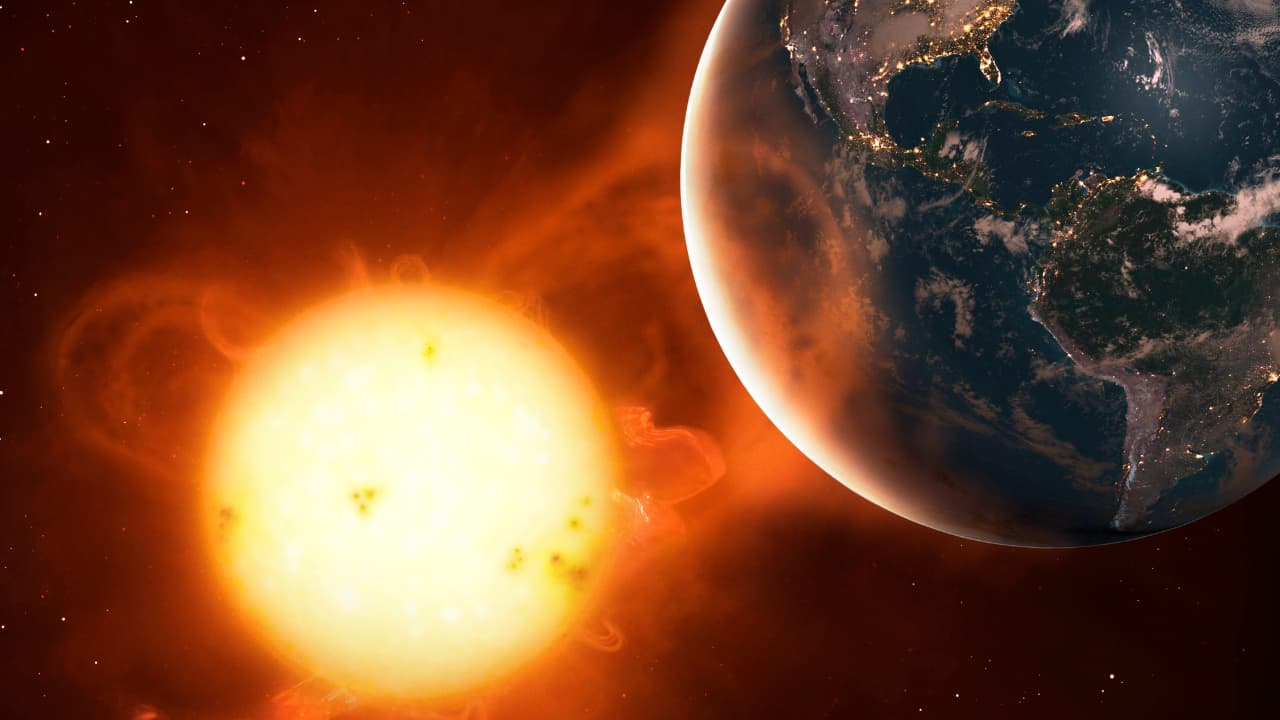
NASA reveals the Sun’s fate in 5 billion years. Learn how its expansion into a Red Giant could destroy Earth and how this cosmic recycling creates new worlds.
NASA has provided a fascinating glimpse into what may occur to our solar system billions of years from now. In approximately five billion years, the Sun will exhaust its fuel and undergo a collapse, leaving behind a cloud of gas and dust. During this process, Earth might either be consumed by the expanding Sun or torn apart by its powerful gravitational pull. However, this cosmic event could ultimately lead to the creation of new planets.
The James Webb Space Telescope (JWST) has captured images that depict this dramatic transformation. One such example is the Helix Nebula, which is located 650 light-years away. This nebula is a shell of gas and dust left behind by a star similar to our Sun that used up its fuel thousands of years ago. The telescope has revealed intricate structures within the three-light-year-wide ring. These structures demonstrate how dying stars can produce the materials necessary for the formation of new worlds.
How Stars Live
A star typically spends the majority of its lifetime in a stable state, where the inward force of gravity is counterbalanced by nuclear fusion in its core. During this process, hydrogen is converted into helium. Stars like our Sun can maintain this stable phase for billions of years. However, once the hydrogen fuel is depleted, the fusion process slows down, and the outer layers of the star begin to collapse inward. The increased pressure from this collapse triggers the fusion of helium into carbon, releasing energy that causes the star to expand significantly.
Becoming a Giant
As a result, the Sun will expand into a Red Giant, becoming hundreds of times larger than it is now. Eventually, its core will contract into a hot, Earth-sized White Dwarf, while the outer layers will drift into space, forming a planetary nebula. The light emitted by the White Dwarf illuminates the surrounding gas, creating beautiful patterns visible in the images captured by JWST.
Earth’s End
Our Sun is expected to follow this transformation in about five billion years, which may result in the destruction of Earth. The planet could either be consumed by intense heat or pulled apart by the Sun’s gravitational forces. Research shows that stars in the Red Giant phase rarely retain large planets in close orbits. This suggests that Earth and other planets may not survive this process.
Cosmic Recycling
Nevertheless, this end is also the start of something new. The gas and dust expelled by dying stars enrich the galaxy with materials that can form new stars and planets. Within these nebulae, cooler regions allow complex molecules to develop. This recycled material has the potential to give rise to new rocky planets that could potentially support life. In this way, even the destruction of Earth might contribute to the creation of future worlds.
Source: Daily Mail (Science & Tech)