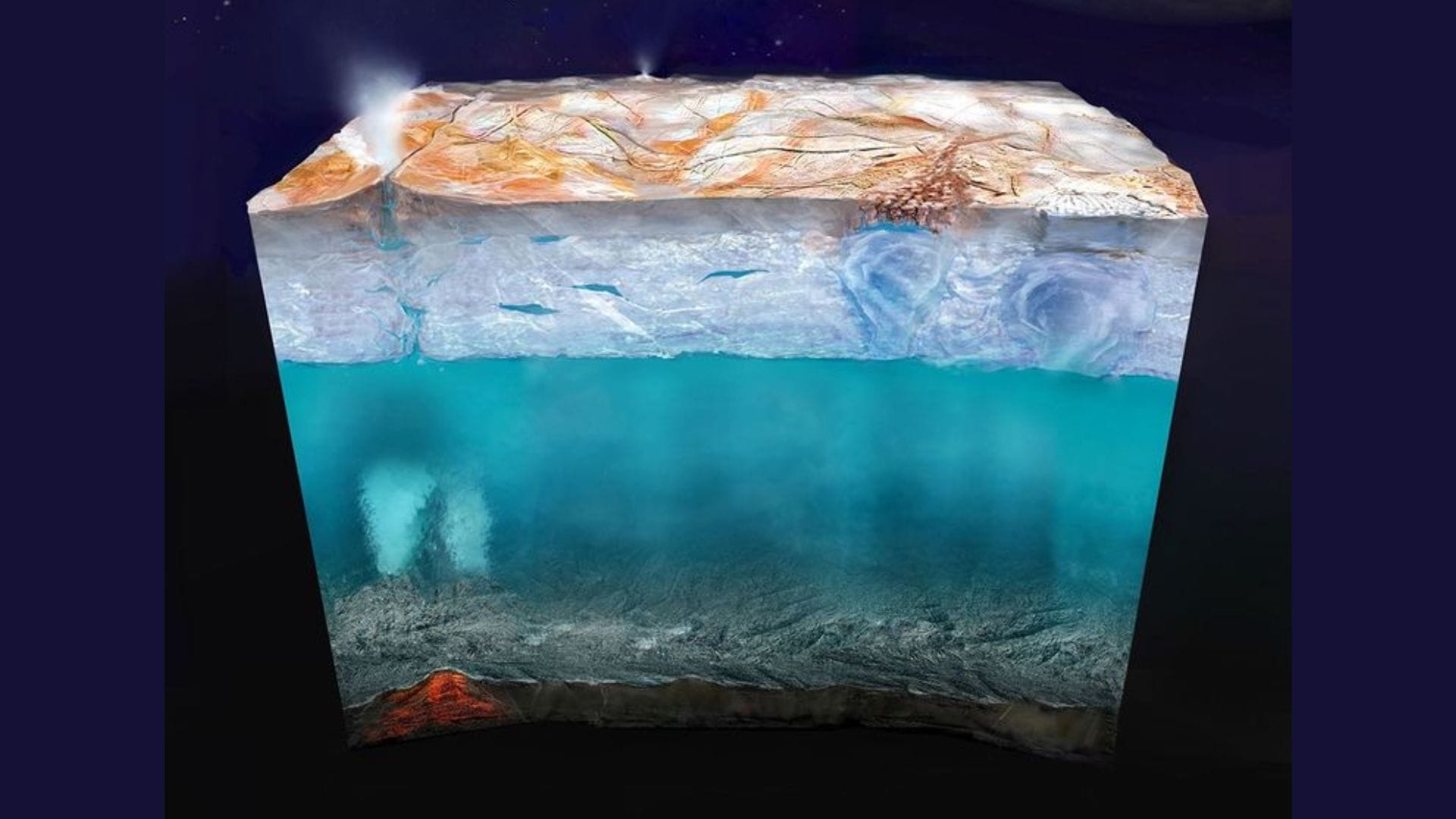
New Delhi: A team of researchers from Georgia Tech, NASA’s Jet Propulsion Laboratory and the University of Tennessee-Knoxville have successfully demonstrated new silicon-germanium electronics designed to operate in the extreme environments of ice moons. These celestial bodies, such as the Jovian moon of Europa and the Saturnian moons of Enceladus and Titan contain global subsurface liquid water oceans beneath ice crusts, and present formidable barriers to explorations with high levels of ionizing radiation and temperatures as low as -180°C. The electronics are capable of operating not just on the surface, but on aquatic robots as well, that can autonomously explore the subsurface oceans.
Conventional space missions protect electronics using heavy, power-consuming warm boxes to maintain Earth-like conditions. These are typically nuclear heat sources that have strict size, weight, power and cost constraints, which are unviable for deep-space missions for exploring distant moons, or conducting underwater operations beneath ice shells. The new silicon-germanium technology eliminates the need for bulky shielding, and leverages the physics of the alloy. Transistors built with this alloy accelerate electrons more efficiently as temperatures drop, resulting in faster operations in the cold. Additionally, the physical structure of these devices minimises the use of radiation-sensitive oxides, significantly improving durability.
Applications on Moon and Mars
Tests have revealed that the integrated circuits function reliably under simultaneous exposure to extreme cold and high-intensity radiation. The primary achievement of the project is developing a powerful, efficient and small radio communication link, that can transmit data flawlessly from the subsurface oceans on ice moons. Further development is required for full commercial availability, but the systems are ready for potential infusion into future NASA missions. The technology also has immediate applications for lunar and Martian missions, where they can power autonomous sensors and communication links on rovers, that can operate from permanently shadowed craters where the sunlight never reaches.