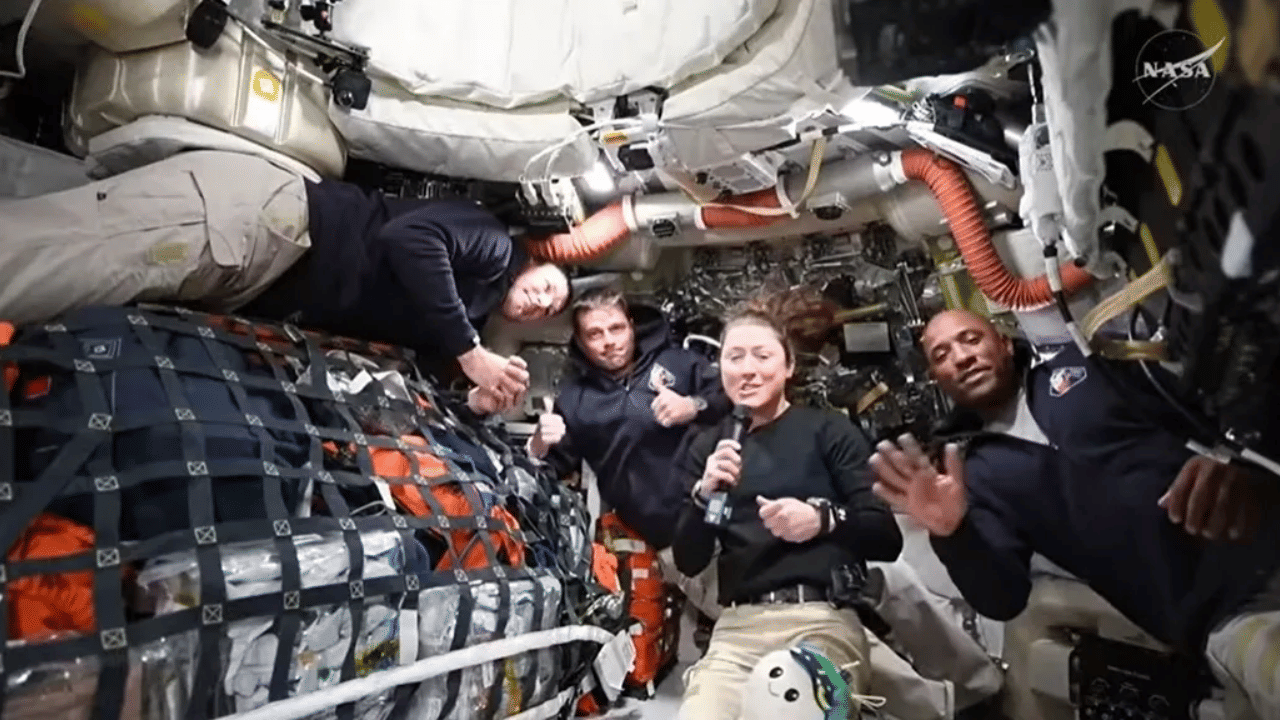
New Delhi: NASA’s Artemis II mission has officially begun its journey beyond Earth orbit, marking a major step in humanity’s return to deep space exploration. During Flight Day 2, the crew of Orion successfully carried out an important engine burn, which put them on their path to the Moon, thus making sure that the spacecraft and its systems work as intended.
After a mission control go call, Orion then fired its main engine for almost six minutes on Thursday evening and completed the translunar injection (TLI) manoeuvre. This scald caused the spacecraft to leave the orbit of the earth and go straight to the exact path leading to the moon. NASA says that the engine provided approximately 6,000 pounds of thrust with a usage of approximately 1,000 pounds of propellant in the process.
Translunar injection burn sends Orion moonward
One of the most dangerous stages of the mission is the TLI burn. It dictates if the spacecraft will make it to lunar space successfully. Orion, which was approximately 58,000 pounds then, performed the manoeuvre with a lot of precision.
According to NASA engineers, all propulsion systems were operating nominally during the burn. The successful landing now firmly positions the Artemis II crew on their journey to a historic lunar flyby, the first in more than 50 years with astronauts.
Crew health and exercise in deep space
While astronauts Reid Wiseman, Victor Glover, Christina Koch and Jeremy Hansen are travelling in space, they are also paying attention to their physical health. The crew has been training on a small flywheel-based exercise device that is made specifically to be used in deep-space missions.
Orion uses this lightweight equipment as opposed to the International Space Station, which has large exercise systems on board. The device itself is only 30 pounds, and it aids in cardio and strength training to keep astronauts fit to both carry out the mission and get ready to come back home. Ground teams are paying close attention to the way these activities are influencing spacecraft dynamics and onboard systems.
Scientific payloads and system checks
The crew have been able to activate and test the AVATAR scientific payload, making it prepared to make future observations. Meanwhile, engineers fixed a temporary communication problem that had arisen soon after its arrival in orbit.
NASA reported that it was due to a ground configuration issue with the Tracking and Data Relay Satellite System. The problem was soon resolved and did not affect the mission safety or operations.
Lunar flyby science plan takes shape
As Orion is on its way now, Nasa lunar scientists are developing a comprehensive targeting plan regarding the future flyby of the spaceship to the Moon. The flyby will be scheduled on April 6, and the astronauts will have approximately six hours to view and record the lunar surface.
The crew will examine craters, lava plains and surface fractures in order to learn more about the geological background of the Moon and how the solar system was formed. Such observations will also aid in improving future landing missions as part of the Artemis programme.
A solar eclipse will be one of the most expected events of the flyby, and it will last almost an hour. The Moon will eclipse the Sun as seen by Orion, and this will provide a rare scientific occasion.
The astronauts will be able to see the corona of the Sun, find out about meteoroid hits on the Moon, and analyse the movement of dust over the surface of the Moon. This temporary darkness will also give the opportunity of deep-space observation, such as of other distant planets.