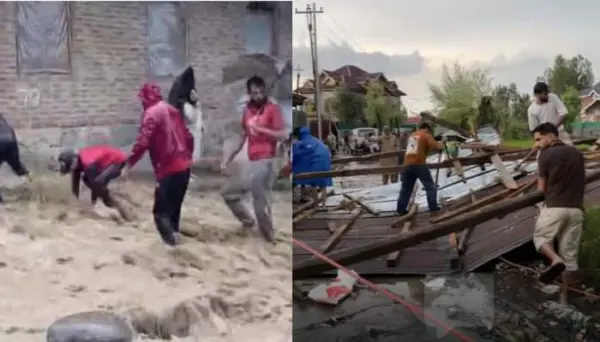
At least eight major cloudburst and cloudburst-like incidents have struck the Union territories of Jammu and Kashmir and Ladakh in the past 24 hours as an active monsoon system unleashed intense, localized downpours across the region.
The extreme weather has triggered flash floods, landslides and mudslides, leaving two people dead while the State Disaster Response Force rescued more than 80 stranded residents.
Sudden torrents of water raced through several districts. Flash floods were reported from Keller and Badrahama in Shopian, Haripora in Kangan, Bandipora, Pahalgam, Kupwara and the Sarbal area of Drass in Kargil.
Floodwaters entered homes, damaged roads, washed away agricultural land and destroyed paddy fields and orchards. Shooting stones caused by the heavy rain forced the closure of the Jammu-Srinagar National Highway from both sides.
This monsoon season has already seen a sharp rise in such events. Around 35 or more cloudburst or cloudburst-like incidents have been recorded in Jammu and Kashmir and Kargil since early July to 3 August 2026.
The IMD Srinagar centre alone noted more than 28 in July across Jammu and Kashmir, with the remainder occurring in Kargil and adjoining areas.
Monitoring remains difficult because these downpours strike over very small areas, making accurate forecasting a persistent challenge. Most trigger flash floods and landslides that have claimed dozens of lives in recent years.
Meteorologists link the surge to climate change. Warmer air holds roughly 7 percent more moisture for every 1C rise in temperature, fuelling heavier short-duration rainfall. Faster warming in the western Himalayas, stronger moisture inflow from a warmer Arabian Sea, shifts in western disturbances overlapping with monsoon winds, and orographic lifting over steep terrain all play a part. Prolonged dry spells in the region since 2024 followed by intense cloudbursts have degraded wetlands, while deforestation and encroachment on flood catchment areas have made the impact worse.
Ajaz Rasool, an environmental expert, described the change clearly. Cloudburst is a phenomenon that used to be very rare. We would hear about cloudburst taking place very rarely, but now the density of cloudburst and the periodic interval have increased manyfold in Jammu region, also Poonch, Rajouri, Doda, Kishtwar and here in Pahalgam and Anantnag. Every second or third day you find there is a cloudburst. So, the intensity is increased and the frequency is increased, and this is causing a lot of trouble and impacting the houses of the people who live there. The government is maintaining a directory of these floods due to cloudburst and studies are going on. They are thinking of adopting measures which we can implement to save the bad effects of a cloudburst. If we cannot stop the cloudburst, its a natural thing. If they can channelize that water to some storage basin, we can use that water later and destruction can be stopped. They have to make some contingency plan, and they are already on it. Cloudbursts started because of climate change. For 45 years we are experiencing global warming and climate change in Jammu and Kashmir also. We have high temperatures, we have less snowfall, we have many rainy days together, and we have drought as well. Even houseboats come on the bank sometimes. This is definitely because of the climatic change.
Parveen Kumar, senior scientist at MeT Srinagar, noted that the department had already warned of erratic weather. We had already forecasted that in Jammu and Kashmir from the first August till the fourth of August, the weather would be erratic. There will be torrential rainfall at multiple places in the Pir Panjal area and the hill areas. There would be intense showers due to which mudslides and landslides have happened. This will continue till August 5. There will be widespread rainfall today and tomorrow across Jammu and Kashmir. At isolated places there would be heavy rainfall as predicted. After August 6, the weather will improve and there will be less rainfall. After the eighth of August therell be rainfall again and some of the places might see heavy rainfall again. The farmer should first check the local weather and then continue their activities. Otherwise, they should suspend their activities. In the hilly areas when there are intense showers, they come via one channel due to which the chances for floods also increase.
Experts say cloudburst activity in Kashmir has clearly risen, both this year with an exceptionally high count in July and over the past few years, driven primarily by climate change interacting with the regions mountainous geography.
They expect the trend to continue without strong adaptation and emission-reduction measures. These sudden events damage or destroy homes, roads, bridges, agricultural land, orchards and infrastructure. Officials and scientists, including the Met Department, explicitly link the pattern to climate change and warn that frequency is likely to keep rising.
Local leaders have called for better climate-resilient planning, stricter land-use rules, restored natural buffers such as forests and wetlands, and stronger early-warning systems that reach villages.
For people living or travelling in vulnerable hill and streamside areas, for farmers and those dependent on tourism, and for long-term development planning in the region, the rising risk is real. It demands serious attention, better preparedness, smarter land use and adaptation measures, rather than treating each cloudburst as an isolated act of nature.