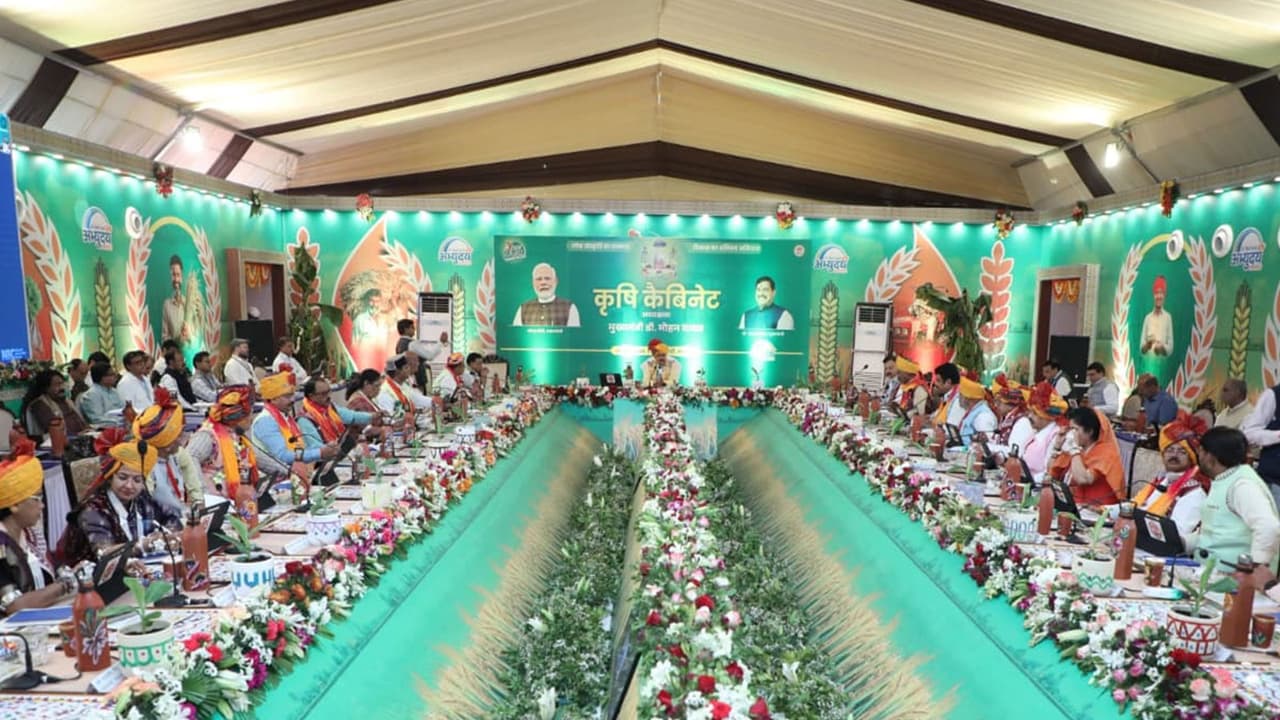
Madhya Pradesh’s first Agriculture Cabinet, chaired by CM Mohan Yadav, approved schemes worth Rs 27,500 crore for agriculture, irrigation, animal husbandry, and fisheries. The funds will be spent over the next five years for farmer welfare.
Madhya Pradesh Chief Minister Mohan Yadav chaired the first Agriculture Cabinet meeting held in Nagalwadi, Barwani district on Monday and the Council of Ministers approved various schemes worth around Rs 27,500 crore related to agriculture, irrigation, animal husbandry, fisheries, horticulture and cooperation.
According to an official release, the agriculture cabinet, organised as part of the declared Farmer Welfare Year 2026, gave a nod to projects worth Rs 25,678 crore aimed at farmers and those engaged in allied productive activities. Additionally, Rs 2,068 crore was granted for the construction of two irrigation projects in Barwani district at the Narmada Control Board meeting held at the Agriculture Cabinet on the occasion, according to an official release. The funds approved for these schemes will be spent over the next five years.
Integrated Fisheries Policy
The cabinet ministers, including the Chief Minister, attended the meeting in traditional tribal attire, conveying a message of respect and welfare for tribal communities. The council of ministers also approved the Madhya Pradesh Integrated Fisheries Policy 2026, which aims to attract an investment of Rs 3,000 crore over the next three years and generate around 20,000 employment opportunities (10,000 direct and 10,000 indirect jobs). A provision of Rs 18.50 crore has been approved under the policy.
Animal Healthcare and Livestock Sector
The Cabinet sanctioned Rs 610.51 crore for animal healthcare in rural areas over the next five years from 2026 to 2031, including infrastructure development of veterinary hospitals and other buildings.
An additional Rs 200 crore was approved for the continuation of the Chief Minister Fishermen Prosperity Scheme for 2026-27 and 2027-28, covering fish seed development, training, interest subsidy and employment generation, the release read.
Horticulture and Food Processing
The Council of Ministers also approved Rs 1,150 crore to continue the National Horticulture Mission for five years, focusing on improving efficiency and impact across agricultural components.
Along with this, Rs 1,375 crores were approved for extending the Micro Food Enterprise Upgradation Scheme for five years to support the modernisation of existing micro food processing units and the establishment of new units with Centre-State participation.
In the horticulture sector, Rs 1,739 crore was approved for nursery development, ensuring the availability of high-quality plants and seeds at subsidised rates for the next five years.
Farmer Welfare and Development Projects
Additionally, Rs 3,502 crores was sanctioned for 20 farmer welfare and agricultural development projects with individual financial outlays below Rs 500 crore for continuation till March 31, 2031.
Cooperative Sector and Credit Support
The Cabinet further granted Rs 1,975 crore for the Cooperative Banks Share Capital Assistance Scheme to ensure crop loan availability through district cooperative banks.
A sum of Rs 3,909 crore was approved for the continuation of the short-term crop loan interest subsidy scheme, enabling farmers to avail loans up to Rs 3 lakh at zero per cent interest through primary agricultural credit societies, the release read.
To strengthen cooperative institutions, Rs 1,073 crore was approved for 12 ongoing schemes, and Rs 1,229 crore was sanctioned for various cooperative department programmes for the next five years.
Breed Improvement and Animal Husbandry
In the livestock sector, Rs 656 crore was approved for the Sorted Sexed Semen Production Project under the National Gokul Mission to promote breed improvement.
Another Rs 1,723 crore was sanctioned for 14 schemes related to animal health protection, breeding and conservation.
Further, Rs 6,518 crore was approved for 11 schemes in animal husbandry and dairy development, covering breeding, poultry, sheep and goat development, disease eradication, vaccination and intensive livestock projects. (ANI)
(Except for the headline, this story has not been edited by Asianet Newsable English staff and is published from a syndicated feed.)