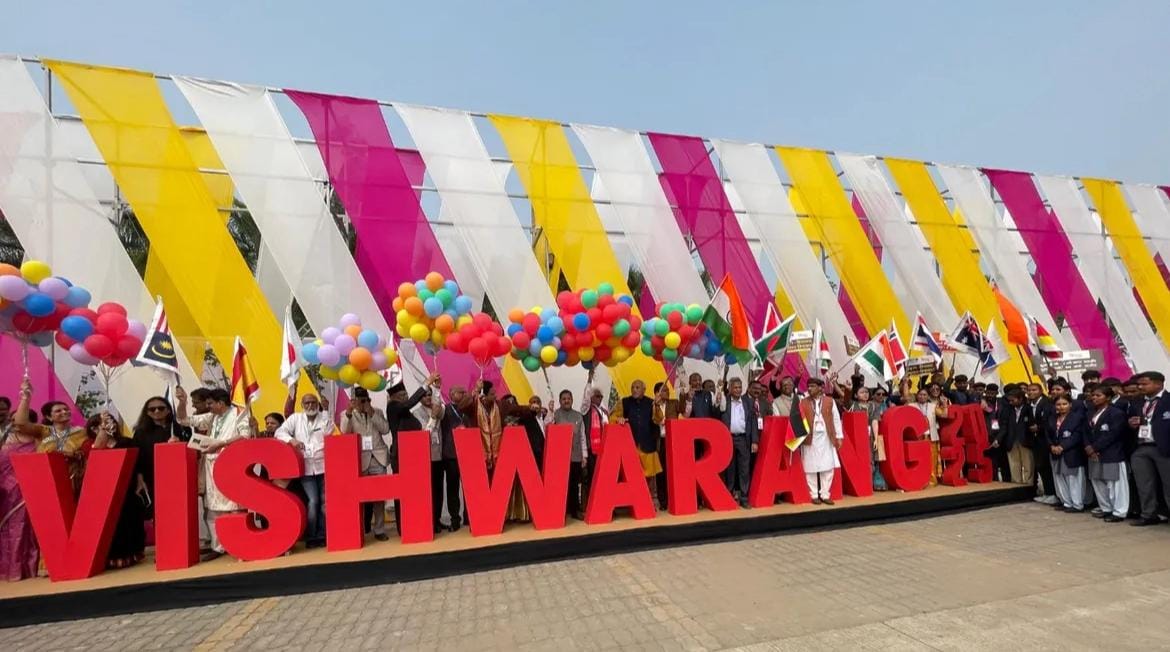
New Delhi: The seventh edition of Vishwarang, Tagore International Literature and Arts Festival organised by Rabindranath Tagore University has a powerful confluence of ideas on literature, technology and India’s cultural diplomacy. The festival was jointly organised by the Vishwarang Foundation and Rabindranath Tagore University drew participation from over 70 countries.
Among the key voices at Vishwarang 2025 was AISECT Founder and Chancellor of Rabindranath Tagore University, Santosh Choubey, who spoke extensively on India’s evolving educational landscape, the future of digital literacy, and the role of culture in strengthening soft power. His insights underscored a vision that blends inclusivity, innovation, and the transformative potential of mother-tongue learning.
Mother-tongue digital learning for an AI-driven future
Choubey, who pioneered India’s first IT curriculum in regional languages through AISECT in the 1980s, stressed that inclusive digital education is foundational to India’s growth. ‘Digital education in one’s mother tongue is not a luxury, it is a necessity,’ he stated. He described the AI Literacy Mission, which aims to equip 10 million youth with AI skills by 2030, as the next big leap in democratising technology. ‘If technology is to empower rather than exclude, it must speak the language of the people,’ he said.
Breaking silos in higher education
Reflecting on India’s higher-education landscape post-NEP 2020, Choubey called for a more flexible and interdisciplinary academic structure. ‘The biggest correction needed is to break rigid silos. Education must allow science to converse with art, philosophy with technology, and skills with academic inquiry,’ he noted. He stressed that employability, creativity and sensitivity not degrees alone should define educational success.
The unfinished journey of rural digital inclusion
Despite decades spent building India’s rural digital infrastructure, Choubey believes significant gaps remain. Connectivity barriers, affordability of devices, and lack of localised content continue to create divides. He remarked that true inclusion will come when every village is not just connected but meaningfully engaged. AISECT, through initiatives like AISECT Learn, continues efforts to bridge these gaps and support digital empowerment in rural India.