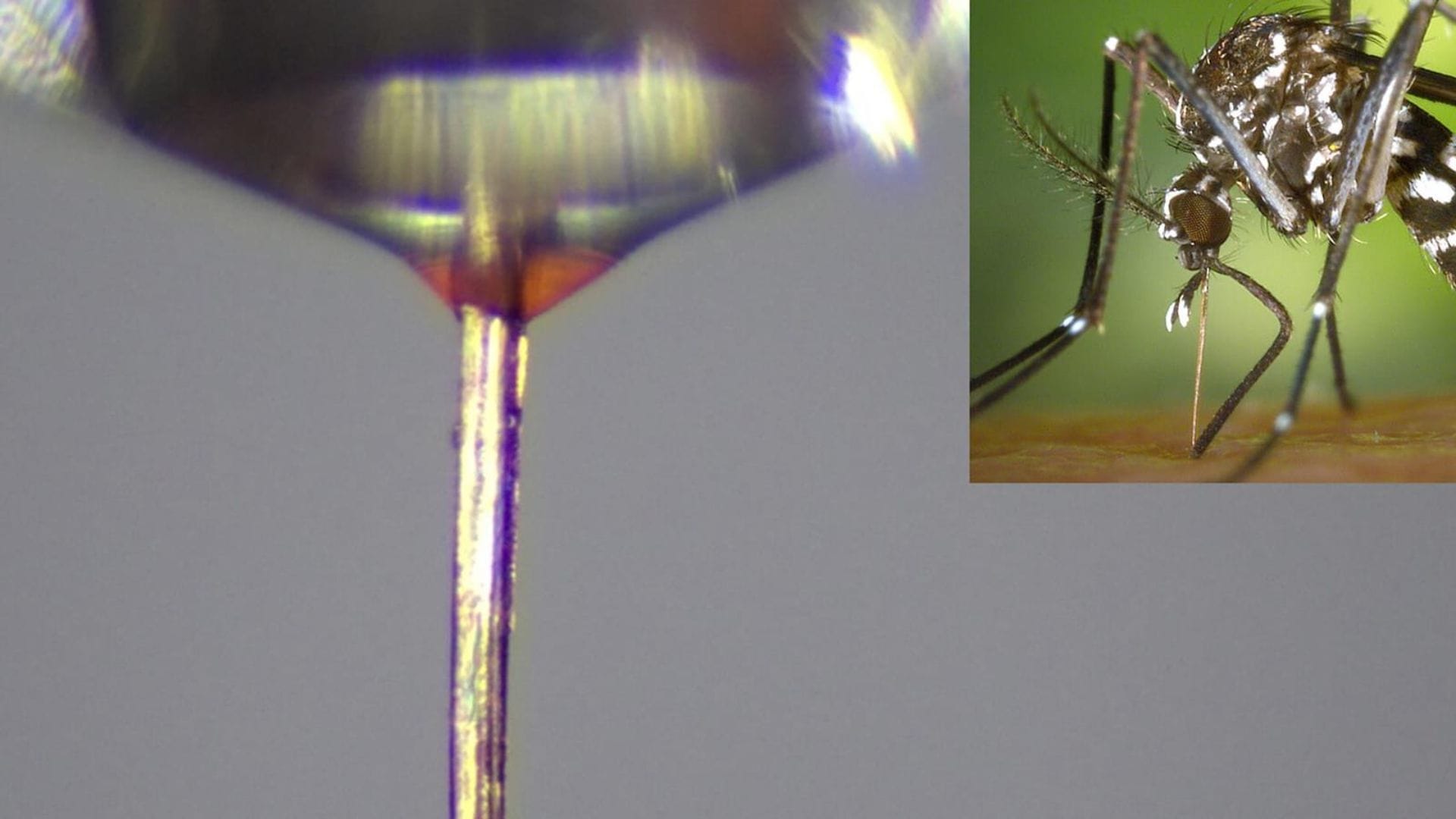
New Delhi: Researchers have discovered that the needle-like proboscis of mosquitoes can be repurposed as a high-resolution tip for 3D bioprinting. The scientists carefully extracted a mosquito proboscis, and attached it to a dispenser using resin. The proboscis produced lines finer than a human hair, and surpassed commercial dispense taps. In tests, the top could print structures with layer thickness of 18 to 22 micrometres. Consistent, 22-micrometre layers were observed in a honeycomb structure with a maple leaf design achieving 18 micrometre layers, with the clearly defined filaments visible in sidewalls under scanning electron microscopy.
The mosquito proboscis was also successfully used to print high-density microscopic patterns containing red blood cells using bioink, demonstrating the suitability for tissue scaffolds in drug responsiveness testing. In another experiment, the proboscis was unsurprisingly successful at piercing pig skin to deposit hydrogel, modelling therapeutic drug delivery in living tissue. The 3D ‘necroprinting’ offers a number of advantages, as the proboscis was engineered, developed and tested by nature over millions of years. The intrinsic elasticity prevents damage to the printing substrates, with the narrow gauge limits acting as a natural safeguard against breakage or leaks. The rigidity and vibration-assisted mechanism for low-force skin penetration provides durability during rapid material extrusion.
Superior to standard glass tips
Fine glass tips are conventionally used for fine 3D printing applications, and are capable of reaching resolutions down to 40 micrometres. These glass tips are incredibly fragile and expensive, with each tip costing about $80. Over four billion such glass tips are used annually in the united states. In comparison, the proboscides from mosquitoes are available for 80 cents each, are durable, and fully biodegradable. Applications include fabrication of tissue models for regenerative medicine, drug screening and cancer research. The researchers intend to examine the suitability of other biological structures such as snake fangs and xylem vessels from plants for similar applications. A paper describing the research has been published in Science Advances.