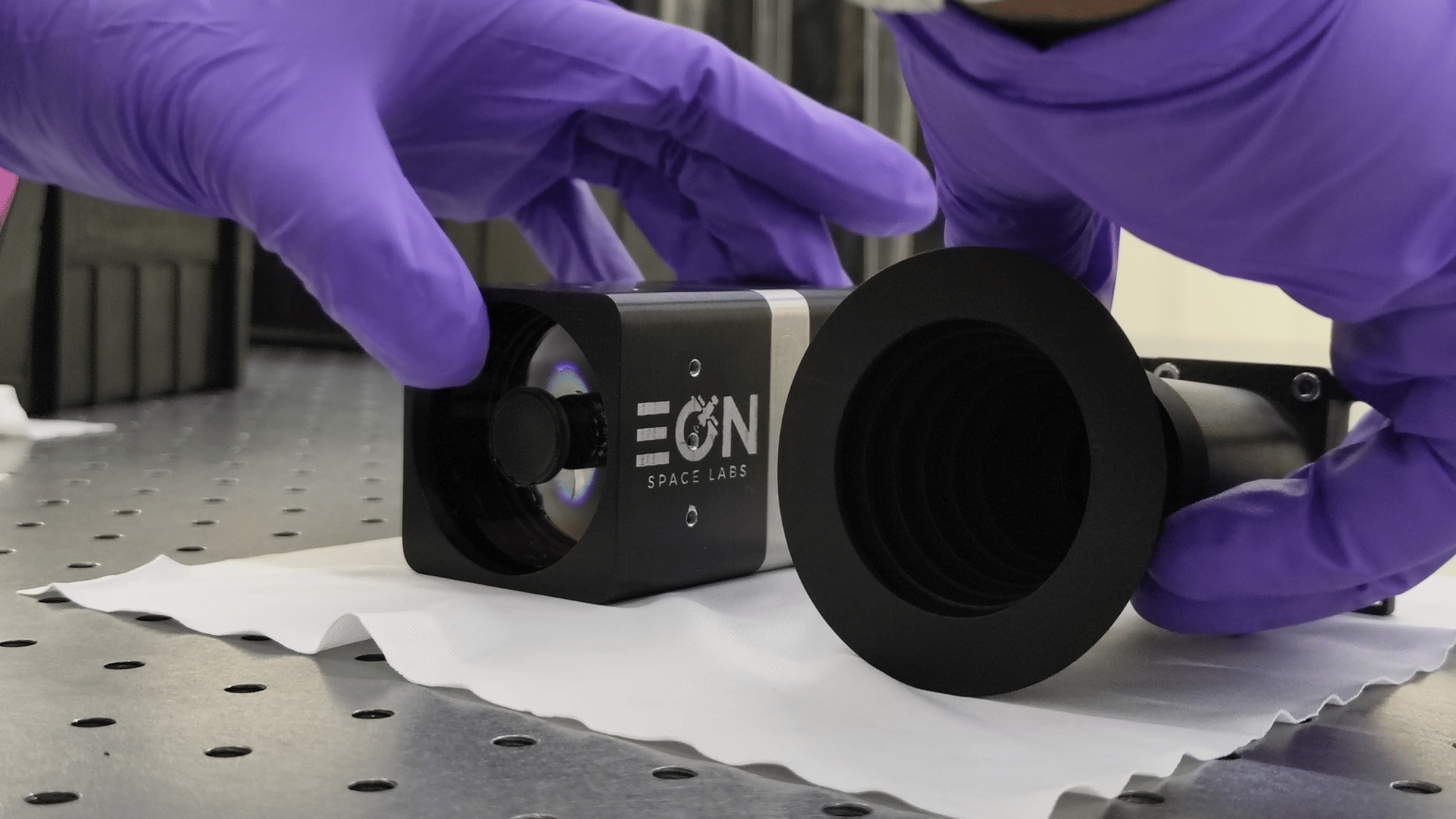
New Delhi: Hyderabad-based New Space Startup EON Space Labs has tested and qualified its compact MIRA space telescope and will be demonstrating the technology in orbit with satellite partner TakeMe2Space. The satellite will fly to Low Earth Orbit as one of the co-passengers on the PSLV-C62 flight, scheduled for 31 December. CEO and Cofounder of EON Space Labs, Sanjay Kumar told us, “MIRA’s December 2025 launch is the pathfinder for a phased low-Earth-orbit constellation, moving from a single in-orbit demonstrator to a network of MIRA-class and follow-on payloads that can revisit key geographies frequently instead of waiting days for an image. The initial satellite count is expected to be part of a six satellite constellation which required MIRA’s space grade validation first.”
The eventual goal is to integrate the instrument into domestic satellites, as well as export it internationally. Kumar explains, “This development is the first step towards cooperation between us and a network of Indian space ecosystem startups who will be partners of EON Space Labs and require high quality EO/IR imaging systems to be integrated with their satellite constellations. The EY report highlights space-based EO satellites and CubeSats as major “systems-level opportunities” for India, especially when integrated with unmanned systems, C4ISR and radar fusion. As this constellation scales, it positions EON not only to serve domestic defence, smart-city, environment and disaster-response demand but also to export compact, high-value EO capabilities globally.”
MIRA has both strategic and civilian applications
The imaging instrument is dual-use. Explaining the strategic applications, Kumar says, “A MIRA-based constellation effectively gives India indigenous high-resolution ‘eyes in the sky’. On the strategic side, it can plug directly into layered surveillance architectures for border and coastal vigilance, critical infrastructure monitoring, grey-zone activity tracking and counter-UAS awareness, complementing radar and other sensors. EO/IR feeds are integral for India’s integrated air-defence, military and counter-UAS grids, as well as in coastal and border command centres.”
The low-cost, compact, low-weight payload also stands to benefit the general population. Kumar says, “On the civilian side, the same technology drives precision agriculture, water-stress mapping, urban planning, crowd management and rapid disaster assessment for floods, landslides, fires and industrial incidents, all use-cases that are high-impact EO opportunities. Because MIRA weighs only approximately 502 grams which is roughly 3–4 times lighter than many traditional space telescopes, it addresses the core SWaP (size, weight, power) limitations. That makes it commercially attractive not only for India but also for exports to countries that are seeking affordable, high-performance EO coverage.”