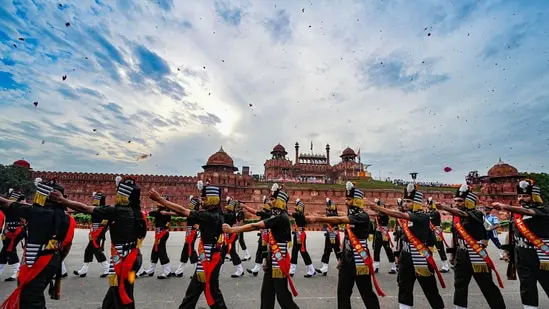
As India marks its Independence Day every year on August 15, the historic Red Fort in New Delhi serves as the centre stage for the official ceremony, which is also shown live across platforms.
This year, India is celebrating its 80th Independence Day, completing 79 years since the country gained freedom from British rule in 1947.
The event is tightly scheduled and choreographed, keeping in mind the magnitude of the situation and the importance of the day.
What exactly happens during the Independence Day ceremony?
The ceremony blends the precision and discipline of the armed forces with national symbolism. Here is a step-by-step guide on what happens every year during India’s Independence Day ceremony:
Phase 1: Morning arrivals and assembly
Long before the official ceremony begins, multi-layered security cordons secure the Red Fort area in the national capital, while on the morning of the ceremony special guests take their seats across designated enclosures.
Phase 2: Arrival of the Prime Minister
Early in the morning, the Prime Minister reaches the Red Fort, where the Union ministers and senior officials are present. According to the Ministry of Home Affairs, the ceremony at Red Fort consists of the presentation of a Guard of Honour by the Armed Forces and the Delhi Police to the Prime Minister.
Phase 3: Flag unfurling, national anthem, and 21-Gun Salute
Now the core moment of the ceremony takes place:
Unfurling the Tricolour: The Prime Minister pulls the ceremonial cord to unfurl the Indian national flag at the top of the ramparts.
Salute and national anthem: As the flag rises, the military band plays ‘Jana Gana Mana’, and the assembled contingents present a salute.
21-Gun salute: Artillery guns fire a 21-gun salute to mark the occasion.
There will be a special place for the National Song, Vande Mataram, too this time in this sequence.
Phase 4: Address to the nation
With the Tricolour fluttering above, the Prime Minister steps up to deliver the Independence Day address. The speech usually outlines the following points:
Tributes: Remembering the sacrifices of freedom fighters and honouring them.
Review of past year: The speech also highlights economic, social, and other achievements of the past year.
Future: The PM also announces policy initiatives, national schemes, and goals for the years ahead.
Phase 5: Nationwide celebrations
The ceremony serves as the apex event of the day, followed by flag-hoisting rituals by Chief Ministers at their respective state capitals, schools, colleges, district headquarters, and civic institutions across the country.
Special place for Vande Mataram this year
As for this year, defence secretary RK Singh said that as part of the Independence Day celebrations, for the first time, the National Song, Vande Mataram, would be sung from the ramparts of the Red Fort.
“The sequence is that he (Prime Minister Modi) arrives on the rampart, then the national song is played, and everybody keeps standing. Thereafter, he unfurls the flag and the national anthem is played,” he said.
An official statement noted that an Mi-17 helicopter of the Indian Air Force (IAF) will carry a banner commemorating 150 years of Vande Mataram, and shower flower petals over the people at Red Fort.
According to details shared by the defence ministry, the Independence Day celebrations this year will commemorate Yuva Shakti (youth power), acknowledging the contribution of young India in building a Viksit Bharat (developed India) by 2047.