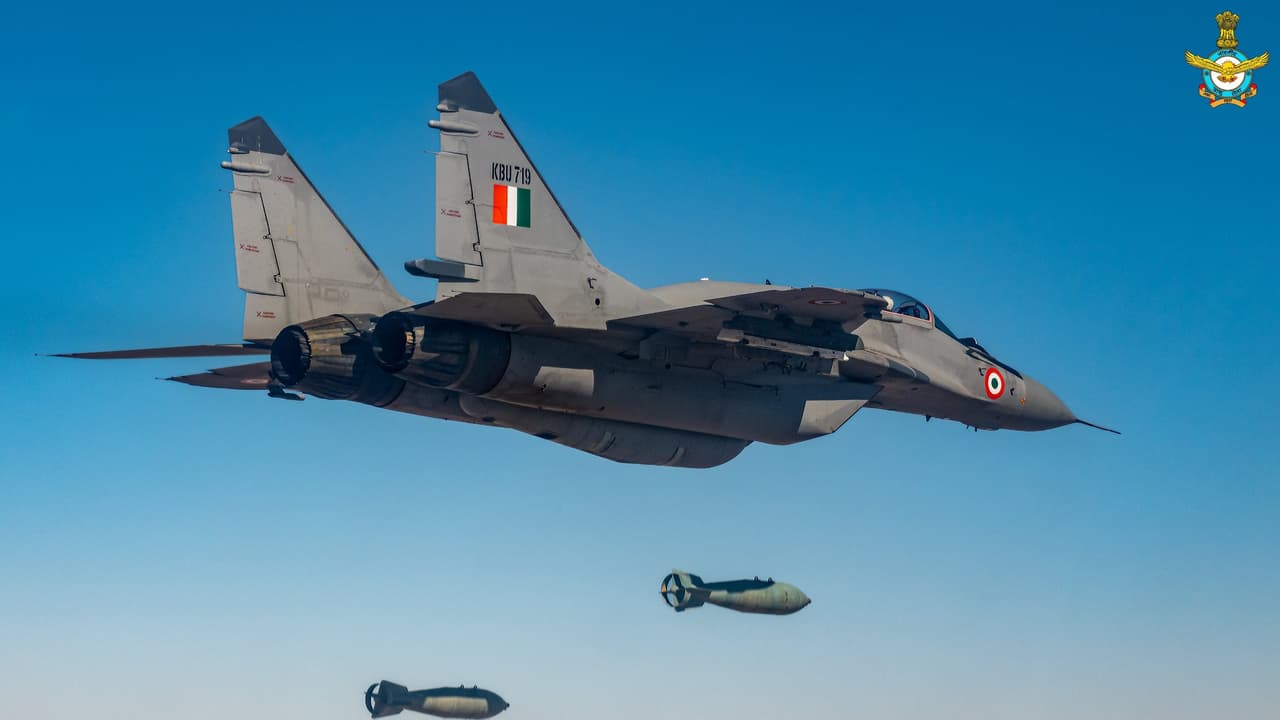
The Indian Air Force is equipping its MiG-29 aircraft with the European ‘Astram’ missile. This missile with a range of more than 25 km will replace the old R-73. The move is a strategic upgrade to counter China-Pakistan’s PL-10 missiles.
New Delhi: The Indian Air Force (IAF) is now preparing to equip its Russian-origin MiG-29 UPG fighter aircraft with the European ‘Astram’ missile. Earlier, the Air Force has successfully installed this missile on its indigenous LCA Tejas and British-origin Jaguar fighters.
Astraam (ASRAAM) i.e. Advanced Short Range Air-to-Air Missile has been made by MBDA, a large European defense company. This missile is adept in one-on-one combat (within-visual-range) and can hit a distance of more than 25 kilometers. In this connection, the Defense Ministry has issued a Request for Proposal (RFP) on March 25. It talks about installing and certifying Astra on MiG-29 UPG. The proposal also includes equipment such as launchers, testing systems and crew training.
At present, the Air Force has more than 55 MiG-29 aircraft, including eight trainer variants. With the installation of Astram, the old R-73 missile of the 1980s will be removed. The R-73 is an infrared-guided weapon with a range of 10 to 15 kilometers. It will now be replaced by a much more modern fourth generation missile. The Air Force has already selected Astram as its next-generation close-combat missile, replacing the R-73 on several of its platforms.
In August 2021, MBDA and Bharat Dynamics Limited (BDL) signed a licensing agreement. Under this, a Final Assembly, Integration and Test (FAIT) facility will be built in BDL’s Hyderabad complex. The facility will also look after the maintenance and repair of missiles.
Features of Astram
The Astram is a highly agile, heat-seeking air-to-air missile designed for close-combat and dogfights. It is known for its ‘fire and forget’ capability. This missile can fly at a speed faster than Mach 3 and can hit targets more than 25 kilometers away. It can take sharp turns of up to 50g, which is possible due to its advanced body-lift technology and tail control fins.
The Astram was commissioned into the Royal Air Force (RAF) in 1998. Its ‘fire and forget’ capability means that the pilot does not need to guide it after launch. It automatically reaches the target. It is also optimized for high-g engagement against high-speed fighter jets.
The length of the missile is 2.9 meters, diameter is 166 mm and weight is about 88 kg. It is equipped with a high-explosive blast fragmentation warhead, equipped with both impact and laser proximity fuzes.
Competing with China’s PL-10 and Pakistan’s PL-10E
India’s neighbors China and Pakistan have also deployed or are deploying similar within-visual-range missiles. China has PL-10 and Pakistan has its export variant PL-10E. Therefore Astram’s entry into IAF is a big strategic step.
China’s PL-10 missile entered service in 2015. Its development began in 2004, the design was approved in 2010, and production began in 2013. It was designed for China’s next generation fighter jets such as the J-10C, J-16 and the fifth generation J-20. The reported range of the PL-10 is about 20 kilometers, although some estimates suggest it could reach 30 kilometers under certain conditions.
Its top speed is Mach 4, which is more than Astram. However, the Astram’s rocket motor is larger (166 mm vs. about 160 mm of the PL-10), giving it a higher sustained speed and better ability to strike at longer ranges. Pakistan became the first foreign customer of PL-10E. It began installing it on its JF-17 Block III fighters from 2021, which is part of its defense partnership with China.