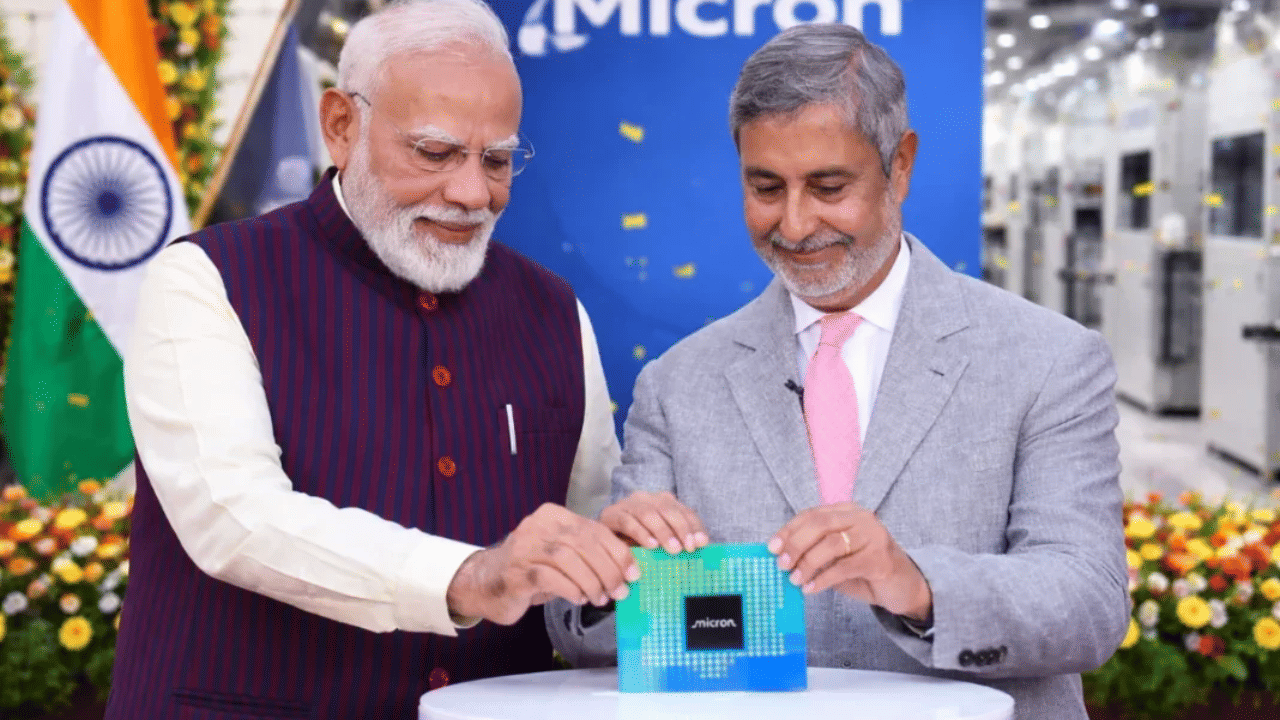
New Delhi: Micron Technology on Monday inaugurated India’s first commercial semiconductor assembly and test facility in Sanand, Gujarat. The plant marks a major milestone for the country’s semiconductor ambitions and signals the start of large-scale chip operations on Indian soil.
Backed by a combined investment of $2.75 billion from Micron and its government partners, the Sanand site has already begun commercial production. The facility converts advanced DRAM and NAND wafers from Micron’s global manufacturing network into finished memory and storage products for global and domestic markets.
A major boost to India’s chip ecosystem
The Sanand plant is ISO 9001:2015 certified and, once fully ramped up, will house over 500,000 square feet of cleanroom space. This will make it one of the world’s largest single-floor semiconductor assembly and test cleanrooms.
Micron expects to assemble and test tens of millions of chips at the facility in 2026. Output is projected to scale to hundreds of millions of units in 2027.
At the inauguration, Micron presented its first shipment of memory modules manufactured in India to Dell Technologies. These modules will power laptops produced in India for the domestic market, marking a significant step in strengthening local electronics manufacturing.
Micron Chairman, President and CEO Sanjay Mehrotra said the facility enhances the company’s global assembly and test network. He added that it will help meet rising demand for memory and storage, especially driven by artificial intelligence workloads.
Prime Minister Narendra Modi, Gujarat Chief Minister Bhupendra Patel and Union Minister of Electronics and Information Technology Ashwini Vaishnaw attended the inauguration ceremony.
Focus on sustainability and workforce development
The Sanand facility has been designed to meet or exceed LEED Gold standards. It uses water-conserving technologies that seek to attain zero discharge of liquid. The company claimed that sustainability is a part of the company in India.
Micron is also working with the universities and training institutions to develop semiconductor talent in the country. The corporation will be investing in workforce preparedness and the expansion of its semiconductor manufacturing plant in India.
Micron claimed that its India expansion supports its high manufacturing and packaging investments in the United States. Having the Sanand plant in operation, India is now a part of the world-wide assembly and test network of the company.
India’s semiconductor roadmap for 2035
The Union Budget 2026–27 has allocated Rs 1,000 crore for the next phase of the India Semiconductor Mission (ISM 2.0). It will concentrate on semiconductor equipment, materials and complete stacks of Indian intellectual property. Another objective of the government is to enhance the domestic and global supply chains.
By December 2025, 10 semiconductor projects valued at Rs 1.60 lakh crore have received approval in six states in previous phases of the programme.
India hopes to have the capacity to design and produce chips that can satisfy 70 to 75 per cent of the domestic market of India by 2029. In Semicon 2.0, the roadmap involves development to 3-nanometre and 2-nanometre technology.
India has a vision of becoming one of the top semiconductor manufacturing countries of the world in 2035.