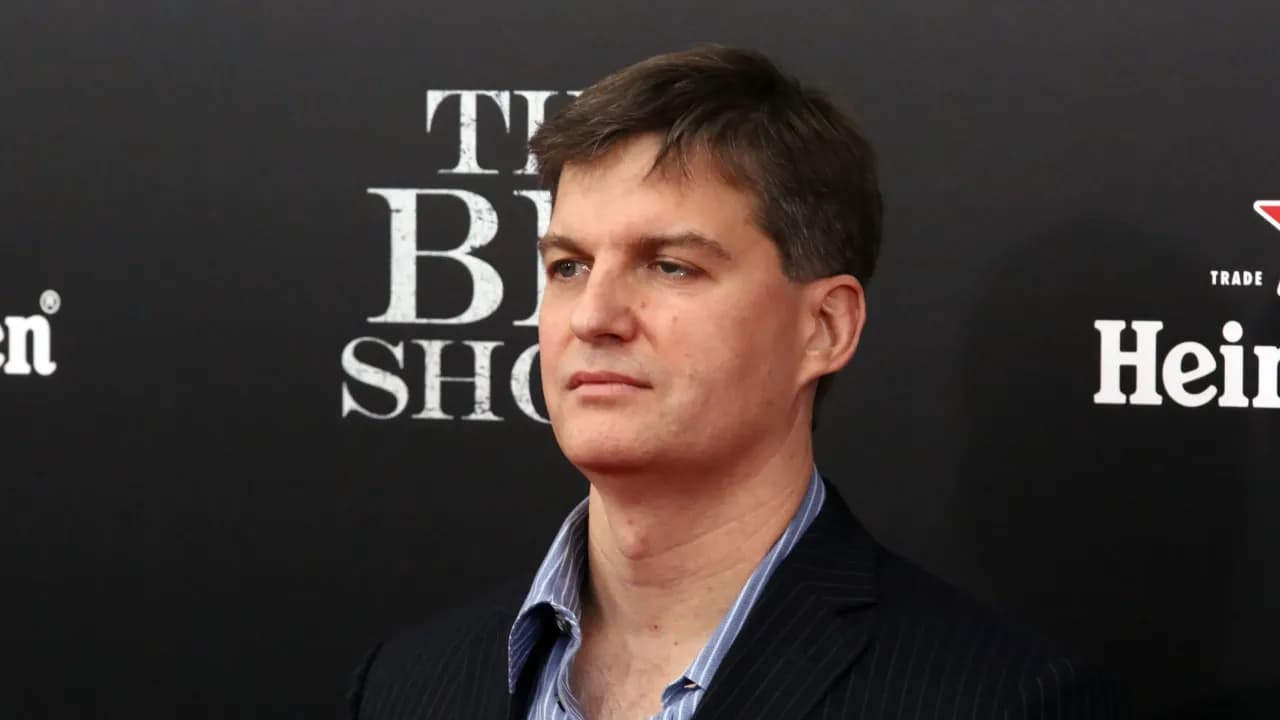
Burry says the Fed has “fewer arrows” and warns Wall Street’s machinery could bring markets down quickly.
- However, Burry warns trillion-dollar backstops would carry “epic moral hazard.”
- Aswath Damodaran holds five Magnificent Seven stocks, excluding Tesla and Nvidia, while directing most fresh money into cash.
- Damodaran warns AI-driven earnings come “with an asterisk,” as infrastructure spending strains cash flows and failed investments could trigger “accounting and market carnage.”
“The Big Short” investor Michael Burry expects the Trump administration to “pull out all the stops” to protect the AI boom, while valuation expert Aswath Damodaran is holding five “Magnificent Seven” stocks but parking most fresh investment money in cash.
The SPDR S&P 500 ETF Trust (SPY) fell 0.4% and Invesco QQQ Trust (QQQ) slid 1.3% on Thursday, while the SPDR Dow Jones Industrial Average ETF Trust (DIA) edged up 0.1%, mirroring the broader indexes’ mixed finish.
Semiconductor losses were steeper, with the iShares Semiconductor ETF (SOXX) dropping 3% as the Direxion Daily Semiconductor Bear 3X ETF (SOXS) surged 10%.
Burry Flags Cost Of Defending AI Boom
Burry said on Substack that the administration views AI investment and stocks as “the best things they have going,” giving it powerful incentives to defend both. “But we are talking [about] backstopping trillions with epic moral hazard implications. It will happen but there will be limits as to what they can do in the end,” he said.
He also called the fiscal situation “terrible,” noting that stocks fell during 2000-2003 despite the Fed cutting rates from 6% to 1%. “The quiver has fewer arrows this time.”
Burry remains uncertain about the market’s position in the cycle, but warned that financial-market mechanics could accelerate a downturn. “There are things that can happen in the machinery on Wall Street that will bring it all down fairly fast. Everyone on Wall Street wants that not to happen, but it’s moving that way anyway.”
Damodaran Keeps AI Exposure, Parks Fresh Money
Meanwhile, Damodaran, widely known as the “dean of valuation,” is maintaining exposure to the boom while limiting new commitments. “I am personally going with the ‘market consensus’ choice for the bulk of my portfolio, since I do hold five of the Mag Seven (all except Tesla and Nvidia),” he said.
His holdings include major AI investors Amazon, Alphabet, Meta and Microsoft. However, most new money added over the past year or two has gone into cash, including short-term Treasuries yielding 4%, leaving his portfolios more cash-heavy than usual.
“I have left money on the table undoubtedly by doing so, but it has helped me sleep better at night,” he said, urging investors to find a path through the “AI jungle” that passes their own sleep test.
Damodaran Warns Of ‘Carnage’ If AI Disappoints
Damodaran said the investment surge has made “not just the market but also the economy a giant bet on AI.”Infrastructure spending boosts suppliers’ revenues but drains builders’ cash, Damodaran explained, so strong aggregate earnings don’t necessarily translate into equally strong cash generation.
“A cap-ex driven surge in aggregate earnings comes with an asterisk,” he said. His analysis found that S&P 500 companies returned 63% of earnings through dividends and buybacks over the trailing period examined, the lowest proportion since 2004. In the worst-case AI scenarios, he warned of “both accounting and market carnage,” including write-offs and distress for debt-dependent companies.
Stock prices would likely respond before accountants formally recognized failed investments, he added. “Put simply, in the event that AI does not deliver on its promise, waiting to act until accountants write off AI cap ex to sell your AI company implies that you waited too long.”
Midterms Test Political Support For AI
Meanwhile, Morningstar highlighted voter scrutiny of data centers as their expansion strains power grids and contributes to higher electricity bills. “If there’s federal legislation floated for some sort of curtailment about AI or data centers … that could have a pretty noticeable impact on markets,” Natixis chief U.S. economist Christopher Hodge said.
State Street investment strategist Michael Arone nevertheless expects AI spending to continue, although a Democratic sweep could bring tighter oversight. “Both Republicans and Democrats recognize the importance [of being a leader in AI] for both economic and national security,” he told Morningstar.
Affordability also links the election debate to market financing. Baird Strategas’ Dan Clifton said higher oil prices are driving higher yields and inflation expectations, hurting Trump’s approval rating and increasing the odds of a Democratic sweep.
Wall Street Splits On The AI Boom’s Staying Power
Rising borrowing costs and depleted hyperscaler free cash flows could undermine the AI boom, according to Panmure Liberum strategist Joachim Klement. “My core conviction is that the AI bubble will either burst in 2027 or in 2028, so sometime in the next two years,” he said.
His year-end 2027 S&P 500 target of 5,000 implies a 36% downside, marking a sharp reversal from his mid-September forecast of 8,300. Klement argues that investors’ focus on tech earnings is obscuring mounting risks. “And they excuse every macro, credit, or whatever headwind that you can come up with with that story,” he said.
Still bullish through the end of 2026, Klement advocates preparing rather than selling immediately, recommending a defensive shift if the index falls below its 200-day moving average.
However, Goldman Sachs offered a more positive near-term outlook. Christian Mueller-Glissmann, its head of asset allocation, said that strong earnings can help stocks withstand higher bond yields. “The tech sector and artificial intelligence theme are still delivering some very strong earnings momentum, and we expect that to continue,” he said.
For updates and corrections, email newsroom[at]stocktwits[dot]com.<