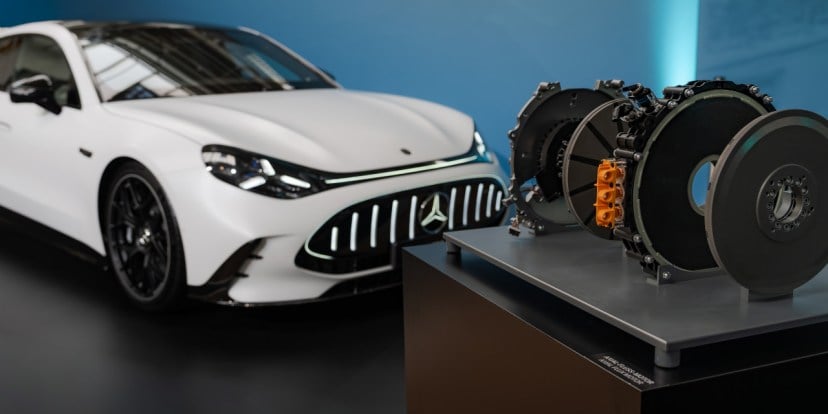
Mercedes-Benz believes it has found part of the answer in a technology that has long attracted attention among engineers but has rarely been produced on a large scale. This week, the German manufacturer announced the start of series production for its new axial flux electric motor at its Berlin-Marienfelde plant, marking the first time the company has brought the technology into full industrial production.
The motor will make its production debut in the new Mercedes-AMG GT 4-Door Coupe, a vehicle intended to demonstrate what the company sees as the next stage of electric performance motoring. While the launch concerns a single component, its importance reaches much further. It represents years of engineering work, a major investment in manufacturing methods and an attempt to solve one of the most difficult questions facing premium carmakers as the shift towards electric vehicles continues.
The announcement also marks a new chapter for Berlin-Marienfelde, Mercedes-Benz’s oldest manufacturing site. Founded in 1902, the facility has spent much of its history producing powertrain components. It is now taking on a new role centred on electric propulsion and advanced manufacturing methods.
Why Mercedes-Benz Is Betting on Axial Flux Technology
Most electric vehicles currently use what engineers call radial flux motors. In those designs, electromagnetic forces move outward from the centre of the motor. Axial flux motors work differently. Their magnetic flow runs parallel to the axis of rotation, creating a disc-shaped structure that looks very different from traditional cylindrical motors.
This design allows engineers to package more power into a smaller space. The result is a motor that can be lighter and more compact while still producing substantial power and torque. Those characteristics have made axial flux technology attractive for years, particularly for performance vehicles where weight and packaging matter.
The problem has never been theoretical. The difficulty has been manufacturing. Producing these motors consistently and at automotive volumes has proven far more difficult than producing conventional electric motors.
Mercedes-Benz’s entry into the field gained momentum after its acquisition of British motor specialist YASA in 2021. YASA had spent years refining axial flux designs and developing prototypes that attracted interest from several automotive manufacturers. Following the acquisition, Mercedes-Benz focused on adapting the technology for large-scale vehicle production.
According to the company, that process required the creation of entirely new manufacturing methods. Production of the motor involves 98 separate manufacturing steps. Sixty-five of those processes are being used for the first time within Mercedes-Benz production facilities, while 35 are described as entirely new to industrial manufacturing.
Those efforts have generated more than 30 patent applications. One example involves the construction of copper coils used within the stator. Engineers selected rectangular copper wire rather than conventional round wire because it allows more copper to fit into the same physical space. More copper means stronger electrical performance, but it also creates manufacturing challenges. The wire must be bent into tight shapes at high speed without damaging insulation or weakening the material. Mercedes-Benz says it developed a specialised production process with external partners to achieve this consistently.
A Manufacturing Test for Germany’s Electric Vehicle Future
The launch arrives at a time when European carmakers face increasing pressure from several directions. Competition in electric vehicles continues to intensify, while manufacturers are under pressure to demonstrate that advanced automotive production can remain economically viable within Europe.
For Mercedes-Benz, the Berlin project carries importance that extends beyond a single vehicle programme. The company is using approximately 30,000 square metres of production space across three halls and seven production lines to manufacture the motors. Automated systems, laser processes, sensor technology and machine-learning based inspection systems all play a role in maintaining production standards.
Since 2022, Berlin-Marienfelde has hosted the Mercedes-Benz Digital Factory Campus, where production technologies are tested and refined before being introduced elsewhere within the company’s manufacturing network.
By bringing axial flux production to Berlin, Mercedes-Benz is effectively combining electric propulsion development with new manufacturing techniques in a single location. Company executives describe the plant as a centre of excellence for high-performance electric motors, suggesting that future developments may also emerge from the site.
The first production application of the technology provides an indication of what Mercedes-Benz hopes to achieve. In the new Mercedes-AMG GT 4-Door Coupe, the front motor measures less than nine centimetres in width, while the rear motors are approximately eight centimetres wide. The compact dimensions allow engineers greater freedom when arranging drivetrain components and vehicle packaging.
Performance figures released by Mercedes-AMG suggest the company expects the technology to play a central role in future performance models. The new electric GT is capable of reaching 100 kilometres per hour from standstill in as little as 2.1 seconds and can achieve a top speed of 300 kilometres per hour when equipped with the appropriate package.
Those figures place the vehicle among the fastest production electric cars currently available, though Mercedes-Benz is clearly positioning the motor as more than a performance enhancement. The company argues that the combination of compact size, efficiency and sustained power output addresses some of the long-standing compromises associated with electric performance vehicles.