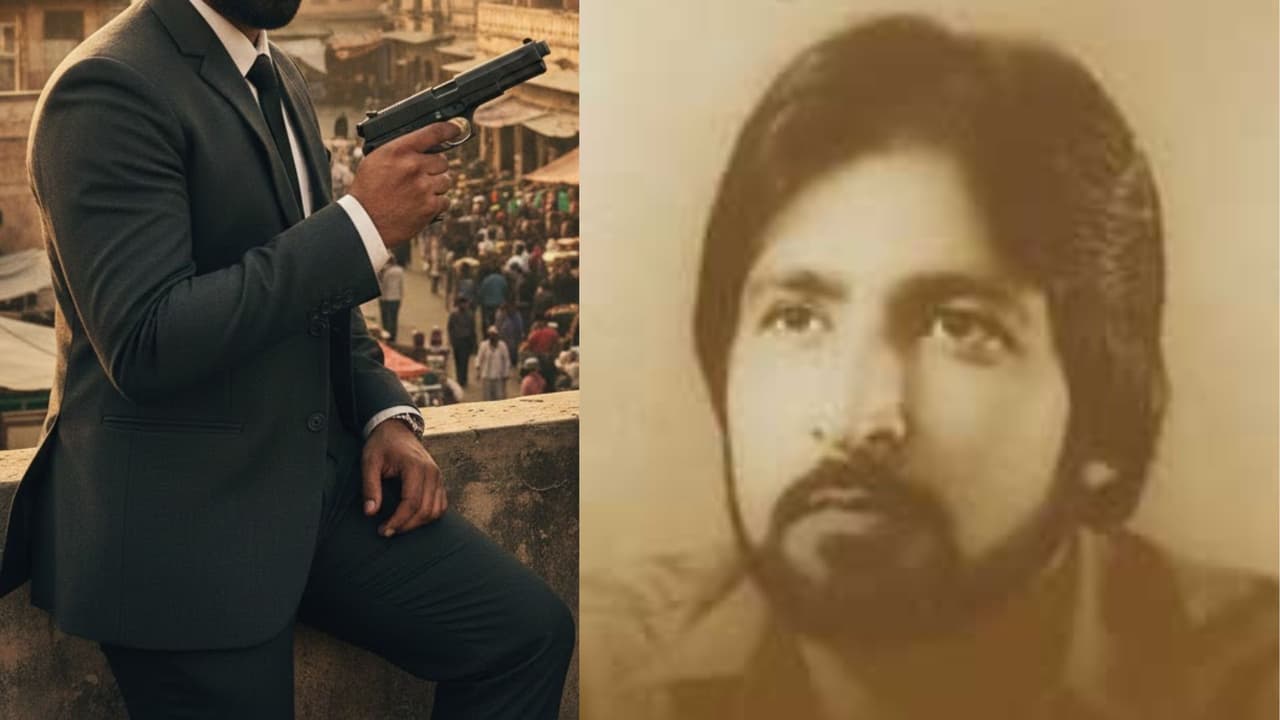
Ravindra Kaushik, an Indian theatre artist, was recruited by RAW in 1973 for a deep-cover mission in Pakistan. Assuming the identity of Nabi Ahmed Shakir, he joined the Pakistan Army and rose to the rank of Major. From 1979 to 1983, he sent vital intelligence to India, earning the codename “Black Tiger.”
Early Life & RAW Recruitment
Born in Sri Ganganagar, Rajasthan, Kaushik began his journey as a theatre artist, where his exceptional acting skills first came to light.
In 1973, at a national-level theatre competition in Lucknow, Kaushik delivered a powerful solo performance portraying an Indian soldier under interrogation. His confidence and command over language impressed talent scouts from RAW, who were present at the event. His ability to convincingly adopt different personas caught the attention of India’s external intelligence agency, the Research and Analysis Wing (RAW), which recruited him for covert operations.
As noted by retired Major General and former RAW officer V.K. Singh in his book India’s External Intelligence: Secrets of Research and Analysis Wing (RAW), Kaushik then underwent nearly two years of intensive training in Delhi. He was trained in Islamic studies, the finer nuances of Pakistani Urdu, and the geography of the region, enabling him to fully assume his new identity as Nabi Ahmed Shakir.
Also Read: Amul celebrates ‘Dhurandhar: The Revenge’ success with a witty doodle
The Original ‘Dhurandhar’ Spy Story
Ravindra Kaushik remains one of India’s most extraordinary intelligence operatives, often described as the real-life embodiment of a “Dhurandhar” spy.
In the mid-1970s, Kaushik underwent intense training before being sent on a high-risk mission to Pakistan. Assuming the identity of “Nabi Ahmed Shakir,” he completely transformed his life—adopting a new religion, background, and lifestyle to blend seamlessly into society. His dedication to the mission was absolute, going as far as altering his physical identity to maintain his cover.
In 1975, at just 23, Ravindra Kaushik crossed into Pakistan on a high-risk deep-cover mission—one of the most dangerous forms of espionage. To build a credible identity, he enrolled at Karachi University, completed a law degree, and gradually integrated into society. His most remarkable achievement followed: gaining entry into the Pakistan Army and steadily rising through its ranks.
Former Intelligence Bureau Joint Director Maloy Krishna Dhar, in his memoir Open Secrets: India’s Intelligence Unveiled, notes that Kaushik eventually became a commissioned officer, serving as a Major in the Military Accounts Department.
Between 1979 and 1983, Kaushik transmitted critical intelligence back to India, including details on Pakistani troop deployments in the Punjab region and sensitive information linked to the Kahuta nuclear facility. These inputs reportedly gave India a significant strategic advantage.
All the while, he led a dual existence—building a life in Pakistan by marrying a local woman, Amanat, and raising a child, even as he remained committed to his mission. During this phase, then Prime Minister Indira Gandhi is said to have honoured him with the codename “Black Tiger,” acknowledging the scale and impact of his work.
Also Read: Jaya Prada, VHP laud ‘Dhurandhar: The Revenge’, call it a must-watch
Betrayal and a Tragic End
His remarkable mission came to a sudden and tragic halt in 1983. A communication breakdown led to the capture of another operative, who, under interrogation, revealed Kaushik’s identity. Once exposed, he was arrested by Pakistani authorities and subjected to severe torture during interrogation.
He was eventually sentenced to death, though the punishment was later commuted to life imprisonment. Kaushik spent nearly two decades in prison under harsh conditions, enduring both physical and emotional suffering. During his incarceration, he managed to send letters to his family, expressing deep pain and a sense of abandonment. In one such letter, he poignantly wrote, “If I had been an American, I would have been out of this prison in three days.”
On November 21, 2001, Ravindra Kaushik died in Mianwali Central Jail, reportedly due to pulmonary tuberculosis and heart-related complications—conditions worsened by nearly two decades of neglect and harsh treatment. He was laid to rest in an unmarked grave within the prison premises.
His story highlights the often-unseen sacrifices made by intelligence operatives, whose contributions remain hidden from public view.
Even today, Kaushik’s life stands as a powerful reminder of courage, dedication, and the heavy price of serving a nation in secrecy—where victories are silent and sacrifices often go unacknowledged.
Also Read: Gaurav Gera shares letter from early Mumbai days amid ‘Dhurandhar’ success