Maruti Suzuki recently entered India’s electric passenger vehicle market with eVitara. While e Vitara represents the company’s first step into the EV space, Maruti is reportedly already working on a significantly more affordable electric car aimed at mass-market buyers. According to a new report by Fortune India, the upcoming EV could target the crucial Rs 10 lakh price point and may eventually be retailed through Maruti’s Arena dealership network.
Maruti Affordable EV Under Development
The upcoming model is reportedly being developed as a dedicated electric vehicle rather than an EV derivative of an existing ICE car. This should allow Maruti Suzuki to optimise battery placement, cabin space and other mechanical components specifically around an electric powertrain.
High levels of localisation and a relatively compact battery pack are expected to play an important role in keeping costs under control. The targeted price is reportedly around Rs 8.5 lakh to Rs 10.5 lakh, ex-showroom.
Rather than chasing the long ranges offered by more expensive electric SUVs, Maruti’s affordable EV is expected to focus on everyday urban and suburban requirements. A claimed range of around 250-315 km is being considered, putting it broadly in the same territory as Tata Tiago EV.
Arena Sales Network Likely
Another important difference could be the retail strategy. While eVitara is sold through Maruti’s premium Nexa network, the upcoming affordable EV could be offered through Arena dealerships.
This would give Maruti access to its core mass-market customer base and one of . Buyers currently considering cars such as WagonR, Swift and other affordable hatchbacks could potentially be among the target audience.
Like eVitara, the new electric car is also expected to be manufactured exclusively in India, with the country serving as an export hub for international markets. A Toyota-badged derivative is also being speculated, although this has not been confirmed.
Could Suzuki e Sky Provide Some Clues?
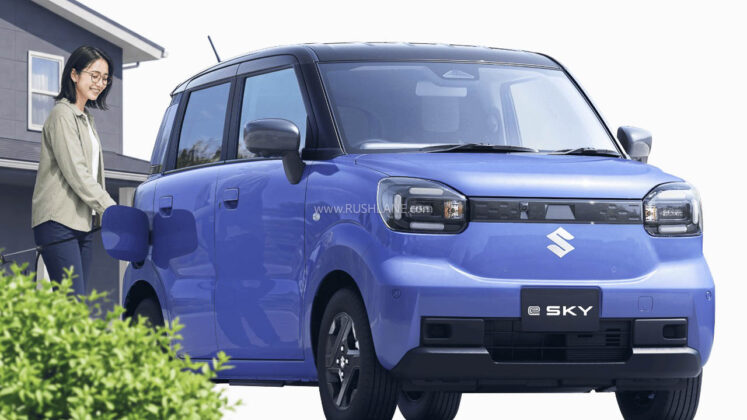
While there is currently no confirmation of any connection between the two products, provides some indication of how the company is approaching compact and affordable electric cars.

Suzuki eSky measures 3,395 mm in length and has a 2,460 mm wheelbase, along with a kerb weight of around 1,030 kg. Its tallboy proportions and short bonnet are designed to maximise interior space within a relatively small footprint. The eSky uses a 26 kWh battery pack and offers a claimed range of up to 310 km.
Maruti’s upcoming affordable EV could follow a similar philosophy of prioritising efficiency, compact dimensions and everyday usability, although its specifications could be completely different. Final battery capacity, chemistry, motor output and charging capabilities of the India-focused model are yet to be revealed.
Affordable EV Could Boost Maruti’s Electric Car Volumes
While Maruti Suzuki , its presence in the electric car segment is still relatively small. This is understandable considering the company has only recently entered the BEV market with e Vitara.
Maruti recorded around 1,600 electric passenger vehicle retail sales, giving it a market share of approximately 4.86%. For comparison, Tata Motors led the segment with 13,678 units and a 41.54% share, followed by Mahindra with 7,742 units and JSW MG Motor with 5,689 units.

Overall electric car retail sales stood at 32,928 units in July 2026, up 83.13% from 17,981 units recorded in July 2025. This indicates that India’s electric passenger vehicle market is expanding rapidly, creating room for more mass-market products.
Recent registration trends in Pune offer another example of this growth. Pune RTO reportedly registered 5,887 electric four-wheelers between January and July 2026, compared to just 1,782 units during the corresponding period last year. That’s an increase of around 230% YoY.
Against this backdrop, an affordable Maruti EV positioned around Rs 10 lakh could play a much larger volume role than eVitara. Maruti’s extensive Arena dealership and service network could also help expose electric cars to buyers beyond the relatively premium audience currently targeted by many EVs.
If Maruti can combine competitive pricing, adequate real-world range and its existing mass-market reach, this upcoming EV could become an important product not only for the company’s electric ambitions but also for the broader adoption of electric cars in India.