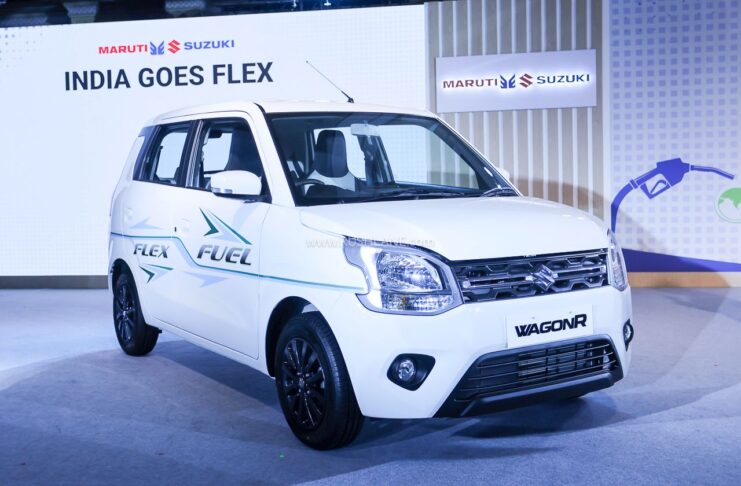
India’s flex-fuel vehicle programme has encountered its first reality check. Just weeks after the launch of the country’s first mass-market flex-fuel passenger car, the Maruti WagonR BioFlex has recorded only three registrations, raising questions about whether the supporting ecosystem is ready for large-scale adoption. While the numbers may appear disappointing at first glance, industry experts believe they say more about India’s current E85 infrastructure than about consumer interest in flex-fuel technology itself.
Infrastructure Still Playing Catch-Up
with customer deliveries beginning on June 17, Maruti WagonR BioFlex is capable of running on petrol-ethanol blends ranging from E20 to E100. Under current regulations, however, it is homologated for E85 fuel. Priced at Rs 7.24 lakh (ex-showroom), WagonR BioFlex commands a premium of around Rs 74,000 over the equivalent top-spec petrol variant. According to Vahan registration data, only three units had been registered by June 29.

One of the biggest reasons is fuel availability. At present, India has only 48 retail outlets dispensing E85 fuel, most of which are concentrated around Delhi-NCR and Mumbai. For buyers outside these regions, owning an E85-compatible vehicle offers little practical benefit. Unlike E20 petrol, which is now available across most fuel stations in India, E85 infrastructure is still in its infancy.
Fuel Savings Alone May Not Convince Buyers
On paper, E85 appears attractive. It is priced at around Rs 91 per litre (in Mumbai), making it roughly Rs 20 cheaper than E20 petrol. However, ethanol contains lower energy content than petrol. Vehicles running on higher ethanol blends generally return lower fuel efficiency, reducing much of the apparent savings at the fuel pump.
Maruti Suzuki has not disclosed WagonR BioFlex’s mileage figures while running on E85. For most buyers, the absence of widespread fuel availability combined with uncertainty around real-world running costs makes the purchase decision more difficult.
Not Just A WagonR Story
The slow start is not unique to Maruti Suzuki. Earlier flex-fuel motorcycles have followed a similar trajectory. Honda Motorcycle & Scooter India launched the CB300F Flex-Fuel in October 2024. While it has managed some sales, registrations have remained limited, with fewer than 30 units registered during the first half of 2026. Suzuki Motorcycle India’s Gixxer SF 250 FFV, launched in early 2025, is yet to record its first registration, according to Vahan data.
Even earlier, TVS Motor experimented with the Apache RTR 200 Fi E100 in 2019. Unlike today’s flex-fuel vehicles, it was designed to run exclusively on 100% ethanol. The motorcycle never reached commercial success, largely because dedicated E100 fuel infrastructure never materialised. The trend suggests that the challenge lies less with the vehicles themselves and more with the ecosystem supporting them.
Government’s Long-Term Vision
India’s flex-fuel strategy is part of a broader plan to reduce crude oil imports, improve farmer incomes by creating additional demand for ethanol and lower vehicle emissions. The country has already achieved nationwide availability of E20 petrol, and flex-fuel vehicles capable of using much higher ethanol blends represent the next stage of this roadmap.
Several manufacturers including Toyota, Hyundai, Tata Motors, Bajaj Auto, Yamaha and Royal Enfield have already showcased or tested flex-fuel vehicles. However, most have stopped short of launching them commercially, waiting for the supporting infrastructure to mature.
Responding to queries from Moneycontrol, Maruti Suzuki said the focus should not be on early registration numbers alone. The company stated that the real question is how quickly all stakeholders can come together behind a national priority aimed at improving India’s energy security, supporting farmers and reducing carbon emissions. According to the company, transformational technologies require long-term commitment rather than being judged by initial sales performance.
Chicken-And-Egg Problem
India’s flex-fuel programme currently faces the same challenge that electric vehicles and CNG vehicles encountered during their early years. Fuel retailers are hesitant to rapidly expand E85 dispensing stations without a sizeable vehicle population, while customers remain reluctant to buy flex-fuel vehicles until fuel becomes easily available. Until this gap is bridged, flex-fuel vehicles are likely to remain a niche offering despite strong policy support.
The first few weeks of WagonR BioFlex sales therefore may not reflect the future potential of flex-fuel technology. Instead, they underline that building an alternative fuel ecosystem requires vehicles, fuel infrastructure and consumer confidence to evolve together, rather than one racing ahead of the others.