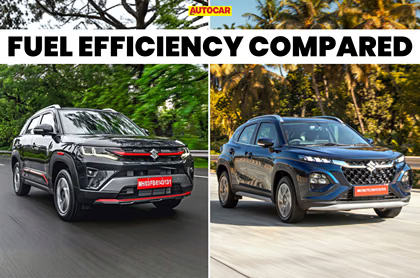
The and share the same 1.0-litre three-cylinder direct-injection turbo-petrol engine. However, the Brezza’s version has been tuned to produce more power and torque, plus it comes with a 6-speed manual gearbox instead of the 5-speed unit fitted to the Fronx turbo. also offers the latter with a 6-speed automatic transmission – an option that’s not available on the Brezza turbo. The Brezza is the larger and heavier SUV of the two. So let’s find out how these differences affect the fuel efficiency of these cars in the real world.
Explore full specs, features and a price breakdown in our comparison.
Maruti Fronx vs Brezza turbo-petrol MT: Specifications and price
The Brezza’s turbo-petrol mill offers 10hp and 22Nm more than the Fronx
| Maruti Fronx vs Brezza turbo-petrol MT: Specifications and price | ||
| Maruti Fronx turbo | Maruti Brezza turbo | |
| Engine | 3 cyls, turbo-petrol | 3 cyls, turbo-petrol |
| Displacement (cc) | 998 | 998 |
| Power (hp) | 100 (5,500rpm) | 110 (5,500rpm) |
| Torque (Nm) | 148 (2,000-4,500rpm) | 170 (2,000-3,500rpm) |
| Gearbox | 5-speed manual | 6-speed manual |
| Fuel tank (litres) | 37 | 48 |
| Price range (in Rs lakh) | 8.97-10.61 | 7.55-11.26 |
Both compact SUVs are powered by Maruti’s 1.0-litre ‘Boosterjet’ turbo-petrol engine. In the Brezza, this mill produces 110hp and 170Nm, which is 10hp and 22Nm more than what the Fronx’s unit manages. The Brezza turbo also gets an extra gear, with a 6-speed manual gearbox in place of the Fronx’s 5-speed setup. Moreover, its fuel tank holds 11 litres more petrol than the Fronx’s.
On the other hand, the Brezza turbo weighs 1,195kg, making it up to 180kg heavier than the manual version of the Fronx turbo. When it comes to price, the entry-level Brezza turbo manual costs Rs 1.42 lakh less than its Fronx turbo-manual equivalent. At the top end, however, the Brezza turbo manual is Rs 65,000 more expensive.
Maruti Fronx vs Brezza turbo-petrol MT: Real-world fuel efficiency
The Fronx is more efficient in the city, while the Brezza takes the lead on the highway
| Maruti Fronx vs Brezza turbo-petrol MT: Real-world fuel efficiency | ||
| Maruti Fronx turbo | Maruti Brezza turbo | |
| Tested city mileage (kpl) | 10.90 | 10.05 |
| Tested highway mileage (kpl) | 16.70 | 17.71 |
| Tested average mileage (kpl) | 13.80 | 13.88 |
The claimed mileage of the Fronx turbo manual is 21.5kpl, while the Brezza turbo manual in its ZXi and ZXi+ trims is rated at 19.96kpl. During our tests, the Fronx returned a combined real-world mileage of 13.80kpl, which is 7.7kpl lower than claimed. Meanwhile, the Brezza’s real-world mileage of 13.88kpl was 6.08kpl lower than the figure quoted by Maruti.

In the city, the Fronx turbo returned 0.85kpl more than the Brezza turbo. One reason for this could be the former’s lower kerb weight. Another is the higher ambient temperature during our testing, which went above 40deg C during the Brezza’s city run. This meant that its AC had to work harder to keep the cabin cool, impacting fuel efficiency.
On the highway, however, the Brezza was in the lead by 1.01kpl. Its sixth gear lets the engine spin at around 2,500rpm while cruising at 100kph, compared to about 2,700rpm in the Fronx’s top gear. Over a combined cycle, the Brezza turbo came out ahead by just 0.08kpl. Thanks to its larger fuel tank, though, its maximum real-world range of 666.24km is 155.64km more than the Fronx turbo’s 510.6km. Both Maruti SUVs get auto engine start-stop, brake energy regeneration and torque assist – all of which can help improve fuel efficiency.
Autocar India’s fuel-efficiency testing
Before our real-world fuel efficiency tests, we fill our test cars’ tanks to the brim and maintain tyre pressures based on the manufacturer’s recommendations. These cars are driven in fixed city and highway loops in and around Navi Mumbai, and we maintain certain average speeds. Throughout the tests, there is only one person in each car, running the air conditioner and other electricals, such as the audio system, indicators and wipers, when required, just like a regular user would. Periodic driver swaps further neutralise variations in driver patterns. At the end of each cycle, we calculate efficiency by filling the tanks to full again.