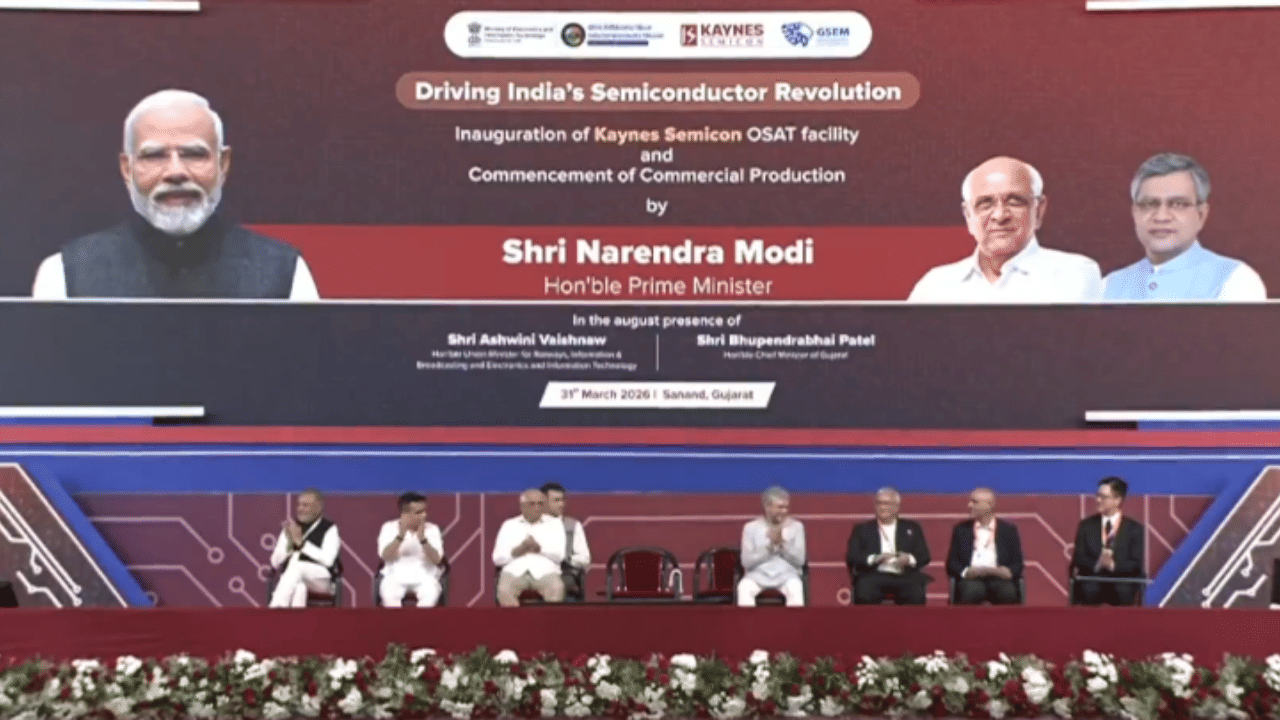
New Delhi: Prime Minister Narendra Modi on Tuesday inaugurated the Kaynes Semiconductor plant in Sanand, Gujarat, marking the start of production at the facility. Addressing a public gathering, he said the launch reflects the rapid growth of India’s semiconductor ecosystem and signals a strong push toward self-reliance. He added that the project is not just a collaboration, but proof of India’s fast-moving progress in a critical technology sector.
The new plant, developed by Kaynes Technology, is expected to strengthen India’s position in the global semiconductor supply chain. Modi highlighted that the facility will manufacture Intelligent Power Modules, which are key components for electric vehicles and industrial systems. A significant portion of the plant’s output is already booked for export, creating a direct link between India and global markets, including Silicon Valley.
The inauguration of the Kaynes Semicon facility strengthens India’s push towards self-reliance. It marks an landmark step in building a robust semiconductor ecosystem. https://t.co/hJOo5srmOS
— Narendra Modi (@narendramodi) March 31, 2026
A step toward global semiconductor leadership
The Prime Minister said the project reflects the vision of “Make in India, Make for the World.” He noted that India is steadily becoming a reliable supplier of semiconductors globally. According to him, the Sanand facility will help power industries worldwide and deepen India’s integration into international supply chains.
He also stressed that disruptions in global chip supply during recent crises highlighted the need for resilient and diversified production hubs. India, as a democratic and fast-growing economy, is well positioned to fill that gap.
India semiconductor mission gains momentum
Modi recalled that India launched the India Semiconductor Mission in 2021 during the pandemic. He described it as more than an industrial policy, calling it a statement of India’s confidence. The mission aims to build capabilities across the semiconductor value chain, from design to manufacturing.
He said projects worth over ₹1.6 lakh crore are currently underway across multiple states. The Kaynes facility and the Micron plant in Gujarat are key parts of this effort. India is also developing indigenous technologies like the Dhruv 64 microprocessor to support sectors such as 5G and automation.
Focus on ecosystem, skills and future tech
The Prime Minister announced that the next phase, Semiconductor Mission 2.0, will focus on building a complete domestic ecosystem. This includes manufacturing equipment, materials, and strengthening global partnerships.
He added that India is investing heavily in talent development. Over 85,000 semiconductor design professionals are expected to be trained soon. Initiatives like the Chips to Startup programme are already helping universities and startups design new chips.
India’s ‘Techade’ vision
Calling this decade India’s “Techade,” Modi said the country aims to lead in emerging technologies. He linked the growth of the semiconductor sector with advancements in AI, clean energy, and digital infrastructure.
He concluded by saying that India is no longer just adapting to change but is determined to lead it. The Kaynes plant, he said, is another step toward making India a global technology and manufacturing powerhouse.