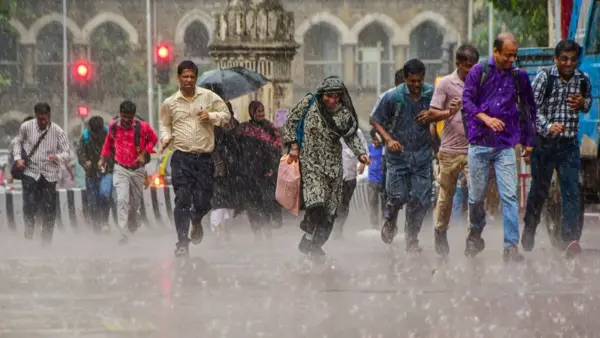
Maharashtra Rains: Maharashtra has been battling relentless rainfall since last week, with landslides, flooded highways and disruptions bringing normal life to a halt in several parts of the state.
The newly opened Mumbai-Pune Link was also forced to shut due to the extreme weather conditions.
Amid this challenging situation, authorities were closely monitoring another weather threat, a possible cloudburst in Nashik. However, timely intervention and advance forecasting helped the state prepare for the situation before it could turn into a major disaster.
The warning came through the Bharat Forecast System (BharatFS), India’s next-generation high-resolution weather forecasting platform. The system provided Maharashtra’s disaster management authorities with highly localised forecasts, indicating the possibility of cloudburst-like rainfall in parts of Nashik district.
How did the warning help authorities?
While Mumbai, Pune and Raigad were already facing the impact of severe weather, BharatFS detected the possibility of extremely heavy rainfall in Nashik nearly a day before the expected peak. The early alert allowed officials to move quickly and put precautionary measures in place.
According to officials, the advance forecast helped the administration:
- Activate the state disaster management machinery.
- Alert the Nashik district administration.
- Position NDRF, SDRF and local rescue teams
- Keep a close watch on vulnerable rivers and dams.
- Prepare evacuation plans.
- Issue public advisories
- Restrict movement in risk-prone areas
Officials said the additional time proved extremely valuable as Maharashtra was already dealing with multiple weather emergencies at the same time.
Maharashtra Disaster Management Minister Girish Mahajan personally monitored the situation in Nashik as authorities stepped up preparations.
As part of the preparedness efforts:
- Schools and colleges were ordered to remain closed.
- Major temples suspended darshan.
- Weekly markets were cancelled.
- Tourist destinations and forts were barricaded.
- Rescue teams and emergency equipment were positioned in advance.
The nearly 24-hour advance warning gave officials enough time to activate emergency protocols before the possibility of intense rainfall, helping reduce risks and improve preparedness.
The Nashik situation has become an important example of how AI-based weather intelligence, advanced numerical weather prediction and high-performance supercomputing can help governments move from responding after a disaster to preparing before it happens.
What is BharatFS?
The Bharat Forecast System (BharatFS) is India’s most advanced indigenous weather prediction system, developed by the Indian Institute of Tropical Meteorology (IITM), Pune, under the Ministry of Earth Sciences.
Unlike earlier forecasting models that generated predictions on grids of around 12 kilometres, BharatFS provides forecasts at an approximately 6-kilometre resolution. This higher level of detail allows meteorologists to identify highly localised extreme weather events, including cloudbursts, flash floods, landslides, extremely heavy rainfall and high-wind events.
The AI weather system is powered by India’s high-performance supercomputers Arka, located at IITM Pune, and Arunika, located at NCMRWF, Noida. Officials said these advanced systems allow forecasts to be generated faster and updated more frequently, improving the ability to track rapidly changing weather conditions.