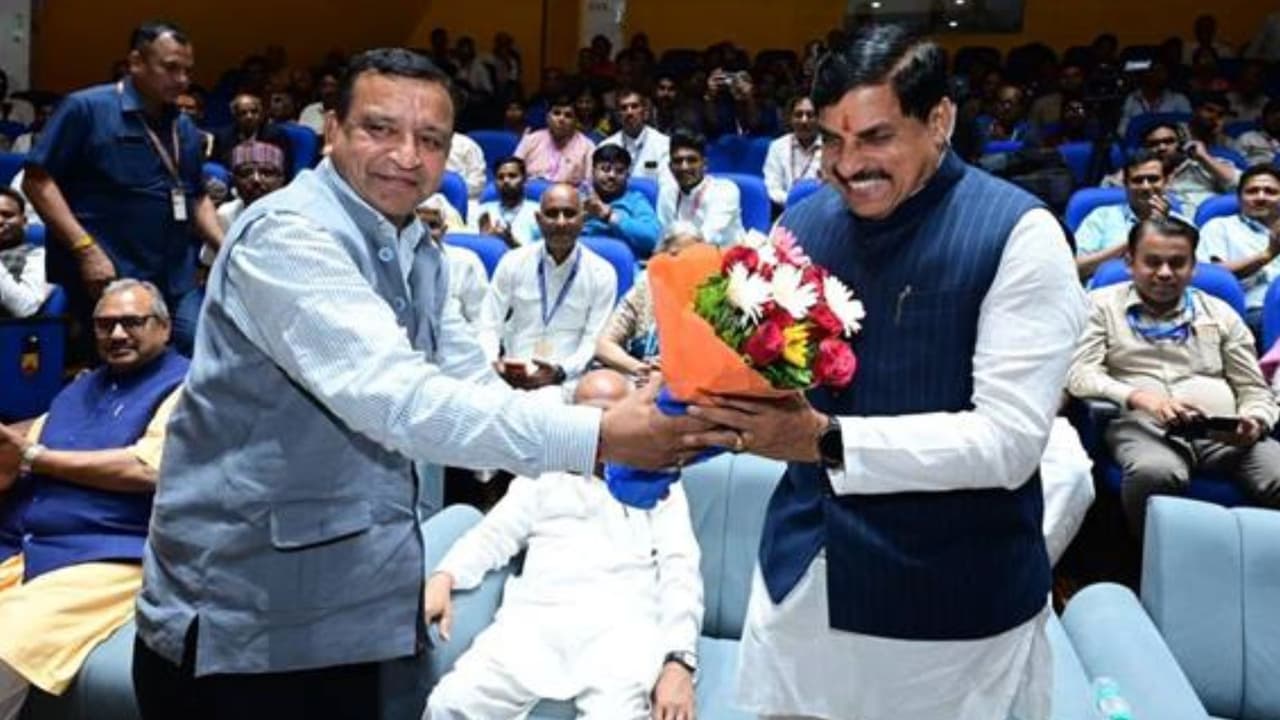
Chief Minister Dr. Yadav attended the conference “Mahakal: The Master of Time”. He described space achievements as a symbol of the country’s scientific capability. Scientists informed about the success of Chandrayaan-3 and future missions like sending humans to the Moon by 2040.
Bhopal: Chief Minister Dr. Mohan Yadav participated in the session on “Present and Future of Astronomy and Space Research in India” organized at Varahamihir Astronomical Observatory, Dongla in Ujjain district on the second day of the International Conference “Mahakal: The Master of Time”. In the session, Chief Minister Dr. Yadav became aware of important information about the country’s space achievements and future plans.
Chief Minister Dr. Yadav presented by scientists
- Describing the information as extremely interesting, he expressed happiness over India’s space achievements. Praising the country’s scientists for successes like Chandrayaan-3, he said that such achievements inspire the youth to move forward in the field of science, research and innovation.
- In the session Prof. Anil Bhardwaj, Director, Physical Research Laboratory (PRL), Department of Space, Ahmedabad, while giving information about the achievements of Chandrayaan-3 mission, said that the successful soft landing of “Vikram Lander” was a historic achievement for India. With this, India became the fourth country to make a soft landing on the Moon and the first country in the world to reach the southern polar region of the Moon. Artificial Intelligence and Machine Learning played an important role in the success of this mission. He informed that “Pragyan Rover” conducted important scientific studies on the lunar surface and this landing site was named “Shiv Shakti Point”. He also informed about Chandrayaan-4 (Lunar Sample Return Mission), Chandrayaan-5 (LUPEX – India-Japan Joint Mission), Venus Orbiter Mission and Mars Lander Mission and India’s ambitious plans to land Indian astronauts on the Moon by the year 2040.
- In the session, Dr. Tarun Pant, Director, Space Physics Laboratory, Vikram Sarabhai Space Centre, Thiruvananthapuram, highlighted the role of ionosphere and upper atmosphere and said that space activities affect the Earth’s atmosphere and climate and their study is very important for space science.
Brainstorming on astronomy and space research
In the sessions “Advances in Astronomy and Astrophysics” and “Space Economy for Developed India: Space Technology in the Service of the Nation” organized on the second day of the International Conference “Mahakal: The Master of Time”, experts expressed their views on astronomy, space research, national security, space economy and scientific dimensions of Indian knowledge tradition, coordination of science-spirituality.
Space technology is the strong base of national security
NITI Aayog Member (Science) Dr. V.K. Expressing his views on “Space-based Strategies for India’s Defence”, Saraswat said that today space technology has become an important basis for development as well as national security. Referring to the initial source of inspiration in his life, he said that the news of a satellite launch in his childhood inspired him to work in the field of space science. Scientist Dr. Saraswat said that in modern times, defense technology is changing rapidly and beyond traditional weapons, drones and Artificial Intelligence based systems are being developed. He described the increasing role of the private sector and start-ups in the defense sector as an important step towards self-reliant India.
Increasing role of space economy for developed India
At the international conference, experts discussed the space economy, private sector participation and growing opportunities for youth in the space sector. Speakers at the conference said that space technology is becoming an important medium not only for scientific progress but also for economic development and employment generation.
The need of the hour is coordination between science and spirituality.
Dr. Shankar Nakhe, former director of Raja Ramanna Center for Advanced Technology (RRCAT) said that science and spirituality complement each other and with their coordination, balanced development of human society is possible. He said that Ujjain city has been the center of time calculation and astronomical studies since ancient times due to the Mahakaleshwar temple and its location on the Tropic of Cancer, which makes the relevance of this conference more meaningful. Throwing light on topics like radioactive waste management and laser technology, Dr. Nakhe said that modern science is being used in many fields including medicine, energy and space research. He underlined the accuracy and possibilities of modern science by mentioning scientific projects like LIGO. He said that building a conscious, balanced and progressive society is possible only with a coordinated approach of science and spirituality.