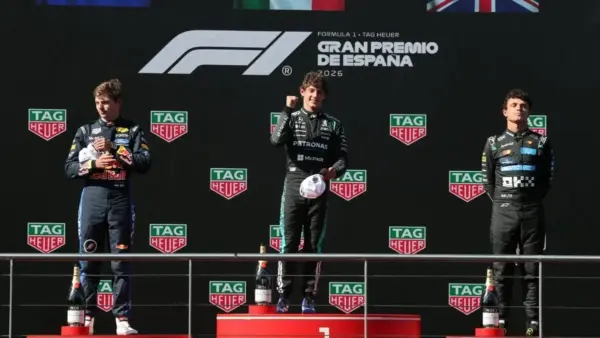
Formula 1’s first race at a brand-new circuit is supposed to be a spectacle, even if the racing itself is rough around the edges.
What happened at the Madring on Sunday wasn’t that. It was a genuinely dull afternoon on a genuinely difficult track – and even the drivers standing on the podium didn’t seem to want to be there.
Kimi Antonelli won his eighth race of the season, but he didn’t pretend it was deserved. “It’s good to win, and I think the pace at the end of the race was good, but if I have to be realistic and honest, you know, today we didn’t deserve to win,” he said. “Lando deserved to win today, and so I think our result was probably P2 or even P3.”
That’s an extraordinary thing for a race winner to say, and it wasn’t false modesty. Norris had taken pole with what was described as a lap for the ages, held off Antonelli twice on the opening lap, and built a six-second lead over the following twelve laps – cruising toward what looked like his third win in four races.
The VSC That Decided Everything
The moment that undid Norris arrived almost by accident. Just as he crossed the pit entrance at the end of Lap 14, race control called a virtual safety car to clear Lance Stroll’s stricken Aston Martin from the Turn 20 runoff. That forced Norris to slow through most of Lap 15 – handing Antonelli and Max Verstappen a nearly free pit stop behind him. By the time Norris reached the pit entry himself, the VSC had already lifted, meaning his own stop came at full racing cost. He emerged in fifth, 16 seconds off the lead, on a track where passing back through the field was close to impossible.
Norris didn’t hide his frustration afterward. “Not a lot we could do… just a load of s—,” he said on team radio, recovering to third by the finish. “We were too quick, that’s all it was. Very unlucky today, guys. We deserved the win quite easily.” He went further post-race, questioning the fairness of a rule that can cost one driver a race purely on timing: “I don’t think many people have lost a race so blatantly over it… today I was the only one that lost out, and I lost out about 20 seconds of race time, and that’s not how it should be.”
McLaren boss Andrea Stella backed that read completely, calling it close to “a mathematical definition of being unlucky,” and explaining why staying out longer wasn’t realistic: pitting outside the VSC window at Madring costs around 27 seconds, a number severe enough that gambling on track position wasn’t a real option once the caution was called.
Verstappen’s Own Grievance, From a Different Angle
Second-placed Verstappen had his own case for what-might-have-been, rooted in a first-lap decision that cost him track position. Defending third from Lewis Hamilton at Turn 1, Verstappen cut the chicane to avoid contact – and was ordered to hand the position back a lap later, by which point he’d also passed Antonelli, who’d lost momentum attempting his own move on Norris. Verstappen’s radio reaction was blunt: “Mate, what the f- are you guys talking about? [Hamilton] would’ve shunted it… If I just stay on the track, I am out of the race.” He later added: “F-ing Mickey Mouse racing, this is.”
Verstappen maintained after the race that staying on track would have meant contact with Hamilton and likely an early exit from the race entirely – making his final result, in his own words, one he was ultimately happy with, even if the process to get there was frustrating.
Why the Racing Itself Was the Real Problem
Strip away the VSC drama and the underlying issue is structural: there was barely any on-track passing all day. Barring the opening-lap shuffle, the only notable moves were Liam Lawson getting past Franco Colapinto and Russell passing Lawson – a total that may have finished below even Monaco’s 10 in-race overtakes, historically F1’s benchmark for a processional race.
The core design flaw was straightforward. The Turn 5/6 chicane, the circuit’s most obvious passing zone coming off the longest straight, had a tight, curved entry that made side-by-side racing nearly impossible. Ollie Bearman had flagged this before the race even started: “That kind of curved braking takes away any possibility of different lines and sending one up the inside. So that’s a shame and maybe a bit of an oversight.” Antonelli echoed the same concern after living it: “It definitely doesn’t create overtaking opportunities… especially in the second chicane, if I would have turned in, me and Lando would have touched and probably gone in the wall.”
Norris’s Blueprint for Fixing It
Norris didn’t hold back on what he thinks needs to change. “There are some obvious changes they should make,” he said. “They should get rid of Turns 18, 19. Useless. Just have more of a straight into a hairpin… straight line from 17 straight to 20 have a much wider entry like Austin Turn 1 or Turn 10 in Austin – a big hairpin. You’ll create much better opportunities for everyone.”
He was clear that the track’s identity in qualifying wasn’t the problem: “To me, it’s not a great racetrack. It’s great in qualifying but… the fact you have to turn and brake basically defeats the whole object of racing.” Leclerc offered a gentler but aligned take, suggesting the track wouldn’t need a major overhaul: “I think just a small change or two small changes could change significantly the racing that we have.”
The Fixes Already Being Planned
According to The Race, Madring organizers are targeting three specific areas ahead of 2027: widening and reshaping the Turn 5/6 chicane entry to allow genuine side-by-side racing; tightening Turn 13, the corner immediately after La Monumental, to give a tow-assisted car a real braking zone to attack into; and widening the pinch-point barriers around Turn 20 so a passing attempt doesn’t carry the risk of missing the exit entirely.
These revisions were reportedly already proposed to the FIA ahead of this year’s race, but were shelved for 2027 due to the complexity of homologation and an already tight construction timeline – track work only began in April 2025 and was further delayed by a wet Madrid winter. Rather than risk rushed changes threatening the track’s readiness for its debut, officials chose to run the imperfect layout first and fix it afterward.
Speaking to Motorsport.com after the race, Spanish Grand Prix managing director Luis Garcia Abad confirmed the event has already received specific recommendations from the FIA and is prepared to act on them. “Being honest with you, the FIA defined clearly which is the way to improve the track layout, and we will be open because we will have to reinstall the track for the next year,” he said. “I really believe that the drivers enjoyed qualifying a lot. But for sure we will try to make an improvement for next year.”
Abad also pointed to genuine flexibility in what’s possible, given that the circuit’s northern section was built from scratch on empty land: “We have the space, we have a venue, we have the facilities, we have the capacity to do it. I’m sure that FOM, FIA, and ourselves, we will try. If we can improve something, we will do it.”
What This Means Heading Into 2027
Sunday’s race was the first of a ten-year contract, which gives Madring organizers real runway to get this right rather than treating the debut as a final verdict. Every driver who spoke afterward agreed on the underlying diagnosis: this is a genuinely good, demanding track to qualify on, undermined by a handful of corners that make wheel-to-wheel racing nearly impossible.
As Stella put it, if overtaking had simply been possible, Norris’s pace advantage likely puts him back in the lead regardless of the VSC drama. With organizers, the FIA, and the drivers themselves all pointing at the same handful of corners, Madring’s second F1 weekend has a clear blueprint to actually deliver the race its debut promised but didn’t produce.